Not all multipoint door locks work in the same way. Although they may look similar from the outside, the way they lock and unlock can be very different.
Knowing which type of multipoint lock you have is important when replacing handles, gearboxes or the complete locking mechanism. It also helps you understand how your door is designed to operate when the door is properly aligned.
Here are the most common types found on uPVC and composite doors.
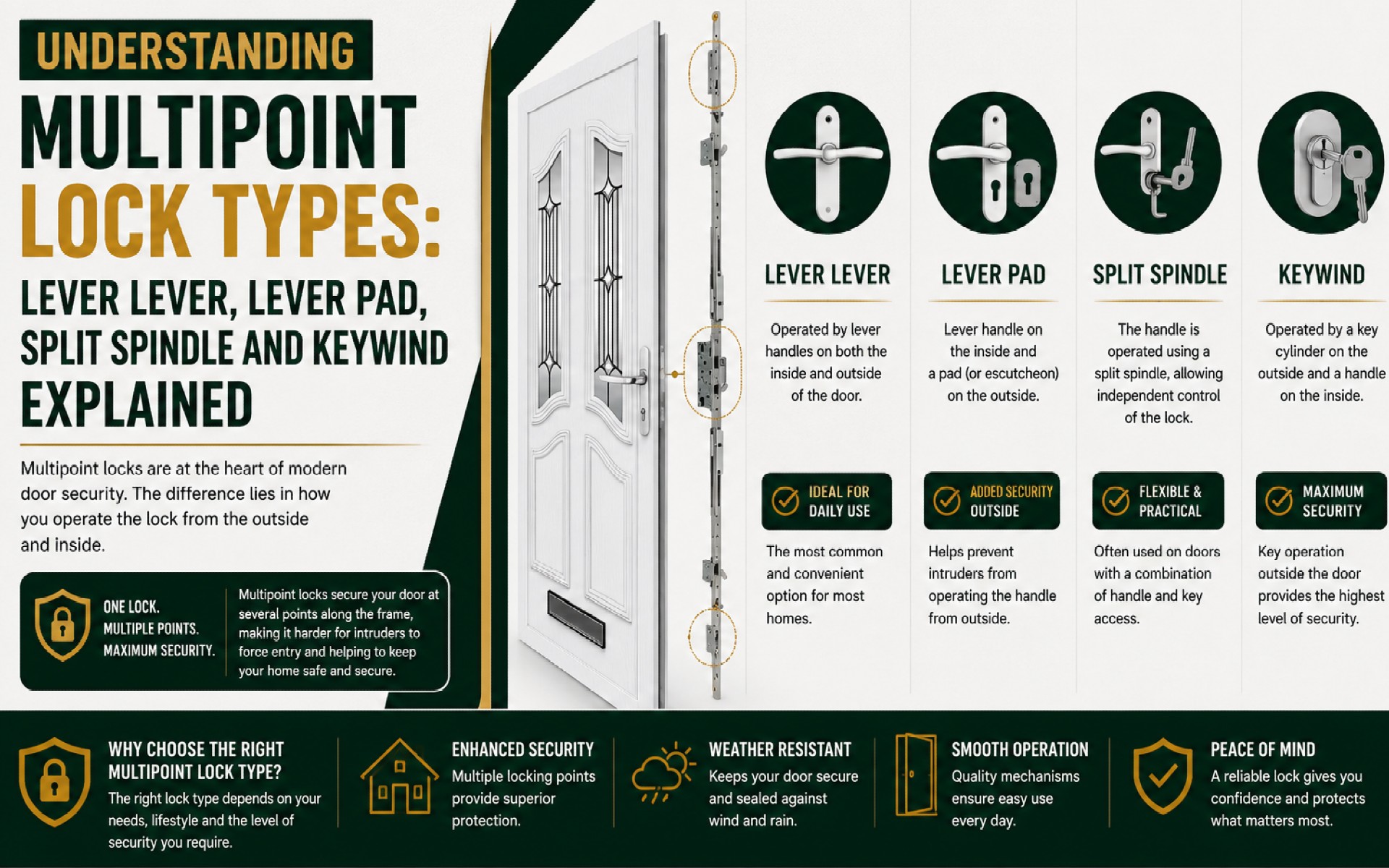
Lever/Lever Multipoint Locks
The lever/lever system is the most common type fitted to residential uPVC and composite doors.
How it works
- Both inside and outside handles operate the latch.
- Lift the handle to engage the hooks, rollers and deadbolts.
- Turn the key to lock the mechanism.
To unlock:
- Turn the key.
- Push the handle down.
Advantages
- Familiar and easy to use.
- Common replacement parts.
- Suitable for most homes.
Often found on
- Front doors
- Back doors
- French doors
Lever/Pad Multipoint Locks
With a lever/pad lock, the handles operate differently.
How it works
Inside:
- A normal lever handle operates the latch.
Outside:
- A fixed pad replaces the normal lever.
- The outside pad does not open the latch unless the key is used.
The key is required before the outside can operate the lock.
Advantages
- Improved security.
- Prevents someone simply pushing the outside handle down.
- Popular on front entrance doors.
Split Spindle Multipoint Locks
Split spindle systems are commonly used with lever/pad handles.
Instead of one spindle passing through the gearbox, there are two separate spindles.
This allows:
- Independent inside operation.
- Controlled outside operation.
- Better security.
The inside handle always operates the door for emergency exit.
The outside handle only works after the key has disengaged the locking system.
Keywind Multipoint Locks
Unlike lever-operated systems, a keywind mechanism doesn't require lifting the handle.
How it works
Simply turning the key:
- Throws the hooks.
- Extends the deadbolts.
- Locks the mechanism.
To unlock:
- Turn the key in the opposite direction.
Everything is controlled by the key.
Advantages
- Very simple operation.
- Fewer moving handle components.
- Popular on apartment entrance doors and some composite doors.
Automatic Multipoint Locks
Some modern composite doors use automatic locking systems.
Instead of lifting the handle:
- Close the door.
- The hooks or latches engage automatically.
- Turning the key fully deadlocks the mechanism.
Benefits include:
- Automatic security.
- No forgotten handles.
- Convenient everyday use.
Heritage Night Latch Multipoint Locks
Some modern composite doors combine a traditional appearance with modern security.
These systems feature:
- Night latch operation.
- Multipoint locking.
- Traditional furniture.
They are popular on cottage-style and heritage doors.
Which Type Is Best?
Each has advantages.
| Lock Type | Best Feature |
|---|---|
| Lever/Lever | Simple everyday operation |
| Lever/Pad | Greater external security |
| Split Spindle | Independent inside/outside operation |
| Keywind | Locks entirely by key without lifting the handle |
| Automatic | Locks when the door closes |
The best choice depends on the style of door and how you use it.
Why It Matters During Repairs
Knowing the lock type helps when replacing:
- Door handles
- Gearboxes
- Multipoint locking mechanisms
- Spindles
- Security furniture
For example, fitting standard lever/lever handles onto a split spindle mechanism may stop the lock operating correctly.
Likewise, not every gearbox is designed for keywind operation.
Correct identification and identifying the right faults effecting the door from working correctly, prevents incorrect parts being fitted.
Don't Guess the Lock Type
Many multipoint locking systems look almost identical from the outside but operate in completely different ways. Before replacing handles, a gearbox or the complete mechanism, it's important to identify whether the door uses a lever/lever, lever/pad, split spindle, keywind or automatic locking system. Choosing the correct replacement parts ensures the door operates safely, securely and exactly as the manufacturer intended.