uPVC and Composite Door Gearboxes Explained
If your uPVC or composite door has become difficult to lock, the handle feels stiff, or the key turns but nothing happens, there's a good chance the problem lies with the gearbox.
The gearbox is one of the hardest-working parts of a multipoint locking system, yet it's also one of the least understood. Every time you lift the handle or turn the key, the gearbox is responsible for operating the rest of the locking mechanism. Understanding what it does, why it fails and how it can usually be repaired may save you from replacing an otherwise perfectly good door.
If you're new to multipoint locking systems, it's worth reading
- What Is a Multipoint Door Lock Mechanism?
- Everything You Need to Know About Multipoint Locking Systems
- The Complete Guide to Multipoint Locking Systems
What Is a Door Gearbox?
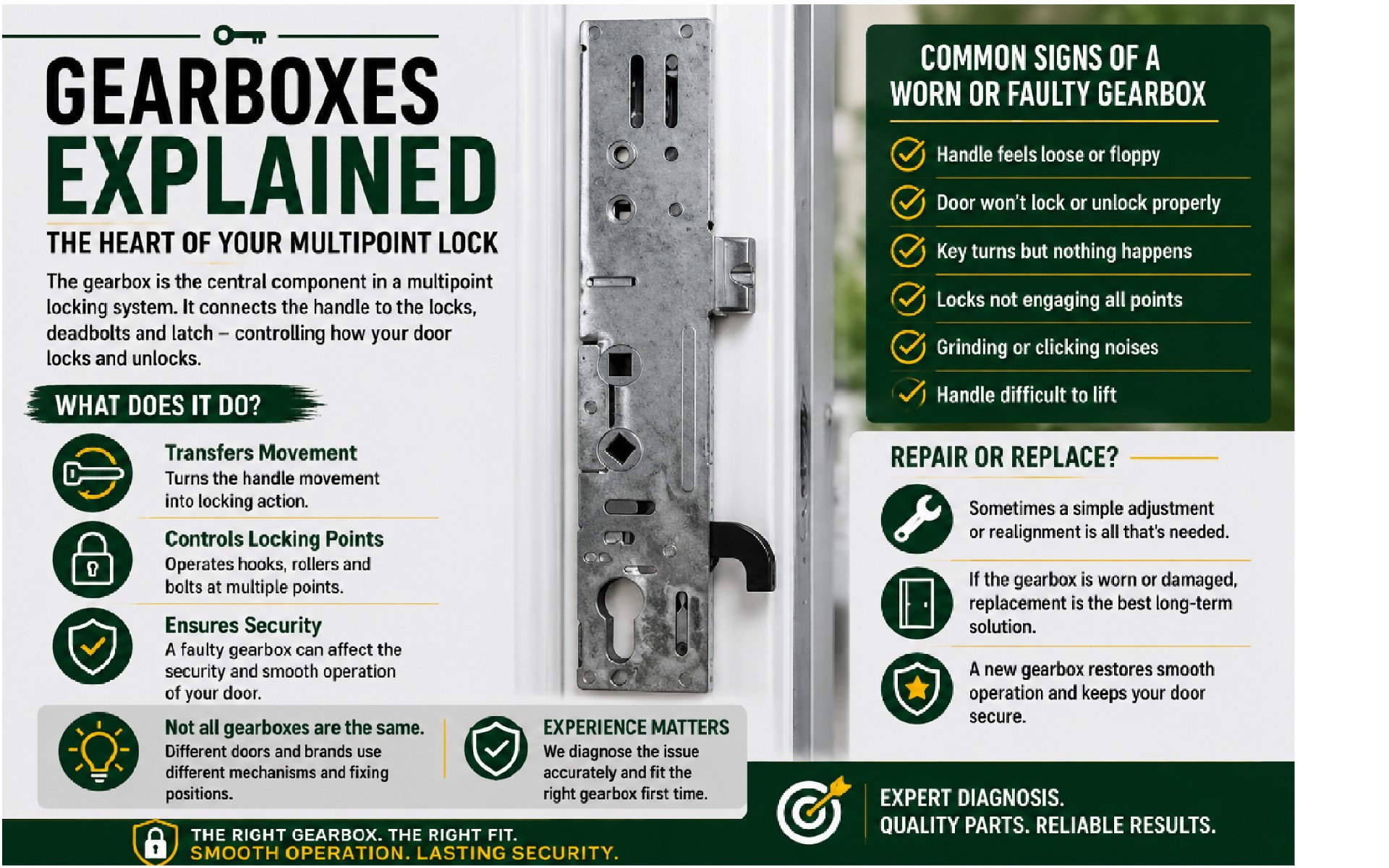
The gearbox is the central operating unit of a multipoint locking mechanism.
It sits in the middle of the locking strip, directly behind the handles and euro cylinder. Whenever you operate the handle or turn the key, you're operating the gearbox.
Without it, the hooks, rollers, deadbolts and latch cannot function.
Depending on the door, the gearbox may be designed for:
- Keywind operation
- Lever/Lever operation
- Lever/Pad operation
- Split Spindle operation
- Fast Lock systems
To understand the different operating styles, see Understanding Multipoint Lock Types: Lever Lever, Lever Pad, Split Spindle and Keywind Explained.
What Does the Gearbox Do?
The gearbox acts as the control centre of the entire multipoint locking system.
When you operate the lock, it transfers movement from the key and handles to every locking point along the mechanism.
This allows it to:
- Operate the hooks
- Engage the rollers
- Extend and retract the deadbolts
- Control the latch
- Lock and unlock the door
For a closer look at how these locking points work together, read The Science of Multipoint Door Locks and Hooks, Rollers and Deadbolts – What's the Difference?
Why Do Gearboxes Fail?
Like any mechanical component, gearboxes eventually wear out.
The most common causes include:
- Years of everyday use
- Poor door alignment
- Worn hinges
- Excessive pressure on the locking points
- Lack of maintenance
- General mechanical wear
Most gearboxes don't suddenly fail overnight. They usually deteriorate gradually after operating under unnecessary strain for months or even years.
Signs of a Failing Gearbox
A failing gearbox often gives plenty of warning before it stops working altogether.
Common symptoms include:
- A stiff handle
- The handle won't lift fully
- The handle drops without resistance
- The key becomes difficult to turn
- The key turns but nothing locks
- The handle moves but the door won't open
- Grinding, clicking or crunching noises from inside the lock
Ignoring these warning signs often leads to a complete lock failure, which can leave the door stuck locked or unlocked.
Does a Failed Gearbox Mean You Need a New Door?
No.
A failed gearbox is one of the most repairable faults found on uPVC and composite doors.
In many cases, replacing the gearbox restores the entire locking mechanism without replacing:
- The door
- The frame
- The glazing
- The full locking strip
This makes gearbox replacement one of the most cost-effective door repairs available.
For more repair advice, see uPVC Door Mechanism Repair, Can You Replace Just the Locking Mechanism? and Can a Locksmith Repair a Multipoint Lock?
Can Every Gearbox Be Replaced?
Not always.
Some older gearboxes have been discontinued and are no longer manufactured.
However, that doesn't necessarily mean the whole door needs replacing.
Depending on the mechanism, a locksmith may be able to:
- Fit a genuine replacement gearbox
- Install a compatible alternative
- Replace the complete multipoint locking mechanism
- Upgrade the mechanism to a newer version where suitable
The correct solution depends entirely on the mechanism fitted to the door.
Why Correct Identification Is Essential
Gearboxes are not universal.
They vary considerably between manufacturers and even between different models from the same manufacturer.
Differences include:
- Backset
- Handle centres (PZ)
- Follower size
- Screw fixing positions
- Overall dimensions
- Internal components
- Locking operation
Correct identification is essential to ensure the replacement gearbox operates smoothly and safely.
To understand why matching parts is so important, read Why No Two Door Mechanisms Are Exactly the Same, A–Z of Multipoint Lock Manufacturers and A–Z of Door Locking Mechanisms – The Complete Homeowner's Guide.
Door Alignment Is Just as Important
One of the biggest causes of premature gearbox failure isn't the gearbox itself—it's poor door alignment.
If the locking points are rubbing against the keeps, every lift of the handle places extra strain on the internal components.
Before replacing a gearbox, a professional locksmith should always check:
- Door alignment
- Hinge adjustment
- Locking point engagement
- Handle operation
- Key operation
Correcting alignment helps ensure the replacement gearbox isn't subjected to the same unnecessary stresses.
For a detailed explanation, see The Complete Guide to Door Alignment and Lock Performance.
Don't Ignore a Stiff Handle
Many homeowners continue forcing a stiff handle because the door still locks.
Unfortunately, every extra bit of force places additional stress on the gearbox.
Eventually this can result in:
- Complete gearbox failure
- Broken handles
- Damaged locking points
- A jammed door
- More expensive repairs
Early diagnosis is almost always simpler and more cost-effective than waiting for the mechanism to fail completely.
Gearboxes on French and Conservatory Doors
Gearboxes aren't found only on standard front and back doors.
Many French doors and conservatory doors also rely on multipoint locking systems that use similar centre gearboxes, although the surrounding mechanisms may be longer or have different locking point arrangements.
Related guides include:
- Repairing French Door Lock Mechanisms: Everything You Need to Know About French Door Lock Repairs
- Conservatory Door Lock Repairs Explained: Repairing Multipoint Locks Without Replacing the Door
Repair the Gearbox, Keep the Door
A failed gearbox doesn't automatically mean your uPVC or composite door has reached the end of its life. In many cases, replacing the gearbox restores the entire multipoint locking system, allowing the door to operate smoothly once again. The key is identifying the correct replacement, checking for any underlying alignment issues and ensuring the complete mechanism works without unnecessary strain.
For a broader understanding of door locks and multipoint systems, you may also find these guides useful:
- What Is a Multipoint Door Lock Mechanism?
- The Complete Guide to uPVC Door Locks
- uPVC and Composite Door Gearboxes Explained
- Hooks, Rollers and Deadbolts – What's the Difference?
- A–Z of Multipoint Lock Manufacturers
- Understanding Multipoint Lock Types: Lever Lever, Lever Pad, Split Spindle and Keywind Explained
- The Science of Multipoint Door Locks
- Everything You Need to Know About Multipoint Locking Systems
- A–Z of Door Locking Mechanisms
- The Complete Guide to Multipoint Locking Systems