
Why Conservatory Doors Develop Lock Problems
Conservatory doors experience greater temperature fluctuations than almost any other external door on a property. During summer they can be exposed to intense heat, while in winter they're subjected to much colder conditions.
These continual temperature changes cause the door and frame to expand and contract throughout the year. Over time, this movement can affect door alignment and place additional strain on the multipoint locking mechanism.
Fortunately, many conservatory door problems can be repaired without replacing the entire door.
How Conservatory Door Locks Work
Most modern conservatory doors use the same style of multipoint locking mechanism found on uPVC and composite doors.
The mechanism is fitted into the edge of the door and typically contains:
- Gearbox
- Hooks
- Rollers
- Deadbolts
- Latch
- Connecting rods
When the handle is lifted and the key is turned, these components work together to secure the door at multiple locking points.
Common Conservatory Door Lock Problems
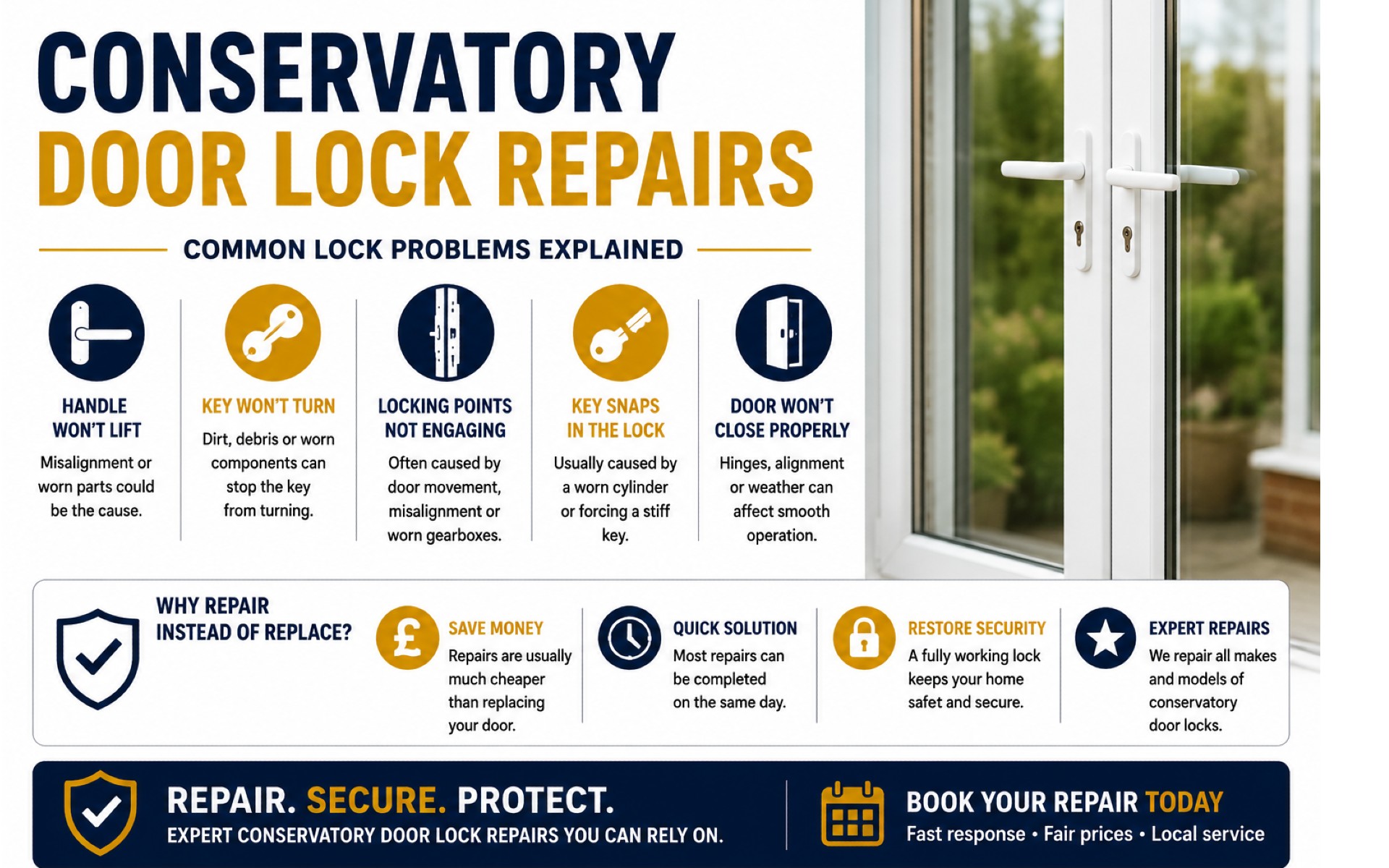
Homeowners frequently report problems such as:
- Handle won't lift
- Key won't turn
- Door difficult to close
- Lock works with the door open but not when closed
- Multipoint lock jammed
- Door catching on the frame
- Gearbox failure
- Locking points failing to engage
Many of these faults are caused by alignment issues rather than complete failure of the locking mechanism.
Why Conservatory Door Locks Wear Out
Several factors contribute to wear over time, including:
- Seasonal expansion and contraction
- Door movement
- Worn hinges
- Frequent use
- Dirt around the locking points
- Lack of lubrication
All of these increase the strain placed on the gearbox and the rest of the locking mechanism.
What Can Be Repaired?
Depending on the fault, repairs may include:
- Gearbox replacement
- Multipoint locking mechanism replacement
- Handle replacement
- Euro cylinder replacement
- Door realignment
- Hinge adjustment
- Keep adjustment
- Roller adjustment
Many of these repairs restore the original mechanism to full working order without replacing the entire door.
Related guides include:
- uPVC Door Mechanism Repair
- Can You Replace Just the Locking Mechanism?
- Can a Locksmith Repair a Multipoint Lock?
The Gearbox Is Often the Culprit
The gearbox is the heart of the multipoint locking mechanism.
Every operation of the handle and key passes through the gearbox before the hooks, rollers and deadbolts move.
When it begins to wear, you may notice:
- A stiff handle
- A key that's difficult to turn
- Locking points that fail to engage
- The handle dropping without resistance
In many cases, replacing the gearbox restores the mechanism without replacing the complete locking strip.
Understanding the Locking Points
Conservatory door mechanisms commonly use a combination of:
- Hooks
- Rollers
- Deadbolts
- Mushroom cams
Each performs a different function.
Hooks improve resistance against forced entry, rollers provide weather sealing and smooth operation, while deadbolts add strength and stability.
Learn more in:
Door Alignment Is One of the Biggest Causes of Failure
Conservatory doors are particularly prone to movement because of changing temperatures.
Even a slight drop in the door can cause the locking points to strike the keeps rather than entering them cleanly.
This creates additional strain on:
- The gearbox
- Handles
- Internal linkages
- Locking points
After any repair, the following should always be checked:
- Door alignment
- Hinge adjustment
- Handle operation
- Key operation
- Locking point engagement
Not Every Conservatory Door Uses the Same Mechanism
Although conservatory doors often look similar, the locking mechanisms inside them can vary considerably.
Differences include:
- Manufacturer
- Overall length
- Backset
- Handle centres (PZ)
- Gearbox design
- Locking point arrangement
This is why replacement parts must be identified carefully before ordering.
Further reading:
- Why No Two Door Mechanisms Are Exactly the Same
- A–Z of Multipoint Lock Manufacturers
- Understanding Multipoint Lock Types: Lever Lever, Lever Pad, Split Spindle and Keywind Explained
- A–Z of Door Locking Mechanisms – The Complete Homeowner's Guide
Signs You Should Arrange a Repair
Arrange an inspection if you notice:
- The handle feels heavier than before
- The key becomes difficult to turn
- The door rubs against the frame
- It only locks with extra force
- The lock behaves differently in hot or cold weather
- The door moves slightly when locked
Dealing with these symptoms early often prevents more extensive and expensive repairs later.
French Doors Often Develop Similar Problems
Many of the issues affecting conservatory doors also occur on French doors because they use very similar multipoint locking systems.
If you have French doors experiencing similar faults, read Repairing French Door Lock Mechanisms: Everything You Need to Know About French Door Lock Repairs.
Repair Before Replacement
A conservatory door that's become difficult to lock doesn't automatically need replacing. In many cases, the problem lies with the gearbox, the multipoint locking mechanism, poor door alignment or another replaceable component rather than the door itself. Professional diagnosis can often restore smooth operation and reliable security while avoiding the unnecessary expense of fitting a completely new door.
For a complete understanding of multipoint locking systems, continue with The Complete Guide to Multipoint Locking Systems and Everything You Need to Know About Multipoint Locking Systems to explore the wider series of repair and maintenance guides.