Why No Two Door Mechanisms Are Exactly the Same
Many homeowners are surprised when a locksmith asks for photographs, measurements or the make of their locking mechanism before ordering replacement parts.
After all, if two uPVC or composite doors look identical, shouldn't they use the same lock?
In reality, they often don't.
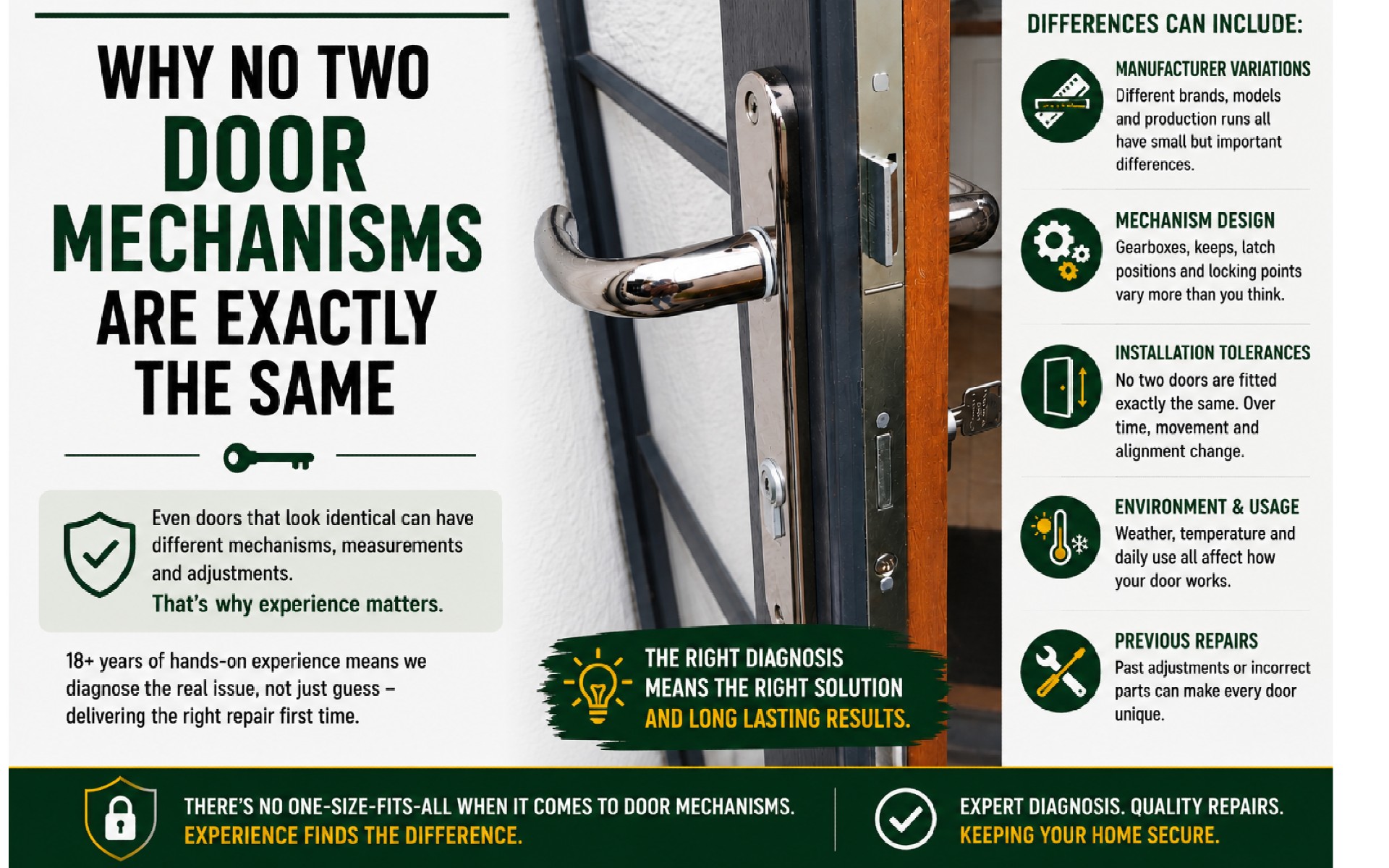
One of the biggest challenges when repairing modern doors is that there's no universal multipoint locking mechanism. Even doors from the same manufacturer can have completely different locking systems depending on when they were made, which hardware supplier was used and the specification chosen at the time.
To understand how these mechanisms work before looking at the differences between them, it's worth reading The Complete Guide to Multipoint Locking Systems.
Different Manufacturers, Different Designs
There are dozens of manufacturers producing multipoint locking mechanisms, each with their own engineering designs.
Although many mechanisms perform the same job, they can differ in almost every important measurement, including:
- Overall length
- Backset
- Handle centres (PZ)
- Faceplate width
- Locking point positions
- Gearbox design
- Screw fixing positions
A mechanism from one manufacturer will rarely interchange directly with another.
If you'd like to see just how many manufacturers there are, have a look at A–Z of Multipoint Lock Manufacturers.
Two Identical Doors Can Have Completely Different Locks
Many door manufacturers don't actually produce their own locking mechanisms.
Instead, they purchase them from specialist lock manufacturers.
As a result, two doors that appear identical on the outside—even two fitted by the same installer—may contain completely different locking systems internally.
This is why experienced locksmiths never rely on appearance alone when ordering replacement parts.
Lock Designs Change Over Time
Manufacturers continually update their mechanisms to improve:
- Security
- Reliability
- Ease of operation
- Compliance with newer standards
This means a mechanism fitted twenty years ago may no longer be available today, even though the door itself remains perfectly serviceable.
Fortunately, an obsolete mechanism doesn't automatically mean the door can't be repaired. Many older systems can still be repaired using compatible replacements or upgraded components, as explained in Can You Replace Just the Locking Mechanism?
Accurate Measurements Are Essential
Finding the correct replacement is about much more than matching the brand name.
A locksmith may need to measure:
- Backset
- Handle centres (PZ)
- Overall mechanism length
- Faceplate width
- Distance between locking points
- Position of the gearbox
Even a difference of only a few millimetres can prevent the mechanism from operating correctly.
That's why ordering parts based purely on photographs found online often ends in disappointment.
Sometimes Only the Gearbox Needs Replacing
Not every faulty mechanism requires a complete replacement.
If the locking strip remains in good condition, replacing only the centre gearbox may restore the entire system.
Whether that's possible depends on the mechanism fitted and the availability of replacement parts.
If you'd like to understand the gearbox in more detail, read uPVC and Composite Door Gearboxes Explained.
"Universal" Doesn't Mean Identical
Many replacement mechanisms are advertised as universal or compatible.
That doesn't mean they'll fit every door.
Compatible mechanisms still have to match the original door's dimensions and locking arrangement.
In some cases they require slight modifications, while in others they won't fit at all.
Selecting the right replacement requires knowledge of different mechanism types, operating styles and manufacturers. The guide Understanding Multipoint Lock Types: Lever Lever, Lever Pad, Split Spindle and Keywind Explained explains why seemingly similar locks can operate very differently.
Every Locking System Is Different
The mechanism isn't just a long strip of metal.
Inside it are numerous working components including:
- Gearboxes
- Hooks
- Rollers
- Deadbolts
- Linkages
- Springs
Different manufacturers use different combinations of these components depending on the level of security and door design.
If you're interested in how these parts work together, The Science of Multipoint Door Locks provide a detailed explanation.
Experience Makes Identification Easier
An experienced locksmith doesn't rely solely on the name stamped onto the locking strip.
They'll also consider:
- The age of the door
- The manufacturer
- Door thickness
- Handle centres
- Backset
- Gearbox dimensions
- Locking point layout
- Previous repairs or modifications
By combining these details, it's usually possible to identify the correct replacement mechanism without unnecessary guesswork.
For a broader glossary of mechanism terminology, see A–Z of Door Locking Mechanisms – The Complete Homeowner's Guide.
A New Mechanism Won't Fix a Misaligned Door
Replacing the correct mechanism is only part of the repair.
If the door has dropped or moved over time, the new mechanism will still be subjected to unnecessary strain.
That's why every professional repair should include checking:
- Door alignment
- Hinge adjustment
- Handle operation
- Key operation
- Locking point engagement
Correct alignment dramatically reduces wear on the new mechanism and helps ensure a much longer service life.
The Same Principles Apply to French and Conservatory Doors
French doors and conservatory doors also use a wide variety of multipoint locking systems.
Although they often appear similar, their mechanisms, locking point layouts and gearboxes can vary just as much as standard front and back doors.
If you own one of these doors, you may also find these guides useful:
- Repairing French Door Lock Mechanisms: Everything You Need to Know About French Door Lock Repairs
- Conservatory Door Lock Repairs Explained: Repairing Multipoint Locks Without Replacing the Door
Choosing the Right Part the First Time
Ordering the wrong mechanism can result in:
- Delays while correct parts are sourced
- Additional labour costs
- Doors that still don't lock correctly
- Premature wear of new components
- Unnecessary frustration
Correct identification from the outset saves time, money and repeat repairs.
Every Door Has Its Own Locking System
Although many uPVC and composite doors look almost identical, the mechanisms hidden inside them are often completely different. Variations in manufacturer, measurements, gearbox design, locking points and operating style mean there is rarely a true one-size-fits-all replacement. Identifying the correct mechanism, using quality replacement parts and ensuring the door is properly aligned afterwards are the foundations of a successful repair.
If you'd like to build a complete understanding of multipoint locking systems, continue with Everything You Need to Know About Multipoint Locking Systems before exploring the rest of the multipoint lock series.