
Introduction
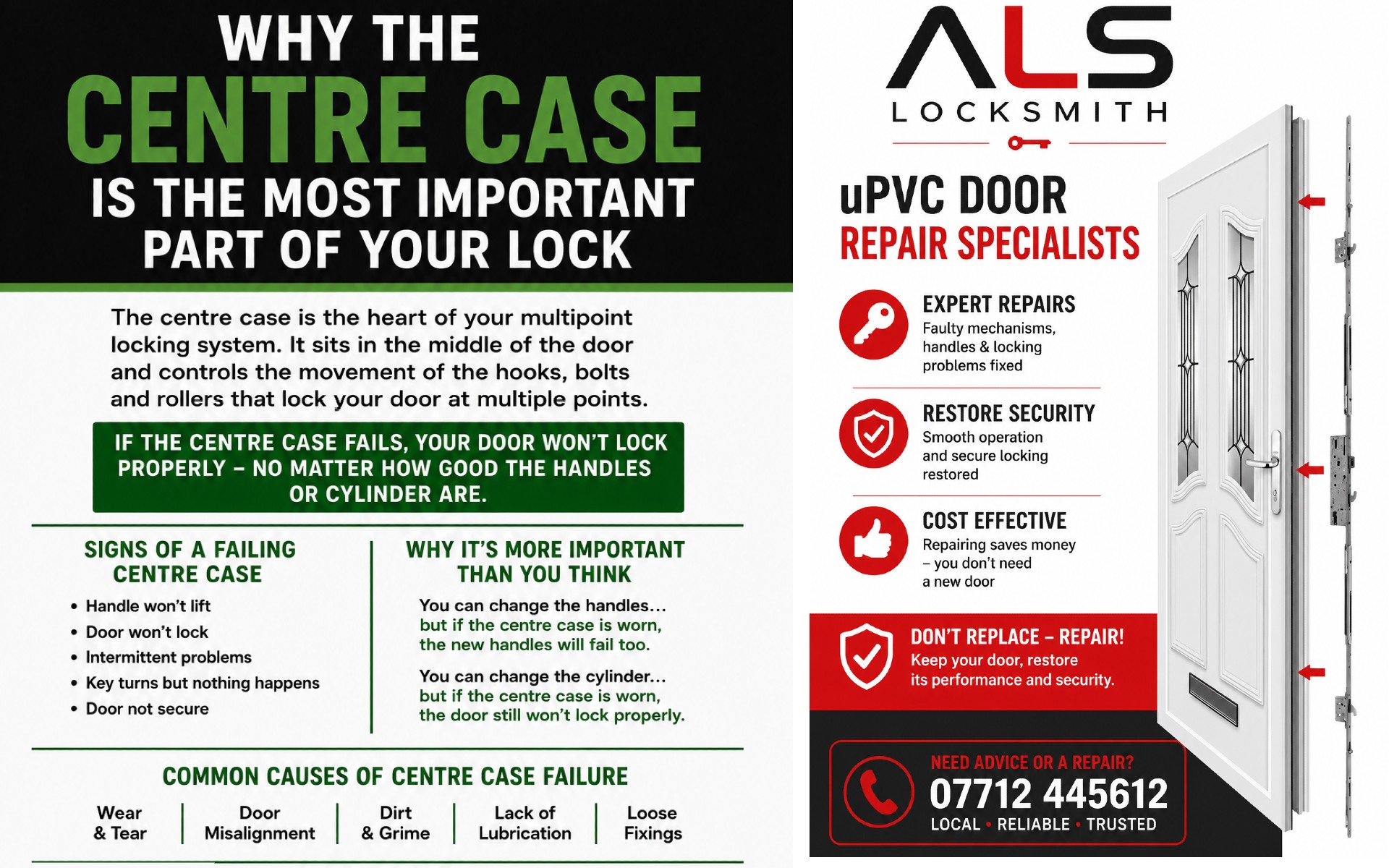
When most people think about a door lock, they picture the key, the handle or the euro cylinder. While these are all important components, the centre case is arguably the most important part of the entire multipoint locking system.
Located in the centre of the mechanism, directly behind the handles and euro cylinder, the centre case houses the gearbox and controls every movement of the locking mechanism. Without it, the hooks, rollers and deadbolts cannot engage or release, regardless of how good the rest of the lock may be.
Understanding what the centre case does—and why it fails—can help homeowners recognise early warning signs and avoid more serious lock problems.
What Is the Centre Case?
The centre case is the main housing positioned in the middle of a multipoint locking mechanism.
It's located behind the door handles and euro cylinder and contains the gearbox along with the internal components responsible for operating the locking system.
Every time you lift the handle or turn the key, you're operating the centre case.
Think of it as the control unit for the entire locking mechanism.
What Does the Centre Case Do?
The centre case coordinates every part of the locking process.
Its functions include:
- Connecting the handles to the locking mechanism.
- Receiving movement from the euro cylinder.
- Operating the gearbox.
- Moving the hooks, rollers and deadbolts.
- Locking and unlocking the door.
Without a functioning centre case, the multipoint locking mechanism simply cannot work.
How the Centre Case Works
Although it's hidden inside the door, the centre case performs a series of precise mechanical actions every time the door is used.
When you:
- Lift the handle, the centre case transfers movement through the gearbox to the connecting rods.
- The rods operate the hooks, rollers or deadbolts positioned along the locking strip.
- Turning the key locks or unlocks the gearbox, securing the entire mechanism.
Every locking point depends on the centre case operating correctly. If it fails, the whole locking system is affected.
Why the Centre Case Is the Hardest-Working Component
Unlike the euro cylinder, which is only operated when you use the key, the centre case works virtually every time the door is opened or closed.
It operates whenever the door is:
- Opened.
- Closed.
- Locked.
- Unlocked.
Over thousands of operating cycles, the internal gears, springs and moving components naturally begin to wear.
It's this constant mechanical workload that makes the centre case one of the components most likely to fail during the life of a multipoint locking mechanism.
Poor Door Alignment Causes Premature Failure
One of the biggest reasons centre cases wear out early isn't poor manufacturing—it's excessive strain.
As doors gradually move out of alignment because of:
- Everyday use.
- Worn hinges.
- The weight of the door.
- Seasonal expansion and contraction.
the locking points no longer line up perfectly with the keeps in the frame.
Instead of operating smoothly, the gearbox has to work much harder every time the handle is lifted.
Over months or years, this additional resistance accelerates wear inside the centre case until a failure eventually occurs.
Common Signs the Centre Case Is Failing
A failing centre case usually gives several warning signs before it stops working completely.
Common symptoms include:
- The handle becoming stiff.
- The key becoming difficult to turn.
- The handle moving but nothing happening.
- The locking points failing to engage or retract.
- Grinding, clicking or crunching noises.
- The handle failing to spring back.
- The key turning while the door remains locked.
- The door becoming progressively harder to lock.
These symptoms often develop gradually and should be investigated before a complete lock failure occurs.
Can the Centre Case Be Replaced?
In many cases, yes.
If the remainder of the multipoint locking mechanism is still in good condition, replacing the centre case or gearbox may be all that's required.
This is often possible when:
- The hooks and rollers remain undamaged.
- The connecting rods are operating correctly.
- The locking points still move freely.
- Suitable replacement parts are available.
Replacing only the failed component is often more economical than replacing the complete locking mechanism.
When the Whole Mechanism Needs Replacing
Sometimes the centre case isn't the only worn component.
A complete multipoint locking mechanism may be the better option if there is:
- Extensive internal wear.
- Broken hooks or rollers.
- Damaged connecting rods.
- Seized locking points.
- Corrosion affecting multiple components.
- An obsolete mechanism with no compatible replacement centre case.
Replacing the entire mechanism restores every moving component rather than repairing just one section.
Why Cheap Centre Cases Can Be a False Economy
Because the centre case carries virtually all of the mechanical load within the locking system, the quality of the replacement matters.
Lower-quality replacements may contain:
- Weaker internal gears.
- Inferior metals.
- Less precise machining.
- Components with a shorter service life.
While cheaper parts may reduce the initial repair cost, they may not offer the same durability as a quality replacement manufactured to a higher standard.
Door Alignment Is Essential
Replacing the centre case without correcting the cause of its failure often leads to exactly the same problem returning.
Every repair should include checking that:
- The door sits correctly within the frame.
- The locking points engage without resistance.
- The handle lifts smoothly.
- The key turns easily.
- The gearbox operates without unnecessary strain.
Correct door alignment is one of the most effective ways of extending the lifespan of both the centre case and the entire locking mechanism.
The Heart of Every Multipoint Lock
Although the euro cylinder allows you to lock and unlock the door, it's the centre case that performs the hard work of operating every locking point.
Without a healthy centre case, even the highest-quality cylinder or handles cannot make the locking mechanism function correctly.
Conclusion
The centre case is the engine of every multipoint locking mechanism. It transfers movement from the handles and euro cylinder to the hooks, rollers and deadbolts that secure your door, making it the single most important mechanical component in the entire locking system.
When it begins to wear, the effects are usually felt throughout the door, with symptoms such as stiff handles, difficult keys and locking points that no longer engage properly. Fortunately, many failed centre cases can be replaced without replacing the entire door—and often without replacing the complete locking mechanism. Combined with proper door realignment and quality replacement parts, a repaired centre case can restore smooth, secure and reliable operation for many years.
Related articles: