Introduction
When a door lock becomes stiff or difficult to operate, it's tempting to reach for the nearest can of lubricant and hope for a quick fix. While lubrication is an important part of maintaining a door, using the wrong product—or applying it incorrectly—can actually make the problem worse.
Some household sprays leave behind sticky residues that attract dirt, while others are simply not designed for precision lock components. In many cases, a lock that has become difficult to operate isn't suffering from a lack of lubrication at all.
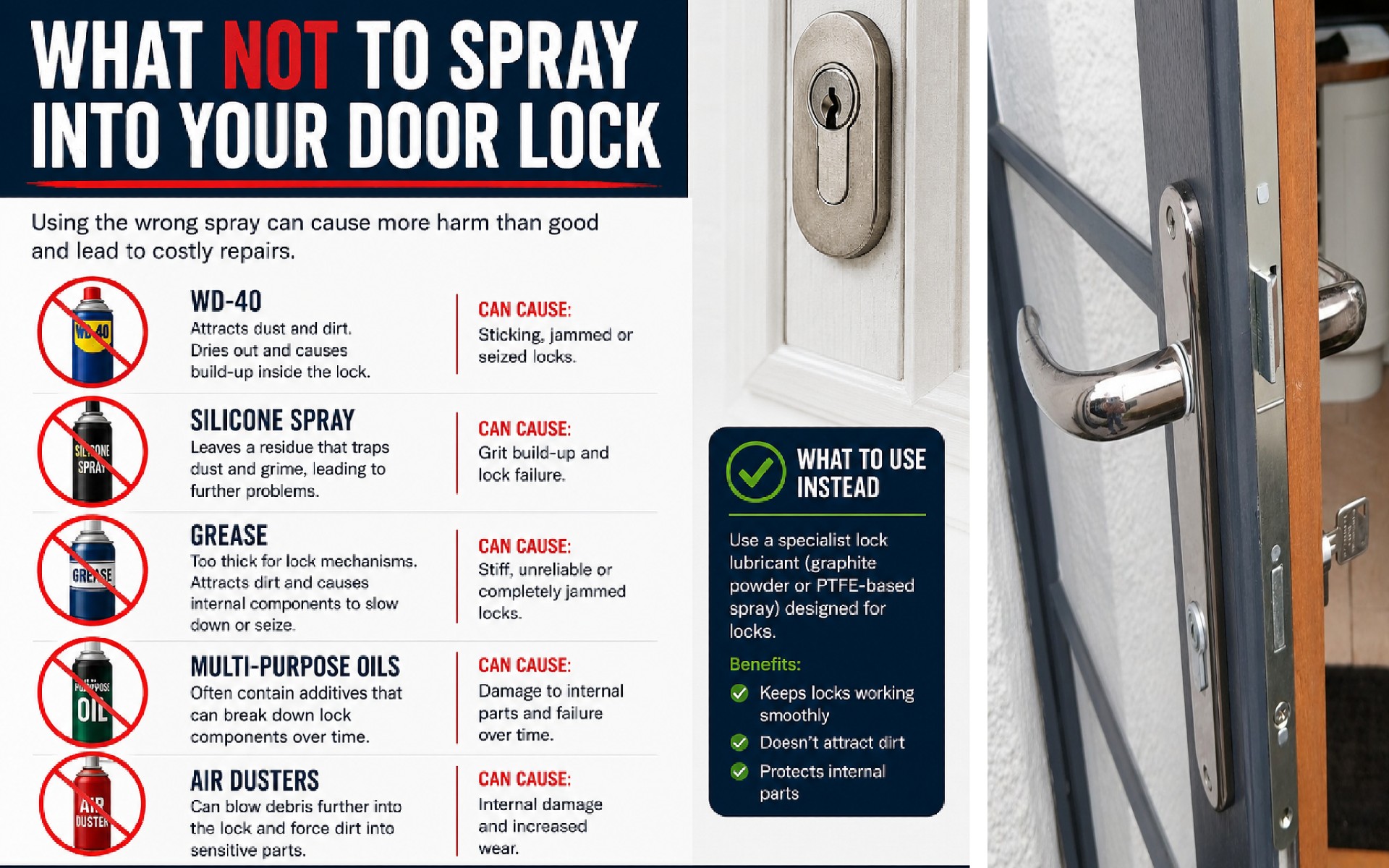
Knowing what not to spray into your door lock is just as important as knowing what to use.
Avoid Thick Oils
Heavy oils may seem like a good way to free up a stiff lock, but they rarely provide a lasting solution.
Instead, they can leave behind an oily residue that attracts:
- Dust
- Dirt
- Grit
- Tiny metal particles created through normal wear
Over time this contamination builds up inside the lock, causing it to become increasingly stiff and more difficult to operate.
Don't Over-Lubricate the Lock
Applying more lubricant doesn't improve the repair.
In fact, flooding a lock or multipoint locking mechanism with lubricant can:
- Push dirt further into the mechanism.
- Trap debris inside moving parts.
- Wash away existing lubricants.
- Leave excess residue that attracts further contamination.
A small amount of the correct lubricant applied in the right place is usually all that's needed for routine maintenance.
Be Careful With General-Purpose Water-Displacing Sprays
Many homeowners already have a can of water-displacing spray in the garage and use it whenever something becomes stiff.
While these products can temporarily free a sticking lock or displace moisture, they are not intended to be long-term lubricants for door locks.
Repeated use may:
- Remove the specialised lubricants already inside the lock.
- Leave a film that attracts dirt over time.
- Provide only temporary improvement without addressing the real cause of the problem.
They're best regarded as a short-term aid in specific situations rather than a routine maintenance product for euro cylinders or multipoint locking mechanisms.
Never Pack Grease Into a Euro Cylinder
The inside of a euro cylinder contains a series of finely engineered pins and springs that require very little lubrication.
Grease can quickly collect dirt and prevent these components from moving freely.
This may lead to:
- Stiff keys.
- Keys sticking in the lock.
- Rough operation.
- Increased wear.
- Premature cylinder failure.
For the cylinder itself, always use a lubricant designed specifically for locks.
Don't Spray Every Part of the Door
It's easy to assume that if something feels stiff, every moving part should be sprayed.
In reality, randomly applying lubricant to:
- Door handles
- The lock cylinder
- The gearbox
- The faceplate
- The entire locking strip
is unlikely to solve the problem if the stiffness is being caused by something else.
Lubrication reduces friction—it doesn't correct mechanical faults or poor door alignment.
A Stiff Lock Doesn't Always Need Lubrication
One of the biggest myths is that every stiff lock is simply dry.
In many cases the real cause is:
- A dropped door.
- Poor alignment.
- A worn gearbox.
- A failing multipoint locking mechanism.
- A worn lock cylinder.
- Pressure on the locking points.
Lubrication may make the lock feel slightly better for a short time, but it won't repair worn or damaged components.
Use the Right Lubricant in the Right Place
Routine maintenance is straightforward when the correct products are used.
As a general guide:
- Use a lock-specific lubricant for the euro cylinder.
- Lightly lubricate the hooks, rollers, deadbolts and latch.
- Wipe away any excess lubricant after application.
- Avoid contaminating the lock with dirt during maintenance.
Used correctly, lubrication helps keep the locking system operating smoothly without attracting unnecessary debris.
If Lubrication Doesn't Solve the Problem
If the lock remains stiff after proper maintenance, avoid forcing the key or handle.
The underlying fault may require:
- Door realignment.
- Gearbox replacement.
- Multipoint locking mechanism repair.
- Euro cylinder replacement.
- Hinge adjustment.
The sooner these problems are identified, the less likely they are to develop into a complete lock failure or an emergency lockout.
Conclusion
Lubrication plays an important role in maintaining your door, but it isn't a cure for every locking problem. Using the wrong spray can encourage dirt to build up, reduce the life of the lock and sometimes make the fault worse. A quality lock lubricant, applied sparingly and in the correct places, helps keep your locking system operating smoothly without attracting unnecessary contamination.
If your door continues to feel stiff after proper maintenance, it's usually a sign that another component—such as the gearbox, lock cylinder or the door alignment itself—requires attention. Identifying the real cause of the problem is always more effective than repeatedly reaching for another can of spray.
Related articles: