Introduction
If your composite door handle keeps dropping instead of returning to its normal horizontal position, it's a clear sign that something isn't working as it should.
Many homeowners assume the handle itself has failed and simply replace it. While worn handle springs are sometimes the cause, a dropping handle is often the first visible symptom of a fault elsewhere in the locking system.
The return action of the handle relies on several components working together, including the handles, gearbox, multipoint locking mechanism and the alignment of the door itself. If any of these develop a fault, the handle may stop returning properly.
The good news is that, in most cases, the problem can be repaired without replacing the entire door.
How Should a Composite Door Handle Work?
A properly functioning composite door handle should:
- Return smoothly to the horizontal position after being lifted or pressed.
- Feel firm without excessive movement.
- Lift easily when locking the door.
- Operate the locking mechanism without excessive force.
- Spring back every time it's used.
If the handle stays pointing down, feels floppy or doesn't return fully, the locking system should be investigated before further damage occurs.
Worn Handle Springs
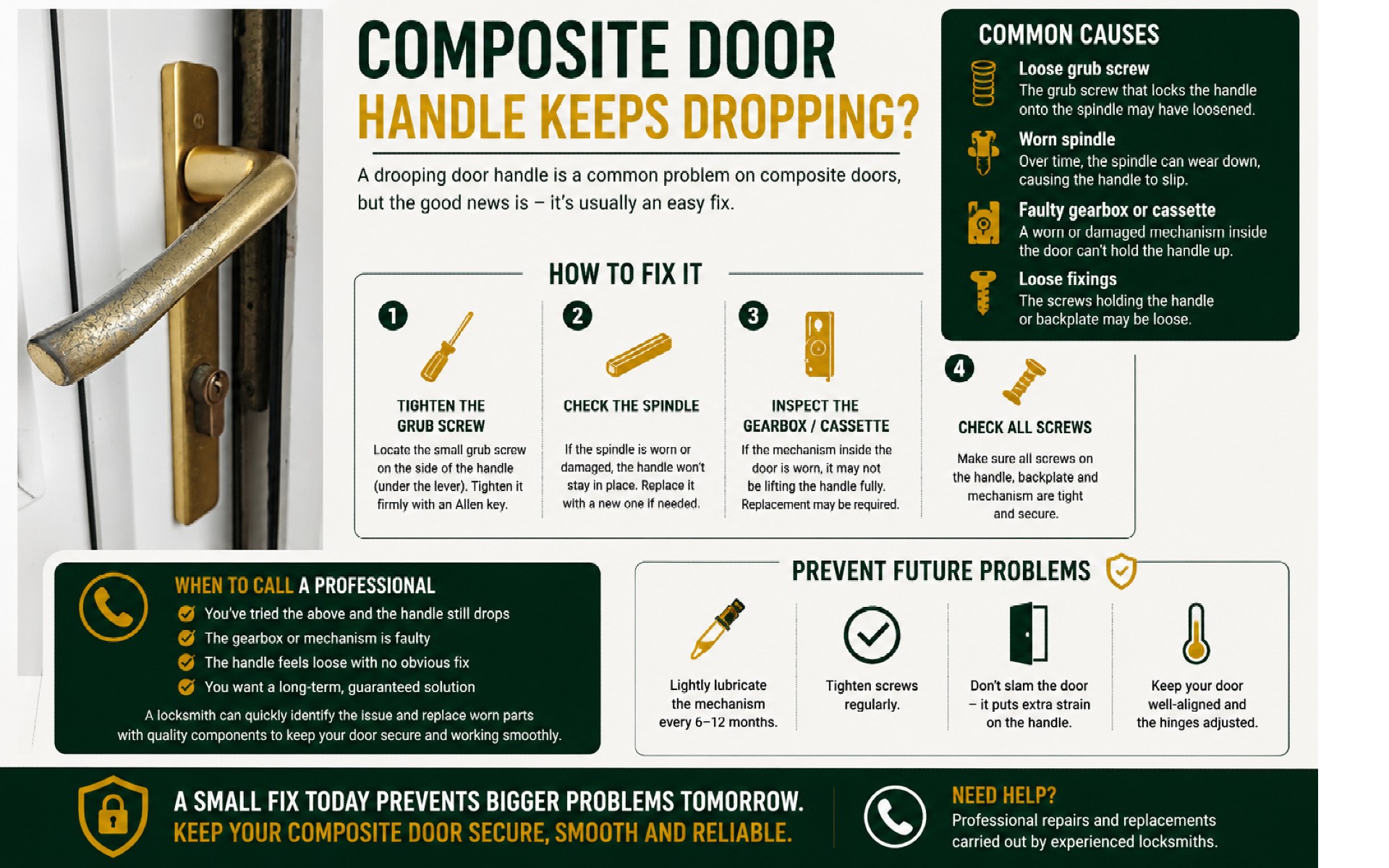
The simplest explanation is worn or broken springs inside the door handles.
Every time you use the door, these springs compress and return the handle to its resting position.
After years of daily use they can weaken or fail.
Common symptoms include:
- The handle remains pointing down.
- The handle feels loose.
- The latch still operates normally.
- The door can usually still be locked.
- The problem gradually becomes worse over time.
If the rest of the locking system is operating correctly, replacing the handles may solve the problem.
However, it's important to establish whether the failed springs are the cause—or whether they've failed because another part of the lock has been placing them under excessive strain.
A Failing Gearbox
One of the most common causes of a dropping composite door handle is a worn gearbox.
The gearbox is the central part of the multipoint locking mechanism and contains springs and moving components that help the handles return correctly.
As the gearbox begins to wear, you may notice:
- The handle no longer springs back.
- The handle feels stiff when lifted.
- The key becomes harder to turn.
- Locking points become more difficult to engage.
- Locking the door requires extra effort.
Many homeowners replace the handles only to discover the new handles begin dropping as well because the underlying gearbox fault was never corrected.
Poor Door Alignment
Door alignment is another common cause that is frequently overlooked.
Composite doors are heavy, and over time they can move slightly due to:
- Everyday use.
- Normal hinge wear.
- Seasonal expansion and contraction.
- Minor movement of the building.
When the door drops, the hooks, rollers and deadbolts begin rubbing against the keeps in the frame.
This creates additional resistance every time the handle is lifted.
Over time that extra strain can damage:
- Handle springs.
- The gearbox.
- The multipoint locking mechanism.
- Other moving components within the lock.
Correcting the alignment often removes the excessive pressure and helps prevent repeat failures.
Worn Multipoint Locking Mechanism
Sometimes the problem lies within the multipoint locking mechanism itself.
Years of operation can eventually cause internal components to wear.
Signs include:
- Rough operation.
- Uneven resistance.
- Locking points failing to move smoothly.
- Stiff handles.
- Loose handles.
- Difficulty locking the door.
If the mechanism has reached the end of its working life, replacing only the handles is unlikely to provide a lasting repair.
Try Operating the Door With It Open
One simple test can provide a useful clue.
Open the door and operate the handle several times.
If:
- The handle returns normally with the door open...
- But drops or becomes stiff when the door is closed...
then the problem is often caused by poor alignment rather than the handles themselves.
This suggests the locking mechanism is under excessive pressure only when it engages with the keeps in the frame.
Although this test can point towards an alignment issue, it doesn't rule out additional wear within the gearbox or locking mechanism.
Why You Shouldn't Ignore a Dropping Handle
A dropping handle is rarely a fault that fixes itself.
Continuing to force the handle can eventually lead to:
- Complete gearbox failure.
- Broken handle springs.
- A jammed multipoint locking mechanism.
- Keys becoming difficult to turn.
- The door becoming difficult—or impossible—to open or lock.
Repairing the problem while the door is still operating normally is usually quicker, simpler and less expensive than dealing with a complete lock failure.
The Importance of Correct Diagnosis
Several completely different faults can produce exactly the same symptom.
A dropping handle may be caused by:
- Worn handle springs.
- A failing gearbox.
- Poor door alignment.
- A worn multipoint locking mechanism.
- Loose handles.
- More than one of these problems occurring together.
Replacing the first part that appears faulty often results in the same problem returning because the real cause was never identified.
A proper diagnosis looks at the complete locking system rather than just the handle.
The Correct Repair
The appropriate repair depends entirely on what has caused the fault.
Possible repairs include:
- Replacing worn door handles.
- Replacing the gearbox.
- Replacing the multipoint locking mechanism where necessary.
- Realigning the door.
- Adjusting or replacing hinges.
- Checking the locking points and keeps.
- Lubricating appropriate moving components.
The objective isn't simply to replace the broken part—it's to remove the underlying strain that caused the failure in the first place.
Repair Before Replacement
A dropping handle does not usually mean you need a new composite door.
In most cases the door itself remains perfectly sound.
Replacing worn mechanical components and correcting any alignment issues will often restore smooth operation for many years while avoiding the considerable cost of replacing the complete door.
Conclusion
If your composite door handle keeps dropping, don't automatically assume the handle is to blame. While worn handle springs are sometimes responsible, a failing gearbox, poor door alignment or a worn multipoint locking mechanism is often the real cause. The handle is frequently the first component to show symptoms rather than the source of the problem itself.
The key to a lasting repair is identifying why the handle has stopped returning properly. Simply replacing the handles without addressing the underlying fault often leads to the same issue happening again. By diagnosing the complete locking system, correcting excessive strain and replacing only the components that have genuinely worn out, it's usually possible to restore smooth, reliable operation without replacing the entire door.
Frequently Asked Questions
Why does my composite door handle stay down?
The most common causes are worn handle springs, a failing gearbox, poor door alignment or wear within the multipoint locking mechanism.
Can I still use my door if the handle keeps dropping?
Sometimes, yes, but it's not advisable to ignore the problem. Continuing to force the handle can cause further damage and may eventually result in the door becoming difficult or impossible to open.
Will replacing the handles fix the problem?
Only if the handle springs have actually failed. If the underlying cause is a worn gearbox or poor alignment, new handles alone are unlikely to provide a lasting solution.
Why does the handle work when the door is open?
If the handle works normally with the door open but drops when the door is closed, it often indicates that the locking mechanism is under excessive strain because the door is out of alignment.
Do I need a new composite door?
Usually not. In most cases the problem can be resolved by repairing or replacing worn locking components and correcting any alignment issues, allowing you to keep your existing door.