Introduction
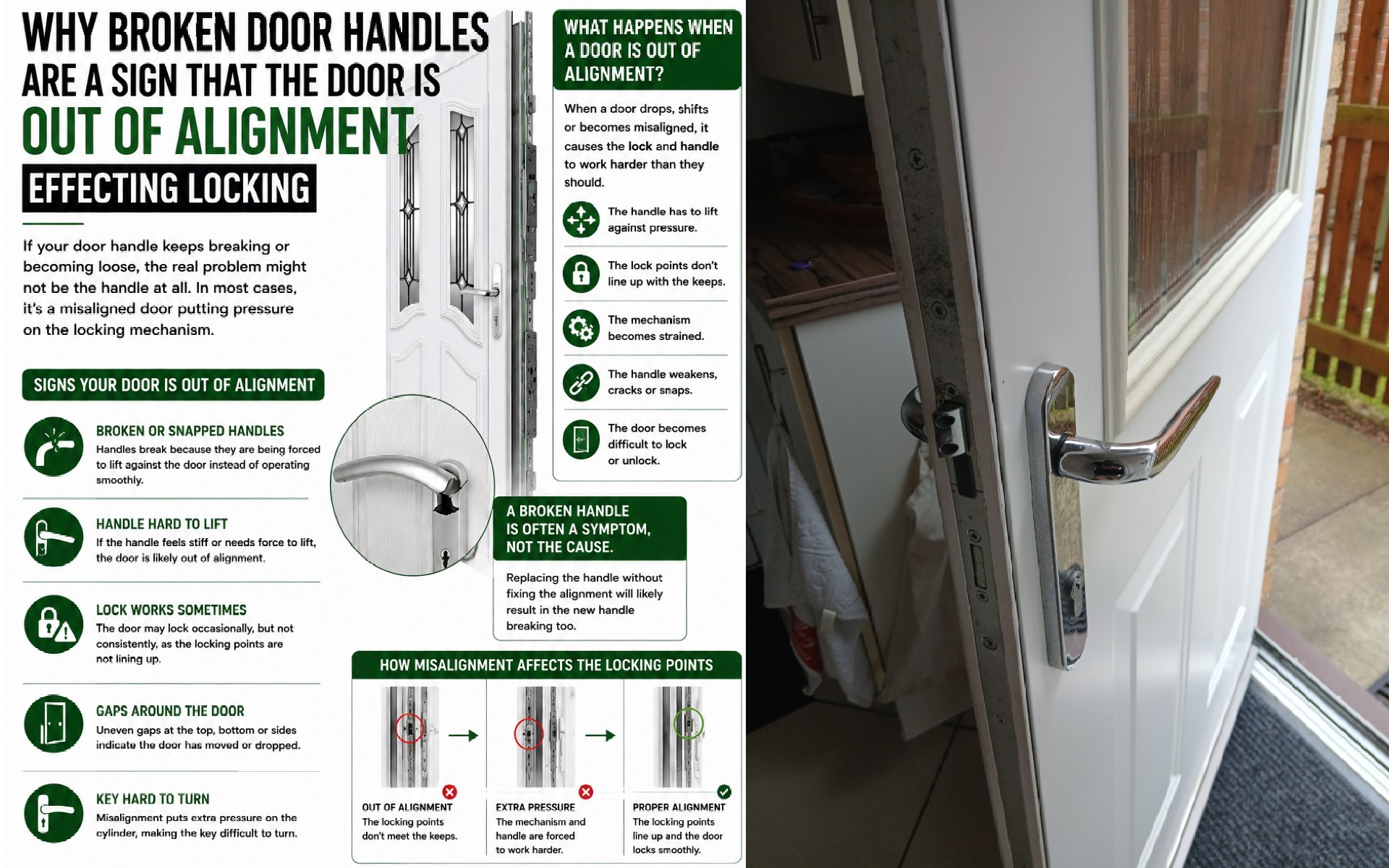
A broken door handle is often treated as the problem—but in many cases, it's actually a symptom of something else.
If you've replaced a door handle only to find the replacement breaks a few months later, it's unlikely you've simply been unlucky. More often, the handle has been subjected to excessive strain because the door has gradually moved out of alignment.
Simply fitting another handle without addressing the underlying cause usually means the new one will be placed under exactly the same pressure. The result is often another broken handle, followed by more serious problems with the gearbox or multipoint locking mechanism.
Door Handles Are Designed to Operate the Lock—Not Force It
A correctly aligned uPVC or composite door should lock with very little effort.
When everything is working properly, lifting the handle simply allows the:
- Hooks.
- Rollers.
- Deadbolts.
to engage smoothly with the keeps fitted to the frame.
The handle should feel light and smooth throughout its movement.
If you're having to lift the handle with significant force, the locking system is telling you that something isn't right.
A Dropped Door Changes Everything
Over time, even a well-fitted door can move slightly.
Common faults and reasons include:
- Everyday use.
- The weight of the door.
- Normal hinge wear.
- Seasonal expansion and contraction.
- Slight movement of the building over time.
As the door drops or shifts, the locking points no longer line up perfectly with the keeps in the frame.
Instead of moving freely into position, they begin rubbing, catching or binding against the frame every time the handle is lifted.
Every Time You Lift the Handle…
When a door is out of alignment, the handle is no longer simply operating the locking mechanism.
Instead, it's being forced to:
- Pull the door into position.
- Force hooks into the keeps.
- Push rollers past resistance.
- Drive deadbolts into misaligned keeps.
- Compensate for the door being out of square.
That's considerably more force than the handle was ever designed to withstand.
The additional pressure is transferred through every part of the locking system, not just the handle itself.
Why Door Handles Break
Repeatedly operating a stiff door places continuous stress on the handle.
Over hundreds or even thousands of locking cycles, this can lead to:
- Broken return springs.
- Cracked handle backplates.
- Loose or wobbly handles.
- Broken spindles.
- Stripped fixing points.
- Handles that no longer spring back into position.
In many cases, the handle hasn't failed because it's poor quality—it has simply been overloaded for months before eventually breaking.
The Gearbox Is Also Under Pressure
The door handle is usually only the first component to show signs of trouble.
The same excessive force is also transmitted through:
- The gearbox.
- Internal gears.
- Connecting rods.
- Hooks.
- Rollers.
- Deadbolts.
It's common for a broken handle to be followed by a failed gearbox if the alignment problem isn't corrected.
Replacing the handle alone doesn't remove the strain that's causing the damage.
Simply Replacing the Handle Isn't a Lasting Repair
Because the broken handle is the most obvious fault, many homeowners replace it and assume the problem has been solved.
However, if the door remains out of alignment:
- The new handle will continue operating under excessive pressure.
- The locking mechanism will continue to wear.
- The gearbox may eventually fail.
- The replacement handle is likely to suffer the same fate.
Unless the underlying cause is corrected, the repair is unlikely to last.
Signs Your Door Needs Realigning
A broken handle is often accompanied by other warning signs.
You may notice:
- The handle becoming progressively harder to lift.
- The key becoming stiff to turn.
- Having to push or pull the door before it locks.
- The top or bottom of the door catching the frame.
- Uneven gaps around the door.
- The lock working better with the door open than when it's closed.
- Scraping or rubbing as the door closes.
These symptoms usually indicate that the locking mechanism is working against unnecessary resistance.
A Proper Repair Looks Beyond the Handle
Replacing the broken handle is only part of the solution.
A lasting repair should also include:
- Identifying why the handle failed.
- Checking the door alignment.
- Inspecting the hinges for wear or movement.
- Adjusting the door where necessary.
- Inspecting the gearbox and multipoint locking mechanism for signs of wear.
- Ensuring the locking points engage smoothly without excessive force.
By correcting the underlying issue as well as replacing the damaged component, the entire locking system can operate as it was designed to.
Preventing Future Handle Failures
The easiest way to avoid repeated handle failures is to act as soon as the door starts feeling stiff.
If the handle suddenly requires more effort than usual, don't ignore it or simply apply more force.
Having the door adjusted early can:
- Reduce strain on the handle.
- Protect the gearbox.
- Extend the life of the multipoint locking mechanism.
- Prevent the inconvenience of a jammed door.
- Reduce the overall cost of repairs.
Small adjustments carried out at the right time often prevent much larger repairs later.
Conclusion
A broken door handle is often the first visible sign that something else is wrong. In many cases, the real cause is poor door alignment, worn hinges or a multipoint locking mechanism that has been operating under excessive strain for some time.
Replacing the handle without correcting these underlying issues simply transfers the same pressure to the new one, increasing the likelihood of another failure. A proper repair involves identifying why the handle broke, restoring the correct door alignment and checking the condition of the gearbox and locking mechanism. By fixing the cause rather than just the symptom, you can restore smooth operation and help ensure the repair lasts for many years.
Related guides:
- UPVC door handles loose here’s why?
- The benefits of sprung door handles.
- Why conservatory door handles become loose?
- Why does my door handle keep dropping?