Introduction
Door handles are one of the most frequently used parts of any uPVC or composite door, yet they're often overlooked until they become loose, stiff or break completely. Choosing the correct replacement handle is about much more than appearance. Door handles are available in a wide range of sizes, fixing arrangements and security ratings, and fitting the wrong handle can prevent the lock from operating correctly or even reduce the security of your door.
Whether you're replacing worn handles, upgrading your home's security or simply modernising the look of your entrance door, understanding the different types of handles and the measurements involved will help you choose the correct replacement.
Why Replace Door Handles?
Door handles may need replacing because:
- The spring has failed.
- The handles have become loose.
- The backplate has cracked.
- The finish has deteriorated.
- You want to improve security.
- You're upgrading to modern hardware.
- The handles no longer return properly.
- You're replacing outdated door furniture.
A quality replacement handle can improve both the appearance and operation of your door.
TS007 2 Star Security Handles
One of the most popular upgrades for uPVC and composite doors is a TS007 2 Star security handle.
Unlike standard handles, these are designed to protect the euro cylinder from attack.
Typical features include:
- Reinforced steel backplates.
- Cylinder protection.
- Anti-grip design.
- High-strength construction.
- Sprung lever operation.
When combined with a TS007 1 Star anti-snap euro cylinder, they achieve an overall TS007 3 Star security rating.
This combination provides protection against:
- Lock snapping.
- Lock drilling.
- Lock picking.
- Lock bumping.
For many homeowners, this is one of the most cost-effective ways to upgrade door security.
Understanding PZ Centres
The most important measurement when replacing a door handle is the PZ Centre.
This is the distance between:
- The centre of the spindle.
- The centre of the keyhole.
If this measurement is incorrect, the handle simply won't fit the lock.
Common PZ Sizes
68mm
Often found on:
- Older uPVC doors.
- Early multipoint locking systems.
70mm
Common on:
- Many residential uPVC doors.
- Various modern locking mechanisms.
92mm
The most common size fitted today.
Found on:
- Modern uPVC doors.
- Composite doors.
- Most current multipoint mechanisms.
113mm
Typically used on:
- Certain composite doors.
- Specialist locking systems.
- Some high-security door manufacturers.
Always measure before ordering replacement handles.
Screw Fixing Centres
Another important measurement is the fixing centres.
This is the distance between the two fixing screws.
Even if the PZ measurement is correct, incorrect fixing centres mean the new handles cannot be fitted without drilling new holes.
Spindle Sizes
The spindle is the square steel bar that connects the inside and outside handles through the gearbox.
Common spindle arrangements include:
7mm Spindle
The most common spindle size fitted to uPVC and composite doors.
8mm Spindle
Found on certain door manufacturers and commercial applications.
Split Spindle
Allows the inside and outside handles to operate independently.
Common on composite doors.
Using the wrong spindle can result in:
- Loose handles.
- Poor handle return.
- Difficulty operating the lock.
- Complete failure of the handle to operate the mechanism.
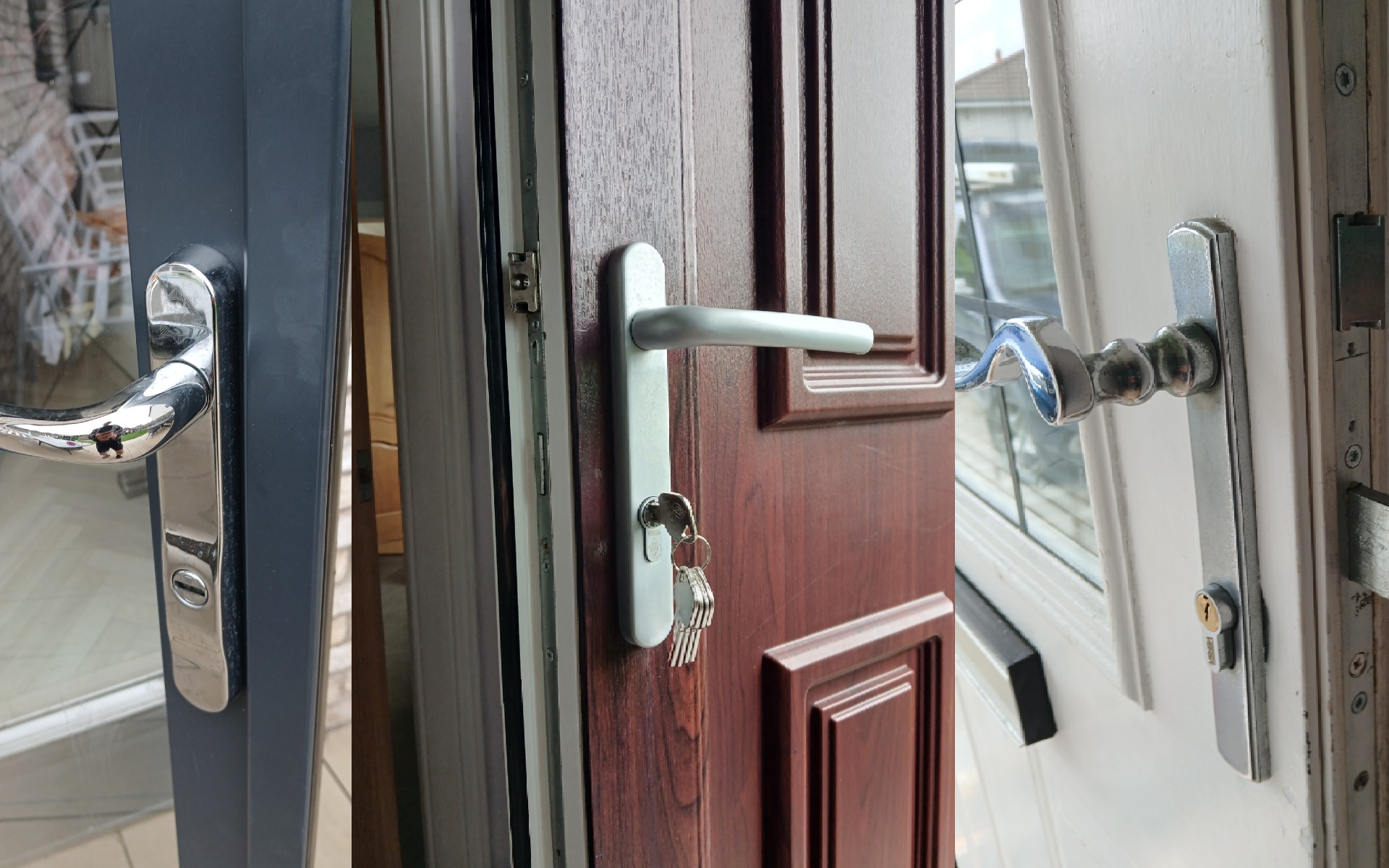
Lever/Lever Handles
These have operating levers on both sides of the door.
Advantages
- Easy operation.
- Suitable for most residential doors.
- Widely available.
- Compatible with many multipoint mechanisms.
Often fitted to:
- Rear doors.
- Patio doors.
- French doors.
- Standard uPVC doors.
Lever/Pad Handles
These have:
- Lever handle inside.
- Fixed pad outside.
The outside pad cannot normally retract the latch without using the key.
Benefits
- Improved security.
- Prevents the latch operating from outside.
- Commonly used with split spindle systems.
Very popular on composite front doors.
Split Spindle Systems
Split spindle systems allow each handle to operate independently.
Typically:
Inside handle:
- Opens the door normally.
Outside handle:
- Requires the key before it will operate.
Benefits include:
- Improved security.
- Reduced unauthorised access.
- Better control over external operation.
Many modern composite doors use split spindle systems as standard.
Sprung vs Unsprung Handles
Sprung Handles
Contain internal springs that help return the handle to its resting position.
Benefits include:
- Reduced strain on the gearbox.
- Smoother operation.
- Better handle return.
- Longer mechanism life.
Generally considered the better option.
Unsprung Handles
Rely entirely on the gearbox spring.
Over time this places more strain on the gearbox.
If the gearbox spring weakens, the handles often begin to droop.
Handle Backplates
Door handles are mounted on backplates which vary considerably between manufacturers.
Measurements include:
- Overall length.
- Width.
- Screw centres.
- PZ centres.
Higher security backplates may also include:
- Cylinder protection.
- Reinforced steel construction.
- Anti-grip designs.
Choosing the Correct Handle
Before ordering replacement handles, measure:
- PZ centres.
- Screw fixing centres.
- Overall backplate length.
- Backplate width.
- Door thickness.
- Spindle size.
- Lever/lever or lever/pad.
- Split spindle arrangement.
- Left or right handing (where applicable).
Taking accurate measurements avoids costly mistakes.
Door Alignment Still Matters
Even the best handles won't solve problems caused by a dropped door.
If the door is:
- Difficult to lock.
- Catching the frame.
- Hard to lift.
- Difficult to unlock.
The alignment should be checked before replacing the handles.
A correctly aligned door reduces strain on:
- Handles.
- Gearbox.
- Lock cylinder.
- Multipoint mechanism.
This significantly extends the lifespan of the entire locking system.
Common Reasons Handles Fail
Door handles commonly fail because of:
- Worn springs.
- Dropped doors.
- Gearbox faults.
- Excessive strain.
- Loose fixings.
- Corrosion.
- Poor-quality replacement handles.
- Incorrect installation.
Many handle failures are actually symptoms of another problem within the locking system.
Professional Installation Matters
A professional handle replacement includes:
- Measuring correctly.
- Selecting compatible hardware.
- Shortening the spindle if required.
- Cutting fixing screws to length.
- Checking cylinder alignment.
- Testing the multipoint mechanism.
- Checking overall door alignment.
These small details ensure smooth operation and maximise the lifespan of both the handles and the locking mechanism.
Conclusion
Choosing the correct door handle involves far more than selecting a style that looks good. Correct measurements, compatibility with the locking mechanism and the appropriate level of security all play an important role in ensuring your door operates reliably. Whether you're replacing worn handles, upgrading to TS007 2 Star security handles, or modernising the appearance of your uPVC or composite door, accurate fitting is essential. Combined with a correctly aligned door and a quality anti-snap cylinder, the right handles will improve security, reduce strain on the locking mechanism and provide many years of smooth, reliable service.
Related guides:
Different types of door handles explained.