Introduction
Door hardware is exposed to some of the harshest conditions around your home. Every day it must withstand rain, frost, sunshine, pollution, fluctuating temperatures and constant use. Unlike many other household fittings, external door hardware spends its entire working life exposed to the weather while also being handled several times a day.
Over the years these conditions can affect both the appearance and performance of door handles, letterplates, hinges, locks and other fittings. The materials used to manufacture these components—and the protective finishes applied to them—play a major role in determining how well they resist corrosion, retain their appearance and continue operating reliably.
No single material is ideal for every application. Manufacturers carefully select stainless steel, brass, zinc alloys, aluminium and protective coatings according to the job each component performs. Understanding how these materials behave helps homeowners choose door furniture that not only looks attractive but also provides years of dependable service.
This guide explains why different materials perform differently, how corrosion develops and why quality materials and finishes are an important part of a durable entrance door.
Why Material Choice Matters
Every component fitted to an external door performs a different function.
Some parts must withstand heavy mechanical loads.
Others need to resist corrosion.
Some require precision machining.
Others are chosen primarily for appearance.
When selecting materials, manufacturers consider factors such as:
- Mechanical strength.
- Corrosion resistance.
- Manufacturing accuracy.
- Weight.
- Surface finish.
- Understanding security standards.
- Cost.
- Ease of maintenance.
- Long-term durability.
Using the right material in the right location allows the complete door system to perform reliably for many years.
Why Stainless Steel Door Hardware Lasts So Well
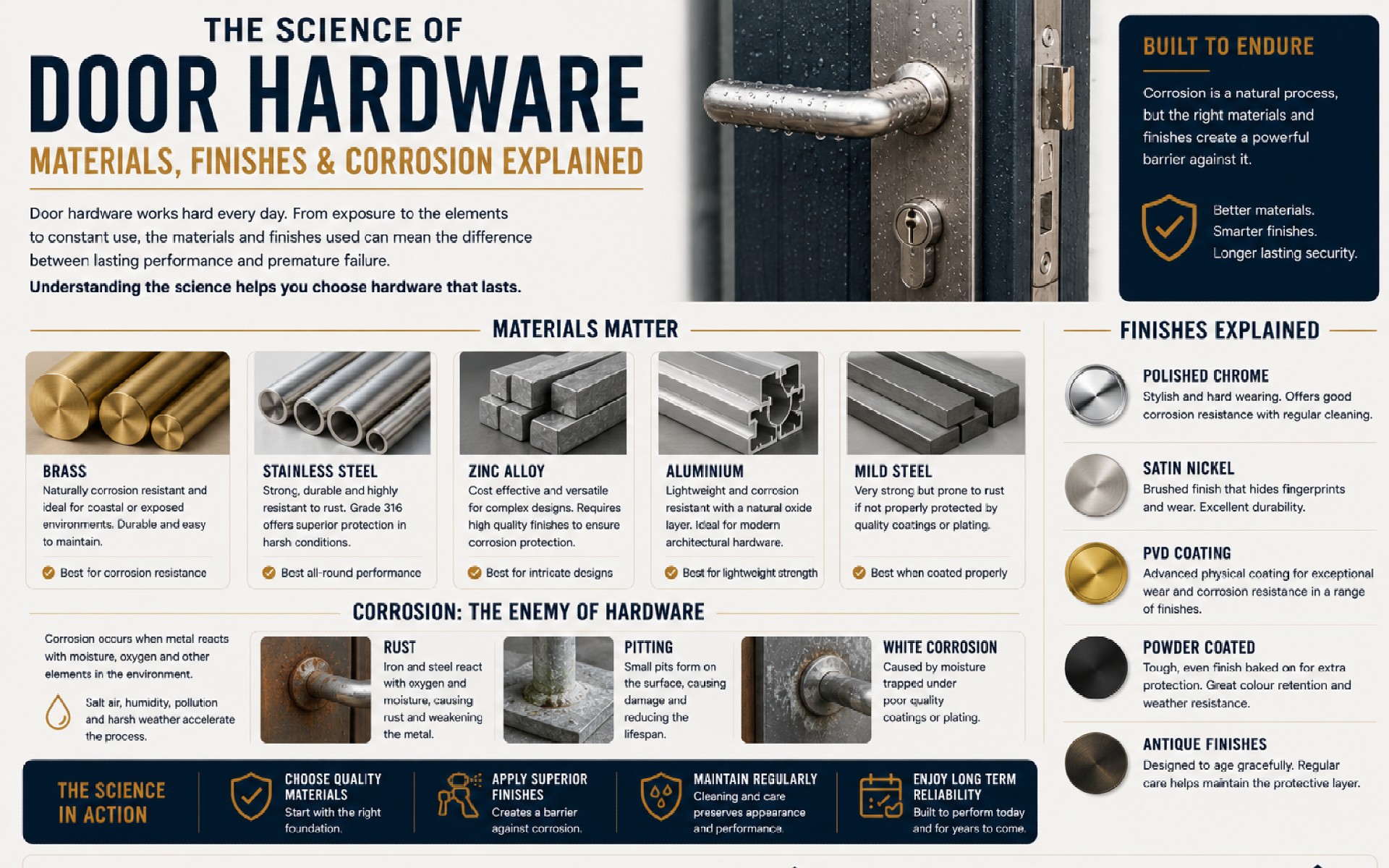
Stainless steel is one of the most durable materials used in external door hardware.
Unlike ordinary steel, stainless steel contains chromium which reacts naturally with oxygen in the air to form a microscopic protective oxide layer.
This invisible layer continually protects the metal beneath from corrosion.
Advantages include:
- Excellent corrosion resistance.
- High mechanical strength.
- Long service life.
- Low maintenance.
- Resistance to staining.
- Attractive appearance.
Stainless steel is widely used for:
- Door handles.
- Pull handles.
- Hinges.
- Fixings.
- Letterplates.
- Door closers.
- Security hardware.
Although highly corrosion resistant, stainless steel still benefits from occasional cleaning, particularly in coastal areas where salt deposits may accumulate.
Understanding Stainless Steel Grades
Not all stainless steel offers the same level of corrosion resistance.
Different grades are designed for different environments.
For many residential applications, standard stainless steel performs exceptionally well.
However, properties located near the coast or exposed to particularly harsh weather may benefit from higher-grade stainless steels specifically designed to resist increased salt exposure.
Choosing the correct grade for the environment can significantly extend the life of external hardware.
Brass – A Traditional Engineering Material
Brass has been used in locks and architectural hardware for well over a century.
Its popularity comes from its unique combination of properties.
Advantages include:
- Excellent corrosion resistance.
- Outstanding machining accuracy.
- Smooth operation.
- Attractive appearance.
- Long service life.
Common applications include:
- Lock cylinders.
- Keys.
- Escutcheons.
- Decorative furniture.
- Precision lock components.
Brass is particularly well suited to components requiring extremely accurate machining, which is why it remains the preferred material for many lock cylinders.
Why Zinc Alloys Are So Widely Used
Many modern door handles and decorative fittings are manufactured from zinc alloys.
This allows manufacturers to produce complex shapes with excellent consistency.
Advantages include:
- Excellent casting properties.
- Good corrosion resistance.
- Lightweight construction.
- Consistent manufacturing quality.
- Compatibility with numerous decorative finishes.
Typical applications include:
- Lever handles.
- Backplates.
- Letterboxes.
- Decorative hardware.
- Some gearbox housings.
The versatility of zinc alloys allows manufacturers to offer a wide variety of styles while maintaining good durability.
Powder-Coated Versus Polished Finishes
The finish applied to door furniture influences far more than its appearance.
Modern finishing systems also protect the underlying material from corrosion and wear.
Powder-Coated Finishes
Powder coating involves applying a dry powder electrostatically before curing it in an oven.
The result is a durable protective coating offering:
- Excellent colour consistency.
- Good impact resistance.
- Resistance to chipping.
- Good weather resistance.
- Low maintenance.
Popular colours include:
- Black.
- White.
- Anthracite Grey.
- Chartwell Green.
- Agate Grey.
Polished and Satin Finishes
Polished finishes rely upon the appearance of the underlying metal.
Common examples include:
- Polished chrome.
- Satin chrome.
- Polished brass.
- Satin nickel.
- Brushed stainless steel.
These finishes provide an attractive appearance but may require more regular cleaning to maintain their original lustre.
Why External Door Hardware Corrodes
Corrosion is a natural chemical process that occurs when metals react with moisture and oxygen.
Several environmental factors accelerate corrosion, including:
- Rain.
- Condensation.
- Air pollution.
- Coastal salt.
- Industrial contaminants.
- Road salt.
- Poor drainage.
- Dirt accumulation.
Protective coatings slow this process considerably, but no external finish is entirely maintenance-free.
Routine cleaning removes deposits that may gradually damage the protective surface.
Understanding Galvanic Corrosion
Galvanic corrosion occurs when two different metals come into electrical contact in the presence of moisture.
One metal becomes more vulnerable and corrodes faster than it normally would.
Examples include:
- Steel fixings in aluminium.
- Aluminium against copper.
- Untreated steel in contact with stainless steel under damp conditions.
Manufacturers minimise this risk by:
- Selecting compatible materials.
- Applying protective coatings.
- Using insulating washers.
- Designing joints that shed water.
- Preventing unnecessary moisture retention.
Correct installation also plays an important role in reducing the likelihood of galvanic corrosion developing.
Coastal Homes Face Greater Challenges
Properties near the sea experience one of the harshest environments for external hardware.
Airborne salt settles on exposed surfaces where it attracts moisture and accelerates corrosion.
This may result in:
- Faster deterioration.
- Surface staining.
- Pitting.
- Reduced lifespan of exposed fixings.
- Increased maintenance requirements.
For coastal locations, corrosion-resistant materials such as marine-grade stainless steel often provide significantly better long-term performance.
Occasionally rinsing exposed hardware with fresh water can also help remove salt deposits before they accumulate.
Why Quality Fixings Matter
Door furniture is only as reliable as the fixings securing it.
Low-quality screws often have:
- Thinner protective coatings.
- Lower-grade steel.
- Reduced corrosion resistance.
Once corrosion begins:
- Screw heads weaken.
- Removal becomes difficult.
- Components may loosen.
- Rust may spread to surrounding fittings.
Quality manufacturers often specify stainless steel or heavily protected fixings to improve long-term reliability.
Surface Finishes Protect More Than Appearance
The finish applied to door hardware performs several important functions.
In addition to providing colour, it helps protect the underlying material from:
- Moisture.
- Ultraviolet light.
- Everyday wear.
- Minor scratches.
- Environmental contaminants.
A high-quality finish also improves:
- Scratch resistance.
- Corrosion resistance.
- Colour stability.
- Ease of cleaning.
- Long-term appearance.
This protective role is often far more important than its decorative effect.
Maintenance Extends Hardware Life
Even premium-quality hardware benefits from routine maintenance.
Simple care includes:
- Washing external hardware with mild soapy water.
- Removing salt deposits where necessary.
- Avoiding abrasive cleaners.
- Inspecting fixings for corrosion.
- Lubricating moving parts where recommended.
- Addressing damaged finishes before corrosion develops.
Small maintenance tasks performed periodically can significantly extend the service life of external hardware.
Choosing the Right Hardware
When selecting replacement door furniture, appearance is only one consideration.
It's also worth considering:
- The material used.
- Corrosion resistance.
- The quality of protective finishes.
- Suitability for the local environment.
- Availability of replacement parts.
- Manufacturer reputation.
- Appropriate guarantees.
Choosing products suited to the property's location often proves more economical over the long term than replacing lower-quality hardware more frequently.
Good Materials Mean Better Long-Term Value
Quality materials generally provide:
- Longer service life.
- Better corrosion resistance.
- Reduced maintenance.
- More reliable operation.
- Improved appearance over time.
Although premium hardware may have a higher initial cost, it often represents better long-term value through improved durability and fewer replacement requirements.
Conclusion
External door hardware operates in one of the most demanding environments around the home, facing continual exposure to weather, changing temperatures and everyday use. The choice of materials—whether stainless steel, brass, zinc alloys or other engineered metals—plays a major role in determining how well door furniture withstands these conditions. Equally important are the protective finishes and corrosion-resistant fixings that help preserve both appearance and performance throughout years of service.
Understanding how different materials behave allows homeowners to make more informed decisions when replacing or upgrading door hardware. By selecting products suited to the property's environment, carrying out simple routine maintenance and choosing well-manufactured components, it is possible to enjoy reliable operation, lasting appearance and excellent long-term value for many years.
Frequently Asked Questions
Why is stainless steel widely used for external door hardware?
Stainless steel offers excellent corrosion resistance, high strength and a long service life, making it particularly suitable for components exposed to the weather.
Is brass better than stainless steel?
Neither is universally better. Brass is ideal for precision-machined components such as lock cylinders, while stainless steel is often preferred for exposed hardware requiring exceptional corrosion resistance.
What causes external door furniture to corrode?
Moisture, oxygen, airborne pollution, coastal salt, road salt and poor drainage all contribute to corrosion. Regular cleaning helps remove contaminants that accelerate this process.
What is galvanic corrosion?
Galvanic corrosion occurs when two different metals are in electrical contact in the presence of moisture, causing one of them to corrode more rapidly. Manufacturers reduce this risk through careful material selection and protective design.
Do powder-coated finishes last longer than polished finishes?
Powder-coated finishes generally offer excellent resistance to weathering, chipping and colour fading. Polished finishes provide a distinctive appearance but may require more regular cleaning to maintain their shine.
Related guides:
- Door security from night latches to multi point.
- Behind the Scenes: How Modern Door Locks and Doors Are Manufactured
- The Engineering Behind Modern Doors.
- The Engineering Behind Modern Doors and Locking Systems