Introduction
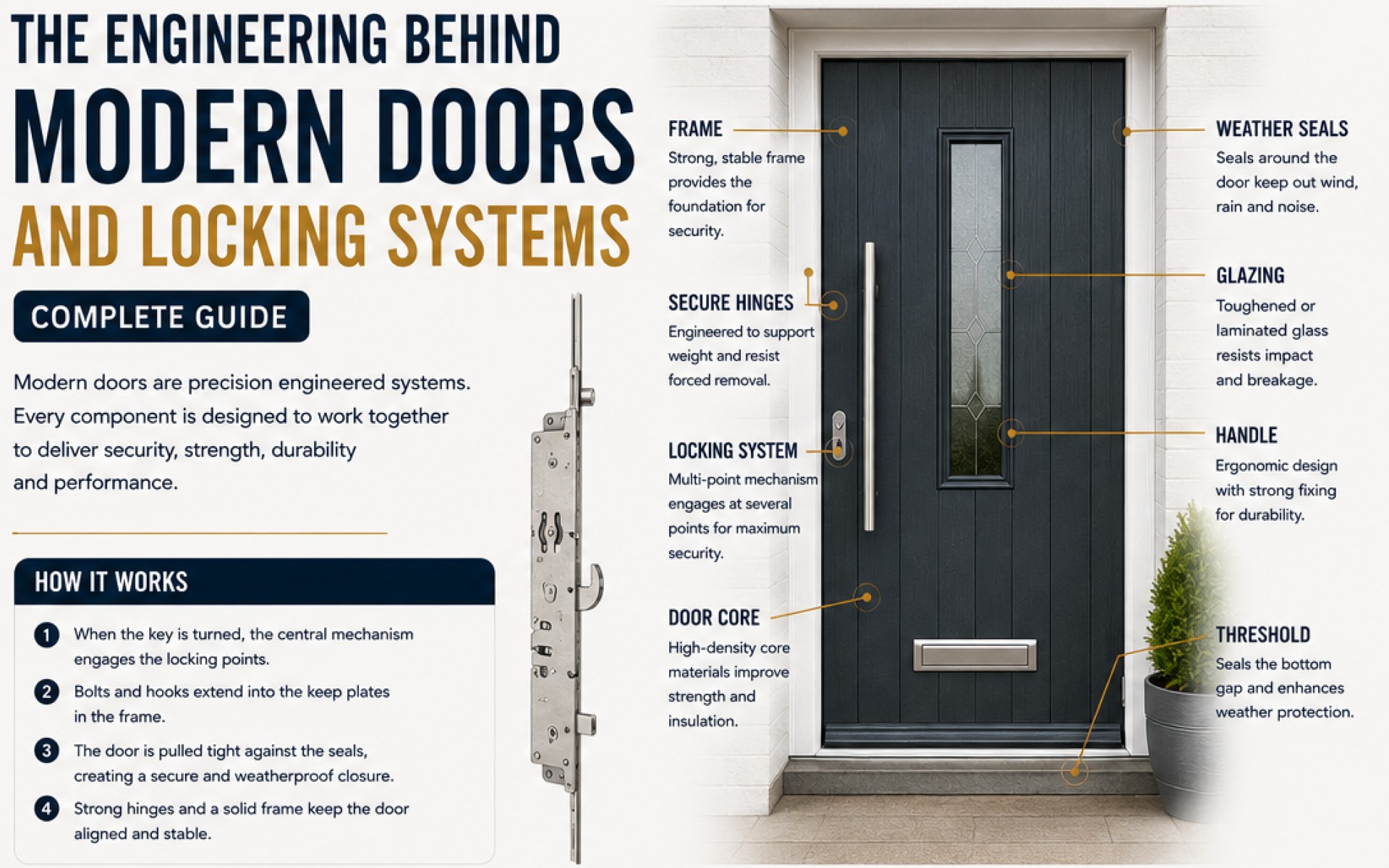
Modern entrance doors appear simple from the outside, but hidden beneath the handles is a precisely engineered mechanical system. Every component—from the hinges and frame to the latch, hooks, rollers, gearbox and lock cylinder—has been designed to operate within extremely small tolerances.
A door that opens effortlessly, locks smoothly and seals tightly does so because its geometry, alignment and hardware are all working together exactly as intended. The relationship between the door and the frame is measured in millimetres, yet those few millimetres determine how efficiently every moving part performs.
Many homeowners assume a stiff handle or difficult key means the lock has failed. In reality, the underlying cause is often a subtle change in the position of the door itself. A slight drop on the hinges, a small amount of seasonal movement or wear within the frame can place the entire locking system under unnecessary strain.
This guide explains the engineering principles behind modern entrance doors and why precision, alignment and correct adjustment are just as important as the quality of the lock itself.
Modern Doors Depend on Precision
Unlike older single-point locks, today's entrance doors contain numerous moving parts that must operate together.
These include:
- Hinges.
- The frame.
- The latch.
- Gearbox.
- Hooks.
- Rollers.
- Deadbolts.
- Euro cylinder.
- Door handles.
- Keeps.
Every one of these components has been manufactured to precise dimensions and is designed to work within carefully controlled tolerances.
When everything remains correctly aligned, the entire system feels effortless.
When even one component moves slightly out of position, resistance begins to build throughout the mechanism.
Why Door Clearances Matter
Door clearance is the narrow gap between the edge of the door and the surrounding frame.
Although these gaps are usually only a few millimetres wide, they are critical to the performance of the entire system.
Correct clearances allow for:
- Smooth opening and closing.
- Proper lock engagement.
- Effective weather sealing.
- Thermal expansion.
- Even compression of the weather seals.
- Prevention of rubbing.
When clearances become uneven, homeowners may notice:
- A handle that becomes harder to lift.
- A stiff key.
- The latch catching.
- The door rubbing the frame.
- Hooks failing to engage fully.
- Increased effort when locking.
A properly adjusted door maintains consistent clearances around its entire perimeter.
Door Weight Constantly Acts on the Hinges
Modern entrance doors are significantly heavier than many people realise.
Typical weights include:
- uPVC door: approximately 30–45kg.
- Composite door: approximately 45–70kg.
- Large glazed composite door: often over 80kg.
This weight is continuously supported by:
- Hinges.
- Frame reinforcement.
- Fixings.
- The surrounding structure.
Over many years, even tiny amounts of hinge wear or movement can allow the locking edge of the door to drop slightly.
Importantly, the lock itself may still be functioning perfectly.
Instead, the relationship between the door and the frame has changed.
The Chain Reaction Inside the Lock
Turning the key initiates a sequence of precisely coordinated mechanical movements.
Depending on the locking system, the key may:
- Rotate the cylinder cam.
- Release or secure the gearbox.
- Extend or retract the deadbolt.
- Lock or unlock the handles.
- Operate internal linkages.
When the handle is lifted, additional movements occur simultaneously.
These may include:
- Hooks rotating into position.
- Rollers engaging the keeps.
- Deadbolts extending.
- Shoot bolts locking.
- Compression rollers tightening against the frame.
Every movement depends upon the previous one occurring correctly.
If one part encounters excessive resistance, strain is transferred throughout the mechanism.
Why Compression Is So Important
When a modern entrance door locks, it does more than simply secure itself.
The locking points gently pull the door against its weather seals.
This controlled pressure is known as compression.
Correct compression:
- Improves weather sealing.
- Reduces draughts.
- Prevents rattling.
- Supports security.
- Keeps the door stable.
Too little compression can allow movement when the door is locked.
Too much compression creates unnecessary friction, making the handle harder to lift while placing additional loads on the gearbox and locking points.
Many modern doors incorporate adjustable rollers that allow this compression to be fine-tuned.
Geometry Determines Performance
One of the most important engineering principles behind any entrance door is geometry.
Geometry describes the relationship between:
- The door.
- The frame.
- The hinges.
- The locking points.
- The keeps.
Every locking point has been designed to meet its keep at a very specific angle and position.
Even if every component remains mechanically sound, poor geometry can prevent the system from operating smoothly.
Differences of only a few millimetres may result in:
- Misaligned hooks.
- Dragging rollers.
- Poor latch engagement.
- Excessive handle force.
- Premature gearbox wear.
- Increased key resistance.
Correct geometry allows every locking point to engage evenly with minimal effort.
The Centre Latch Does More Than Hold the Door Shut
The centre latch is often overlooked because it is smaller than the hooks or deadbolts.
However, it performs one of the most important functions within the entire system.
Every time the door closes, the latch:
- Holds the door shut.
- Positions the door correctly.
- Aligns the locking mechanism.
- Prepares the locking points for engagement.
Unlike hooks and deadbolts, which only operate when locking the door, the latch functions every single time the door is opened or closed.
Its constant use explains why it is often one of the first components to exhibit wear.
The Door Frame Carries the Load
When the locking points engage, considerable forces are transferred into the frame.
A quality door frame distributes these loads through:
- Steel reinforcement.
- Welded or mechanically strong corners.
- Structural fixings.
- The surrounding masonry.
Rather than concentrating stress at one point, the frame spreads it across the entire opening.
The stronger and more rigid the frame, the better the locking system performs.
Small Movements Create Large Problems
Door movement can occur gradually through:
- Building settlement.
- Seasonal expansion and contraction.
- Hinge wear.
- Loose fixings.
- Everyday use.
Although these movements may only measure a few millimetres, they alter the relationship between every moving component.
Instead of working together, the locking points begin working against the frame.
This accelerates wear on:
- Gearboxes.
- Handles.
- Spindles.
- Rollers.
- Hooks.
- Cylinders.
- Springs.
Many apparent lock failures are therefore secondary symptoms rather than the original fault.
Understanding Lock Engagement Depth
Every hook, roller and deadbolt is designed to engage its corresponding keep by a specific distance.
This is known as the engagement depth.
Correct engagement:
- Maximises security.
- Improves load distribution.
- Reduces movement.
- Minimises wear.
- Helps prevent levering.
If the door becomes misaligned, engagement depth may be reduced.
The locking points may still appear to operate, but they are no longer working exactly as the manufacturer intended.
Friction Is the Enemy of Every Lock
Modern locking mechanisms are engineered to operate with minimal resistance.
When friction increases because of:
- Misalignment.
- Excessive compression.
- Worn hinges.
- Poor adjustment.
- Lack of maintenance.
every moving component must work harder.
Over time this increases stress throughout the mechanism and shortens the service life of components that would otherwise continue operating reliably for many years.
Reducing unnecessary friction is therefore one of the simplest ways of extending the life of a multipoint locking system.
Tolerances Are Measured in Fractions of a Millimetre
The word tolerance describes the amount of variation a component can have while still operating correctly.
Modern door hardware is manufactured to extremely fine tolerances.
Although homeowners may only notice movement once it reaches several millimetres, much smaller changes can already be affecting:
- Handle pressure.
- Key operation.
- Latch engagement.
- Compression.
- Gearbox loading.
This is why seemingly minor adjustments can dramatically improve how a door feels.
Every Component Depends on the Others
A modern entrance door is an integrated engineering system.
Each component performs a specific role:
- Hinges support the weight.
- The frame maintains geometry.
- The latch positions the door.
- The gearbox coordinates movement.
- Hooks and deadbolts secure the door.
- Rollers create compression.
- The cylinder controls authorised access.
- Handles transfer operating force.
If one component develops a fault, every other component may be affected.
Replacing the most obvious failed part without correcting the underlying cause can simply transfer the problem elsewhere, resulting in repeated failures and unnecessary expense.
Good Alignment Extends the Life of Every Component
One of the greatest benefits of maintaining correct alignment is that it reduces unnecessary stress throughout the entire system.
A correctly adjusted door allows:
- The latch to engage cleanly.
- Hooks to align accurately.
- Rollers to compress evenly.
- The gearbox to operate with minimal effort.
- The key to turn smoothly.
- The handles to lift naturally.
This not only improves everyday operation but also helps extend the lifespan of virtually every moving component within the door.
Conclusion
Modern entrance doors are precision-engineered systems in which every millimetre matters. Correct clearances, accurate geometry, balanced compression and proper alignment allow the hinges, latch, gearbox, locking points and cylinder to operate together with minimal resistance and maximum efficiency. Even very small changes in the relationship between the door and its frame can increase friction, accelerate wear and create symptoms that are often mistaken for lock failures.
Understanding door security standards and these engineering principles explains why many problems originate with door movement rather than faulty hardware. Regular inspection, timely adjustment and routine maintenance help preserve the precise alignment the system was designed to operate within, allowing the entire door to continue providing smooth operation, reliable security and long service life.
Frequently Asked Questions
Why does my handle become harder to lift over time?
A stiff handle is often caused by changes in door alignment rather than a fault within the handle itself. Small movements in the door or frame can increase resistance throughout the locking mechanism.
What is door compression?
Compression is the gentle pressure created when the locking points pull the door against its weather seals. Correct compression improves weather resistance, stability and security without making the lock difficult to operate.
Why does a small amount of hinge wear affect the lock?
Even minor hinge wear can slightly alter the position of the door. This changes the alignment between the locking points and the keeps, increasing friction and placing additional strain on the gearbox and handles.
What is engagement depth?
Engagement depth is the distance that hooks, rollers or deadbolts enter their corresponding keeps. Correct engagement helps maximise security, reduce movement and distribute loads evenly.
Can a lock fail because of poor alignment?
Yes. Many apparent lock failures are actually symptoms of poor door alignment, excessive compression or hinge movement. Correcting these underlying issues often restores smooth operation without replacing the entire locking mechanism.
Related guides: