Introduction
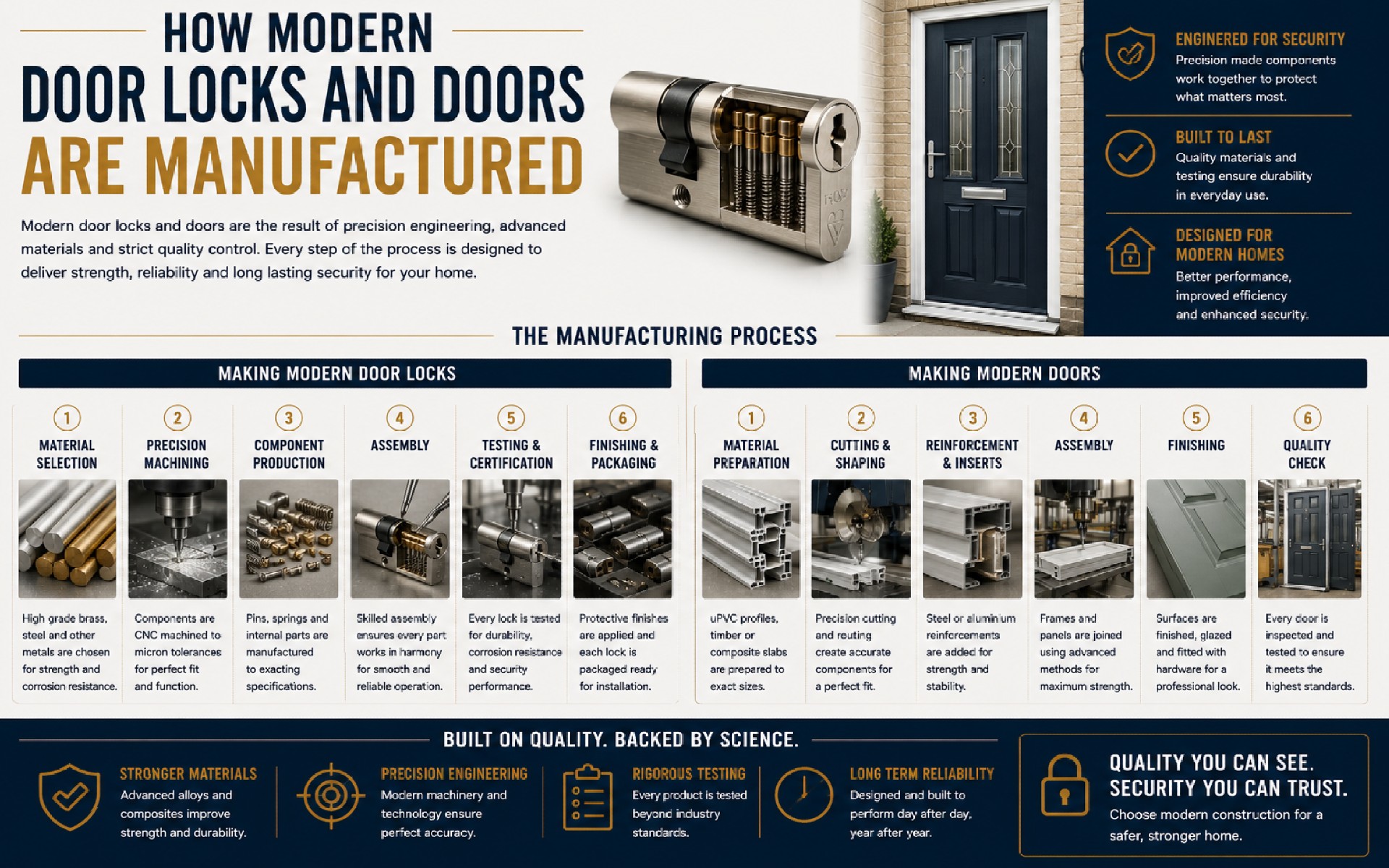
Modern doors and locks may look simple from the outside, but every component has gone through a sophisticated manufacturing process involving precision engineering, specialist materials and rigorous testing.
From the microscopic tolerances inside a euro cylinder to the extrusion of uPVC door profiles, the moulding of composite door skins and the automated testing of multipoint locking mechanisms, today's entrance doors are the result of decades of engineering development.
Every component has been designed to perform a specific function while working alongside dozens of other precisely manufactured parts. A difference measured in fractions of a millimetre can affect how smoothly a lock operates, how securely a door closes and how long the entire system will last.
This guide explains how many of the key components of a modern entrance door are manufactured and why precision matters at every stage of production.
Precision Engineering Is the Foundation of Modern Door Security
Unlike many older locks, modern locking systems rely on numerous interacting components manufactured to extremely fine tolerances.
These include:
- Euro cylinders.
- Gearboxes.
- Multipoint locking mechanisms.
- Door handles.
- Hinges.
- Keeps.
- Lock cylinders.
- Keys.
Every component must fit and operate precisely with the others.
Small manufacturing inaccuracies could lead to:
- Rough operation.
- Premature wear.
- Poor security.
- Difficult locking.
- Reduced reliability.
Modern manufacturing techniques allow these components to be produced consistently on a large scale while maintaining exceptionally high levels of accuracy.
How Euro Cylinders Are Manufactured
The euro cylinder is one of the most precisely engineered parts of the entire door.
Although relatively small, a typical cylinder contains numerous individual components, including:
- Cylinder body.
- Plug (barrel).
- Driver pins.
- Key pins.
- Springs.
- Cam.
- Retaining clips.
- Hardened steel security inserts on high-security models.
The cylinder body is normally manufactured from precision-machined brass.
Brass is chosen because it provides:
- Excellent corrosion resistance.
- Outstanding machining accuracy.
- Smooth operation.
- Long service life.
The internal pin chambers are drilled to exact dimensions before the various pins and springs are assembled.
Every completed cylinder is then tested to ensure:
- The correct key operates smoothly.
- Meets security standards.
- Incorrect keys cannot rotate the plug.
- Internal components move freely.
- The cam functions correctly.
Premium cylinders also incorporate:
- Anti-drill pins.
- Anti-pick pins.
- Anti-bump technology.
- Anti-snap reinforcement.
How Keys Are Manufactured
A modern key is much more than a shaped piece of metal.
Every groove, angle and cutting depth corresponds precisely with the pin positions inside the lock cylinder.
Manufacturers use computer-controlled cutting equipment capable of producing extremely accurate profiles.
During manufacture, keys are inspected for:
- Overall dimensions.
- Groove profile.
- Cutting depth.
- Surface finish.
- Burrs.
- Manufacturing defects.
Even tiny inaccuracies may affect how smoothly the key operates or whether it functions at all.
This precision allows thousands of different key combinations while maintaining reliable operation.
Manufacturing the Multipoint Locking Mechanism
A multipoint locking mechanism consists of numerous moving parts assembled into one complete unit.
Typical components include:
- Gearbox.
- Connecting rods.
- Hooks.
- Deadbolts.
- Rollers.
- Latches.
- Springs.
- Linkages.
- Faceplates.
Each component is manufactured individually before final assembly.
Once assembled, the mechanism is tested to ensure:
- Smooth movement.
- Correct timing of locking points.
- Reliable operation.
- Consistent engagement.
Because several locking points must operate simultaneously, precision throughout the manufacturing process is essential.
Why Multipoint Locks Undergo Cycle Testing
Every time you open or close your front door, the multipoint locking mechanism operates.
Over its lifetime, this may amount to hundreds of thousands of operating cycles.
Manufacturers therefore use automated endurance rigs that repeatedly:
- Lift the handle.
- Retract the latch.
- Extend hooks.
- Retract hooks.
- Operate rollers.
- Lock and unlock the gearbox.
Testing allows engineers to:
- Identify wear patterns.
- Improve designs.
- Compare materials.
- Confirm durability.
- Verify long-term reliability.
Cycle testing provides confidence that the mechanism will continue operating smoothly when correctly installed and maintained.
How Door Hinges Are Manufactured and Tested
Door hinges perform one of the hardest-working roles within any entrance door.
Every opening and closing movement transfers the weight of the door through the hinges.
Heavy composite doors place particularly high loads on these components.
Before reaching the market, many hinges undergo testing that includes:
- Mechanical endurance testing.
- Load testing.
- Wear assessment.
- Corrosion testing.
- Strength evaluation.
Many modern adjustable hinges are designed to allow fine alignment adjustments after installation, helping compensate for natural building movement over time.
How Composite Doors Are Manufactured
Composite doors combine several materials to produce a door that is both strong and thermally efficient.
Although designs vary between manufacturers, construction commonly includes:
- Reinforced outer skins.
- High-density insulating cores.
- Reinforcement where required.
- Internal fixing points.
- Multipoint locking preparation.
The different materials are bonded together under carefully controlled factory conditions to create a rigid door slab.
This engineered construction provides:
- High strength.
- Excellent insulation.
- Good weather resistance.
- Long-term dimensional stability.
How Composite Doors Receive Their Colour
Unlike traditional timber doors that are painted after installation, many composite doors receive their finish during manufacture.
Depending on the manufacturer, colour may be achieved using:
- Pigmented gel coats.
- Through-coloured skins.
- Specialist paint systems.
- UV-resistant coatings.
- Protective clear finishes.
Factory finishing provides:
- Excellent colour consistency.
- Improved durability.
- Better weather resistance.
- Reduced maintenance.
- Resistance to fading.
Applying finishes under controlled factory conditions generally produces a more consistent result than site painting.
How uPVC Door Profiles Are Manufactured
uPVC door profiles begin life as carefully controlled mixtures of:
- PVC resin.
- Stabilisers.
- Pigments.
- Processing aids.
- Performance additives.
The material is heated until it becomes workable before being forced through a precision steel die in a process known as extrusion.
As the newly formed profile leaves the die, it passes through cooling and calibration equipment that maintains its exact dimensions.
Additional features are then incorporated, including:
- Steel reinforcement.
- Drainage chambers.
- Gasket grooves.
- Fixing chambers.
- Thermal barriers.
Finished profiles are cut to length before being assembled into complete door frames.
The accuracy of this extrusion process is one reason modern uPVC doors fit so precisely.
Why Door Manufacturers Use Different Dimensions
Many homeowners assume all multipoint locks are interchangeable.
In reality, manufacturers use their own dimensions to suit different door systems.
Common variations include:
- PZ centres.
- Backset.
- Faceplate width.
- Gearbox dimensions.
- Handle screw centres.
- Locking point positions.
- Keep locations.
These measurements influence:
- Security.
- Appearance.
- Compatibility.
- Structural strength.
- Ease of manufacture.
For this reason, accurate measurements are essential before ordering replacement locks or gearboxes.
Quality Control Throughout Manufacturing
Modern door manufacturers carry out inspections throughout the production process rather than only checking the finished product.
Typical quality control procedures include:
- Dimensional inspection.
- Material verification.
- Surface finish inspection.
- Functional testing.
- Assembly checks.
- Operational testing.
These inspections help ensure every component meets the manufacturer's required specification before leaving the factory.
Manufacturing and Testing Work Together
Manufacturing and testing are closely linked.
Engineers continually use test results to improve:
- Materials.
- Component design.
- Surface finishes.
- Manufacturing techniques.
- Assembly methods.
- Door hardware materials.
As products evolve, manufacturing processes evolve alongside them.
This continual refinement is one reason modern doors are generally more secure, durable and reliable than earlier generations.
Precision Creates Everyday Reliability
The smooth operation homeowners experience every day is the result of countless engineering decisions made long before the door is installed.
Accurate machining, carefully selected materials, controlled manufacturing processes and extensive testing all contribute to:
- Smooth locking.
- Reliable operation.
- Long service life.
- Improved security.
- Better weather performance.
- Reduced maintenance.
Most homeowners never see the engineering hidden inside their door, yet it influences every turn of the key and every lift of the handle.
Conclusion
Modern entrance doors are far more than simple building components. They are precision-engineered systems made up of dozens of individually manufactured parts that must work together with exceptional accuracy. From the machining of euro cylinders and the computer-controlled cutting of keys to the extrusion of uPVC profiles, the moulding of composite doors and the endurance testing of hinges and multipoint locking mechanisms, every stage of manufacturing contributes to the finished product's security, durability and reliability.
While homeowners rarely witness these manufacturing processes, their benefits are experienced every day through smooth operation, dependable locking and long service life. Choosing well-engineered components, ensuring they are correctly installed and maintaining proper door alignment allows this precision engineering to deliver reliable performance for many years.
Frequently Asked Questions
Why are euro cylinders manufactured from brass?
Brass offers excellent corrosion resistance and can be machined to extremely fine tolerances, making it ideal for the precision components inside a lock cylinder. High-security cylinders reinforce vulnerable areas with hardened steel where additional strength is required.
How accurate is modern key cutting?
Modern computer-controlled key-cutting machines produce highly accurate keys with precisely controlled groove profiles and cutting depths, ensuring the pins inside the cylinder align correctly.
Why are multipoint locks tested so extensively?
Manufacturers use automated endurance testing to simulate many years of everyday operation. This helps identify wear, improve designs and verify long-term reliability before products reach the market.
Why aren't all multipoint locks interchangeable?
Different door manufacturers use varying measurements such as PZ centres, backsets, faceplate widths and locking point positions. Accurate identification and measurement are therefore essential when sourcing replacement parts.
Why does manufacturing precision matter?
Modern locks rely on many moving parts working together. Even very small manufacturing inaccuracies can affect security, smooth operation and long-term reliability, which is why precision engineering and quality control are fundamental to modern door systems.