Introduction
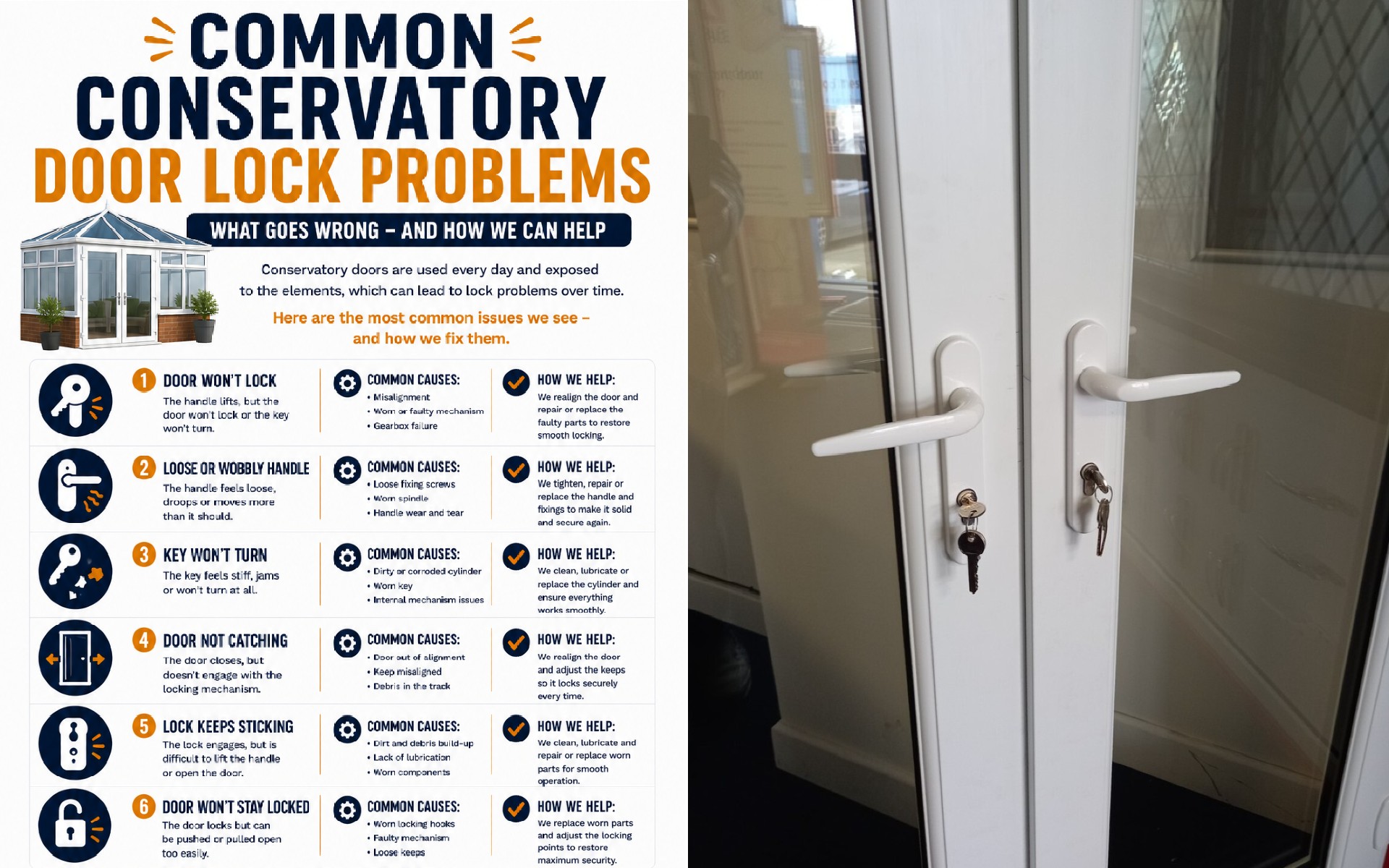
Conservatory doors are exposed to daily use, changing temperatures and the elements throughout the year. Unlike many other external doors, conservatories experience significant fluctuations in temperature, causing the door and frame to expand and contract with the seasons.
Over time, this can lead to wear within the locking mechanism, making the door harder to lock, unlock or operate smoothly.
The good news is that most conservatory door lock problems can be repaired without replacing the entire door.
Difficulty Lifting the Handle
One of the earliest warning signs is a handle that's becoming difficult to lift.
This is commonly caused by:
- A dropped door.
- Poor door alignment.
- A worn gearbox.
- Doors hitting one another.
- Loose handles.
- Stiff locking points.
- Worn hinges.
A correctly adjusted conservatory door should lock smoothly without excessive force.
The Key Is Hard to Turn
If the key becomes stiff or difficult to turn, don't ignore it.
Common causes include:
- A worn lock cylinder.
- Pressure from a misaligned door.
- A failing gearbox.
- Dirt or debris inside the cylinder.
- Poorly cut or worn keys.
Continuing to force the key can result in a snapped key, damaged cylinder or complete lock failure.
The Door Won't Lock Properly
If the handle lifts but the door won't lock, or you have to push or pull the door before the key will turn, the problem is often poor alignment rather than the lock itself.
Look for signs such as:
- The door catching the frame.
- Uneven gaps around the door.
- Scrape marks on the keeps.
- Difficulty engaging the locking points.
- Draughts around the door.
Correcting the alignment often restores smooth operation and significantly reduces strain on the locking mechanism.
Failed Gearbox
The gearbox is the heart of the multipoint locking mechanism.
As it begins to wear, you may notice:
- The handle becoming stiff.
- Failure of the multi point locking mechanism.
- The lock working intermittently.
- The key turning but the locking points not moving.
- The door refusing to lock or unlock properly.
- The handle moving without operating the mechanism.
In many cases, only the gearbox needs replacing.
However, if the damage extends to other parts of the mechanism, replacing the complete multipoint locking mechanism may provide the most reliable long-term repair.
Loose or Drooping Handles
Door handles receive constant daily use and eventually begin to wear.
Typical symptoms include:
- Loose handles.
- Drooping handles.
- Broken return springs.
- Excessive movement.
- Handles that don't return properly.
Replacing worn handles often improves operation, but it's important to ensure a failing gearbox isn't the underlying cause.
Stiff or Seized Locking Points
Hooks, rollers and deadbolts should move freely every time the handle is operated.
Over time they can become:
- Dirty.
- Dry.
- Corroded.
- Stiff.
- Contaminated with debris.
This increases the load placed on the gearbox and makes the entire door more difficult to operate.
Seasonal Movement
Conservatories experience larger temperature changes than most other parts of a property.
This can result in:
- Slight expansion during warm weather.
- Tighter door operation.
- Increased resistance.
- Existing alignment problems becoming more noticeable.
The weather rarely creates the fault itself, but it often highlights issues that were already developing.
Obsolete Lock Mechanisms
Many conservatories were installed 15–25 years ago, and some original locking mechanisms are now obsolete.
This doesn't automatically mean the door needs replacing.
Depending on the mechanism, it may be possible to:
- Replace only the gearbox.
- Install a complete replacement mechanism.
- Source compatible replacement parts.
- Upgrade the locking system.
An experienced locksmith can often repair doors that others recommend replacing.
Door Alignment Is Just as Important as the Lock
Many conservatory lock failures actually begin with a door that's slightly out of alignment.
A dropped door places constant strain on:
- The gearbox.
- The lock cylinder.
- The handles.
- The locking points.
Correcting the alignment not only improves operation but also helps extend the life of the entire locking system.
Don't Force the Lock
If your conservatory door becomes difficult to lock or unlock, avoid forcing the handle or key.
Doing so can damage:
- The gearbox.
- The lock cylinder.
- The handles.
- The locking points.
- The multipoint mechanism.
A simple adjustment or minor repair can quickly become a much more expensive repair if excessive force is used.
Most Conservatory Door Lock Problems Can Be Repaired
One of the biggest misconceptions is that a faulty conservatory door lock means replacing the entire door.
In reality, most problems are caused by:
- Poor door alignment.
- Failed gearboxes.
- Worn lock cylinders.
- Loose or worn handles.
- Seized locking points.
- Worn multipoint mechanisms.
These faults can usually be repaired quickly and cost-effectively without replacing the door itself.
Related article: Common causes of conservatory door failure.
Conclusion
A conservatory door lock should operate smoothly with very little effort. If the handle becomes stiff, the key is difficult to turn or the door starts becoming harder to lock, these are usually early warning signs that something needs attention. Addressing the problem promptly can prevent unnecessary wear, avoid inconvenient lockouts and extend the life of your locking mechanism. In most cases, a professional repair, realignment or replacement of worn components is all that's needed to restore your conservatory door to full working order.