Can Every Multipoint Lock Be Repaired?
Introduction
When a multipoint lock fails, many homeowners assume the gearbox can simply be replaced and everything will be working again.
In many cases, that's exactly what happens.
However, not every fault is confined to the gearbox. Sometimes the damage extends to other parts of the locking mechanism, making a full multipoint mechanism replacement the only reliable long-term solution.
The key is identifying exactly what has failed before ordering parts or carrying out repairs.
When a Gearbox Replacement Is Enough
The gearbox is the heart of a multipoint locking mechanism and is one of the most common components to fail.
If the remainder of the locking strip is in good condition, replacing the gearbox is often the most cost-effective repair.
A gearbox replacement is usually suitable when:
- The locking points still move freely.
- The faceplate is undamaged.
- The hooks and rollers are in good condition.
- The connecting rods remain intact.
- The failure is confined to the gearbox itself.
Replacing only the faulty gearbox retains the original mechanism and is often quicker and more economical than replacing the entire strip.
When the Entire Mechanism Needs Replacing
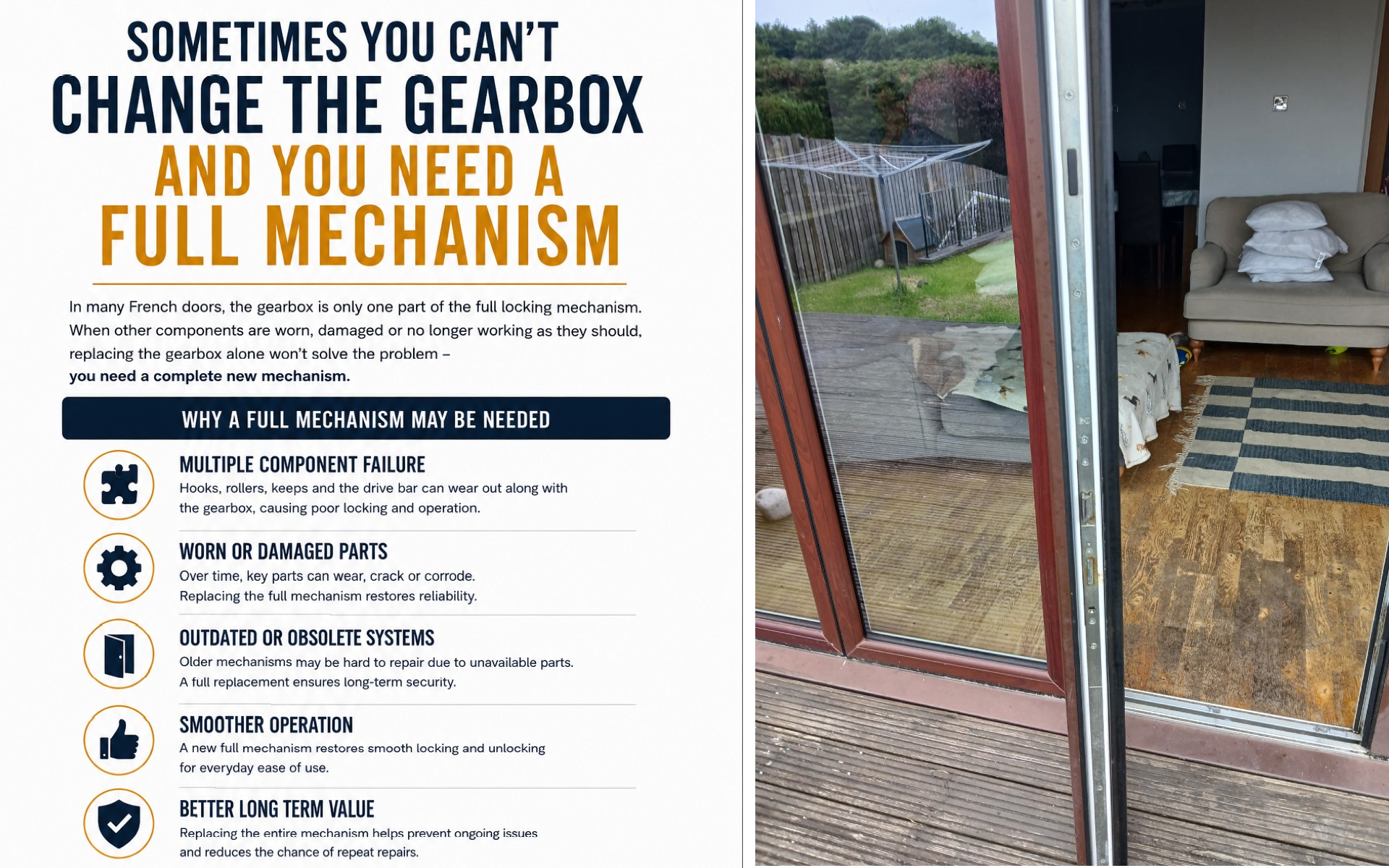
Sometimes the damage extends well beyond the gearbox.
A complete multipoint locking mechanism may be required if:
- Hooks or rollers have failed.
- Internal connecting rods have broken.
- Several locking points have seized.
- The faceplate has become bent or damaged.
- Linkages have worn excessively.
- Multiple components have reached the end of their service life.
Replacing only the gearbox in these situations is unlikely to restore reliable operation and may simply delay further problems.
Wear Doesn't Always Stop at the Gearbox
Multipoint locks contain numerous moving components that work together every time the handle is lifted.
After years of daily use, wear can affect:
- Hooks.
- Rollers.
- Mushroom cams.
- Connecting rods.
- Deadbolts.
- Latches.
- Internal linkages.
If several of these components are worn, replacing the entire mechanism often provides the most reliable long-term repair.
Obsolete Locking Mechanisms
Many older uPVC and composite doors are fitted with locking mechanisms that are no longer manufactured.
Fortunately, this doesn't automatically mean the door needs replacing.
Depending on the mechanism, it may be possible to:
- Source new old stock.
- Fit a compatible replacement mechanism.
- Replace individual components.
- Modify the locking strip using suitable replacement parts.
- Use lower quality universal mechanism kits.
Every door should be assessed individually before deciding on the best solution.
Damage Caused by Continued Use
It's very common to find that a door has been difficult to lock for weeks or even months before the mechanism finally fails.
Continuing to force a stiff door places excessive strain on:
- The gearbox.
- Connecting rods.
- Locking points.
- Hooks.
- Rollers.
- Internal springs.
A repair that could originally have involved only a gearbox replacement may eventually require an entirely new mechanism because the problem was left too long.
Door Alignment Is Part of the Repair
Replacing any locking component without checking the alignment is only addressing half of the problem.
If the door has dropped or moved out of position, the new parts will immediately be placed under the same strain that damaged the originals.
Whenever a gearbox or mechanism is replaced, it's important to check:
- Door alignment.
- Hinge condition.
- Keep positions.
- Locking point engagement.
- Overall door operation.
Correcting the underlying cause helps prevent repeat failures.
Quality Replacement Parts Matter
Not all replacement mechanisms offer the same level of quality.
Whenever possible, using high-quality or manufacturer-specific parts provides:
- Smoother operation.
- Better durability.
- Improved reliability.
- Longer service life.
- Better compatibility with the original door.
Cheap universal replacements may fit but often don't operate as smoothly as the original mechanism.
Does a New Mechanism Mean a New Door?
Absolutely not.
One of the biggest misconceptions is that replacing a full multipoint locking mechanism means the door itself has reached the end of its life.
In reality, replacing the locking strip is often far less expensive than replacing:
- The door.
- The frame.
- Handles.
- Glazing.
- External finishing.
Provided the door and frame remain structurally sound, fitting a new mechanism can restore many more years of reliable service.
The Importance of Correct Diagnosis
Many locking systems are replaced unnecessarily because the fault hasn't been properly identified.
An experienced locksmith will determine whether the problem is caused by:
- A failed gearbox.
- Worn locking points.
- Broken linkages.
- Door misalignment.
- A faulty lock cylinder.
- Damaged handles.
- A worn multipoint mechanism.
Replacing only the components that genuinely require attention usually provides the best value and the most reliable repair.
Conclusion
Not every failed multipoint lock requires a complete new mechanism, and not every fault can be solved by replacing the gearbox alone. The correct repair depends entirely on the condition of the locking system as a whole.
A thorough diagnosis ensures the right components are replaced, unnecessary costs are avoided and the underlying cause of the failure is corrected. Whether that involves a simple gearbox replacement or fitting a complete multipoint mechanism, the goal is always the same—restoring smooth, reliable operation without replacing the entire door.
Related guides: