Introduction
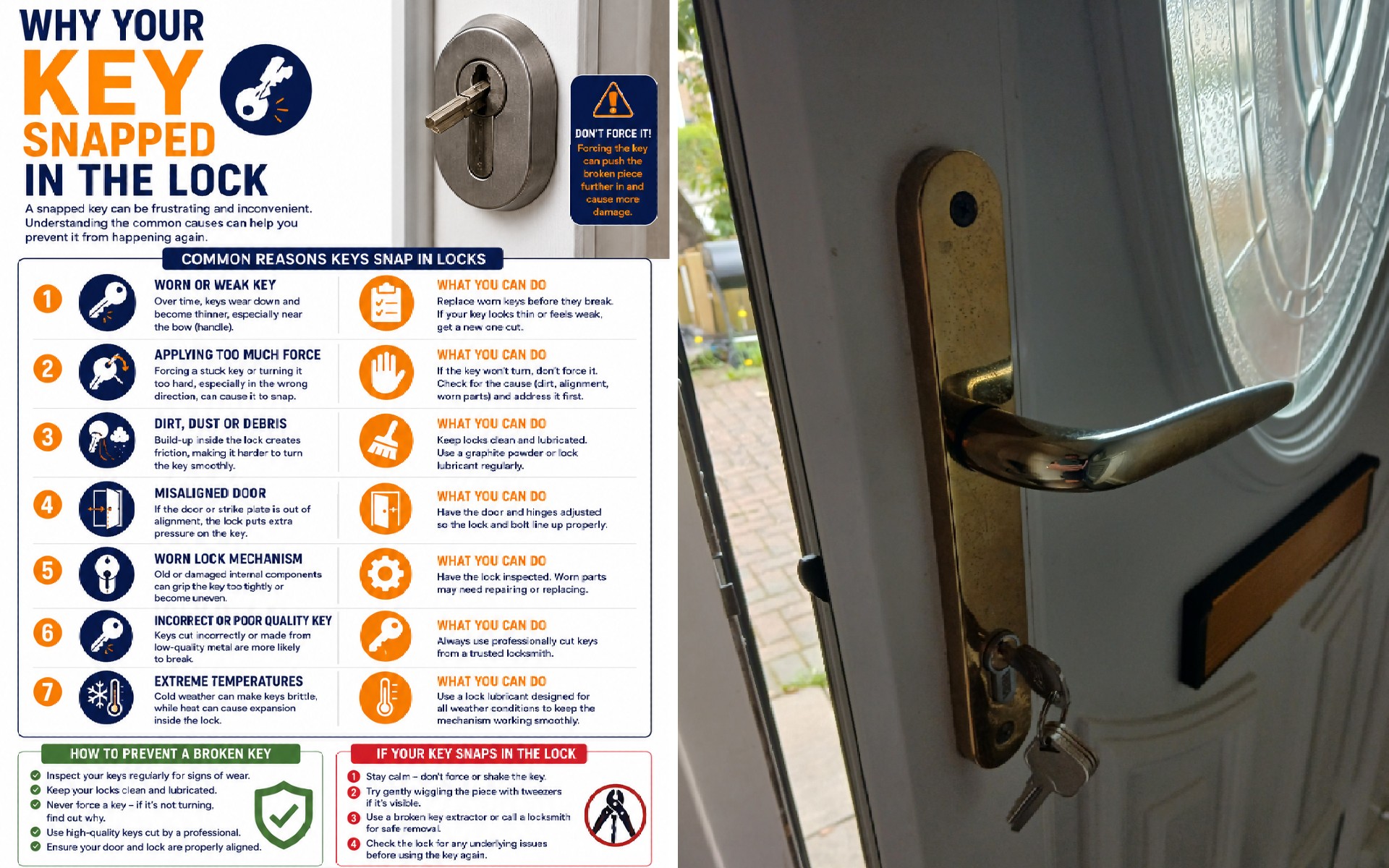
Few things are more frustrating than putting your key into the lock and suddenly finding half of it stuck inside. While it can seem as though the key has broken without warning, that's rarely the case. In most situations, a snapped key is a symptom of an underlying problem that has been developing over weeks or even months.
Whether you have a uPVC, composite or timber door, a key should turn smoothly with very little effort. If you're regularly forcing the key or noticing increasing resistance, it's important to identify the cause before the key eventually breaks. Addressing the problem early can prevent lockouts, avoid damage to the lock and save the cost of more extensive repairs.
The Lock Was Becoming Stiff
The most common reason a key snaps is excessive force.
If your lock has gradually become harder to turn, you may find yourself applying a little more pressure every time you use it. Eventually, the key becomes the weakest part of the locking system and gives way.
Common warning signs include:
- The key becoming difficult to turn.
- The lock feeling rough.
- Having to wiggle the key.
- The key sticking in the cylinder.
- Having to push or pull the door while locking it.
A stiff lock should always be investigated rather than forced.
The Door Is Out of Alignment
Many snapped keys are actually caused by a dropped or poorly aligned door.
When the hooks, rollers and deadbolts no longer line up correctly with the keeps on the frame, extra pressure is transferred through the lock cylinder and into the key.
Common signs include:
- The door catching the frame.
- Difficulty lifting the handle.
- The key becoming harder to turn.
- The need to push or pull the door to lock it.
- Draughts around the door.
Correcting the door alignment removes unnecessary strain from the entire locking system.
Worn Keys
Keys naturally wear with years of daily use.
Over time they can become:
- Thin.
- Slightly bent.
- Worn around the cuts.
- Cracked through metal fatigue.
An older key is far more likely to snap when additional force is applied.
If your main key is badly worn, replacing it before it fails is often a wise investment.
Poorly Cut Key Copies
Not every key copy is cut accurately.
A poorly cut key may still operate the lock but can place additional pressure on the internal pins and springs every time it's used.
This increases friction and makes the lock progressively harder to operate.
The problem is often made worse when:
- A copy is made from another copy.
- The original key is badly worn.
- The key-cutting equipment is poorly calibrated.
Using the original manufacturer's key whenever possible usually produces the most accurate copy.
A Worn Lock Cylinder
The lock cylinder itself may be reaching the end of its service life.
Common problems include:
- Worn pins.
- Weak springs.
- Internal scoring.
- Dirt build-up.
- Corrosion.
- General wear.
These faults increase resistance when the key turns, placing extra stress on both the key and the locking mechanism.
Replacing a worn cylinder early can often prevent a snapped key.
The Gearbox Is Under Strain
On uPVC and composite doors, the gearbox is another common contributor.
If the gearbox begins to wear or the multipoint mechanism becomes stiff, additional resistance is transferred to the key every time the lock is operated.
Warning signs include:
- Heavy handle operation.
- Inconsistent locking.
- Stiff locking points.
- Rough operation.
Ignoring these symptoms often leads to both gearbox failure and snapped keys.
Cold Weather
Cold weather can make an existing problem more noticeable.
Lower temperatures may cause:
- Slight contraction of metal components.
- Moisture inside the lock.
- Increased resistance.
Although cold weather rarely causes a key to snap by itself, it often highlights an underlying fault that already exists.
The Key Was Already Damaged
Sometimes the key has developed a crack that isn't immediately visible.
Years of twisting force can weaken the metal until it eventually fails.
Small cracks commonly develop:
- Near the shoulder.
- Around the narrowest sections.
- At previous bending points.
The final break often appears to happen suddenly, even though the damage has been developing for some time.
What Should You Do If Your Key Snaps?
If your key breaks inside the lock:
- Don't push the remaining piece further into the cylinder.
- Avoid forcing the lock.
- If part of the key is visible, don't pull aggressively with unsuitable tools.
- Specialist key extraction tools can often remove the broken section without damaging the lock.
- Once removed, identify why the key snapped before simply cutting another one.
Replacing the key alone may not solve the underlying fault.
Preventing Future Key Breakages
You can greatly reduce the likelihood of another snapped key by:
- Addressing stiff locks early.
- Keeping the door correctly aligned.
- Replacing worn keys.
- Using accurately cut key copies.
- Lubricating the locking mechanism where appropriate.
- Replacing worn cylinders before they fail.
- Never forcing the key when resistance is felt.
Routine maintenance often prevents emergency lockouts.
The Key Is Often the Victim
Many people blame the key when it breaks.
In reality, the snapped key is often the final symptom of another fault, such as:
- A dropped door.
- Poor alignment.
- A worn lock cylinder.
- A failing gearbox.
- Seized locking points.
- Poorly cut keys.
- Lack of maintenance.
Identifying and repairing the underlying cause helps prevent the same problem from happening again.
Conclusion
A snapped key is rarely just bad luck. More often, it's the result of a lock, door or locking mechanism that has been under increasing strain for some time. Whether the cause is poor door alignment, a worn cylinder, a failing gearbox, an ageing key or an inaccurate key copy, forcing the lock will usually make matters worse. By recognising the warning signs early and dealing with stiff locks before they fail, you can avoid inconvenient lockouts, extend the life of your locking system and save yourself the cost of more extensive repairs. A key should never have to fight against the lock—if it does, it's time to find out why.