Introduction
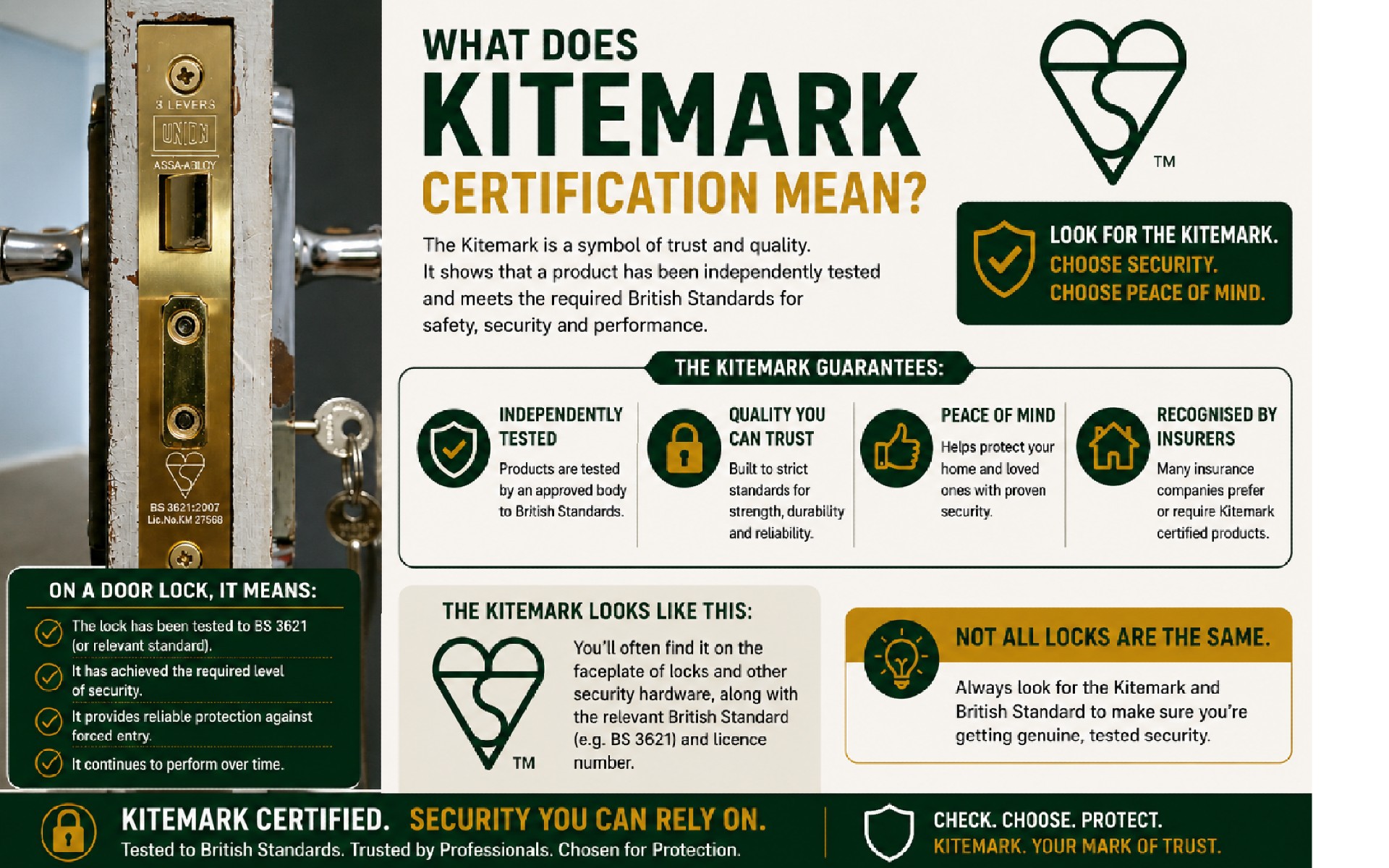
If you've been looking at new door locks, euro cylinders or security products, you've probably noticed the BSI Kitemark displayed on the packaging or stamped onto the product itself.
But what does it actually mean?
Many homeowners assume it's simply a manufacturer's logo or a marketing symbol. In reality, it represents something much more important. The BSI Kitemark shows that a product has been independently tested against recognised British or European standards and that the manufacturer is subject to ongoing assessment to ensure consistent quality.
While no certification can guarantee complete security on its own, choosing Kitemark-certified products gives homeowners greater confidence that the hardware has been independently verified rather than relying solely on a manufacturer's claims.
Understanding what the BSI Kitemark represents can help you make more informed decisions when repairing, replacing or upgrading your home's security.
What Is the BSI Kitemark?
The BSI Kitemark is one of the UK's longest-established and most widely recognised product certification marks.
It is awarded by the British Standards Institution (BSI) to products that have successfully met specific British or European standards through independent testing and ongoing assessment.
Unlike a manufacturer simply describing a product as "high quality" or "high security", the Kitemark provides independent evidence that the product has met recognised performance requirements.
For many homeowners, it offers reassurance that the product has been tested beyond the manufacturer's own claims.
What Does the Kitemark Tell You?
When a product carries the BSI Kitemark, it indicates that it has been assessed against an appropriate recognised standard.
Depending on the type of product, testing may include areas such as:
- Performance.
- Durability.
- Strength.
- Security.
- Reliability.
- Safety.
- Manufacturing consistency.
Certification is not simply a one-off laboratory test.
Manufacturers must continue to meet the required quality standards to retain certification, with ongoing surveillance helping to ensure products remain consistent over time.
Why Independent Testing Matters
Choosing security products can be confusing.
Many products are marketed using terms such as:
- High security.
- Premium quality.
- Heavy duty.
- Professional grade.
These descriptions are often marketing terms and may not indicate that the product has been independently assessed.
Independent certification provides additional confidence because the product has been evaluated against recognised standards rather than relying solely on advertising claims.
Which Door Products Can Carry a BSI Kitemark?
A wide variety of door security products can carry Kitemark certification, including:
- Euro cylinders.
- BS3621 Mortice locks.
- Multipoint locking mechanisms.
- Door handles.
- Hinges.
- Security hardware.
- Door closers.
- Complete door sets.
- Other architectural ironmongery.
The exact testing requirements depend on the type of product and the relevant standard.
Does Every Kitemark Mean the Same Thing?
No.
The BSI Kitemark is a certification mark, but the standard behind it varies according to the product.
For example, different standards exist for:
- Lock cylinders.
- Mortice locks.
- Fire door hardware.
- Hinges.
- Complete door assemblies.
The Kitemark confirms that the product has met the requirements of the relevant standard—it does not mean every certified product has been tested in exactly the same way.
Is the BSI Kitemark the Same as Insurance Approval?
Not necessarily.
A BSI Kitemark confirms that a product has met a recognised testing standard.
Insurance companies, however, may specify particular standards depending on:
- The type of property.
- The type of door.
- The location of the lock.
- Policy conditions.
For example:
- A timber entrance door may require a lock complying with BS 3621.
- Modern euro cylinders may also carry TS007 certification for resistance to lock snapping.
- Complete door assemblies may be tested to PAS 24.
Many products carry more than one recognised certification because they satisfy different requirements.
The Kitemark Applies to the Product That Was Tested
One important point that's often misunderstood is that the Kitemark applies only to the product that has been certified.
For example:
- A Kitemark-certified euro cylinder does not automatically certify the entire door.
- A Kitemark lock does not guarantee correct installation.
- A certified handle cannot compensate for poor door alignment.
- A certified locking mechanism still depends on the rest of the door functioning correctly.
Every component of the door contributes to its overall security.
A Good Lock Still Needs a Good Door
Even the highest-quality Kitemark-certified lock cannot perform properly if other parts of the door have developed faults.
Examples include:
- A dropped door.
- Poor door alignment.
- A worn gearbox.
- Loose handles.
- Damaged hinges.
- Locking points failing to engage correctly.
A secure door depends on the entire locking system working together.
Correct installation, regular maintenance and early repairs are just as important as choosing quality hardware.
Why Certification Matters When Upgrading Your Home Security
If you're replacing worn components or improving your home's security, choosing independently certified products provides several advantages.
These include:
- Independent verification.
- Proven performance.
- Consistent manufacturing quality.
- Greater durability.
- Recognised testing standards.
- Confidence when comparing replacement parts.
Certification shouldn't be the only factor influencing your choice, but it provides valuable reassurance that the product has been assessed against recognised requirements.
Should You Replace Non-Certified Locks?
Not necessarily.
If your existing lock:
- Operates smoothly.
- Provides the level of security you require.
- Is appropriate for your property.
- Remains in good condition.
there may be no immediate need to replace it.
However, if you're replacing worn components or carrying out a security upgrade, selecting independently certified replacement parts is generally a sensible long-term investment.
Certification Is Only One Part of a Secure Door
A certified lock is only one element of an effective security system.
The most secure doors combine:
- Independently tested locking components.
- Correct door alignment.
- A properly functioning multipoint locking mechanism.
- High-quality door handles.
- Secure hinges.
- Professional installation.
- Regular maintenance.
Each of these contributes to the overall security of the entrance.
Even the highest-quality certified product cannot compensate for poor installation or a door that's no longer operating correctly.
Conclusion
The BSI Kitemark is far more than a familiar logo on the side of a lock or cylinder. It represents independent testing, recognised standards and ongoing quality assessment, giving homeowners greater confidence that the product has been manufactured and tested to consistent performance requirements.
However, certification should always be viewed as part of the bigger picture. A secure home depends not only on quality hardware but also on correct installation, proper door alignment, a well-maintained locking mechanism and regular maintenance. When all of these elements work together, they provide a far higher level of protection than any single certified product could achieve on its own.
Choosing Kitemark-certified components when replacing or upgrading your door is a sensible investment—but ensuring the entire door operates correctly is what ultimately delivers lasting security.
Frequently Asked Questions
What is the BSI Kitemark?
The BSI Kitemark is an independent certification mark awarded by the British Standards Institution to products that meet recognised British or European standards through testing and ongoing quality assessment.
Does the BSI Kitemark mean a product is secure?
It indicates that the product has successfully met the requirements of a recognised testing standard. However, overall security also depends on correct installation, maintenance and the condition of the entire door.
Is a BSI Kitemark the same as TS007 or BS 3621?
No. The Kitemark is the certification mark, while TS007, BS 3621 and other standards specify the testing requirements that different products are assessed against.
Should I only buy Kitemark-certified locks?
Certification is a useful indication of independently verified quality and performance. When replacing locks or upgrading your home's security, choosing certified products is generally a sensible option.
Does a Kitemark-certified lock make my whole door secure?
No. The lock is only one component. Door alignment, hinges, handles, the locking mechanism and correct installation all contribute to the overall security of the door.
Related guides: