French Doors That Wouldn't Lock Properly
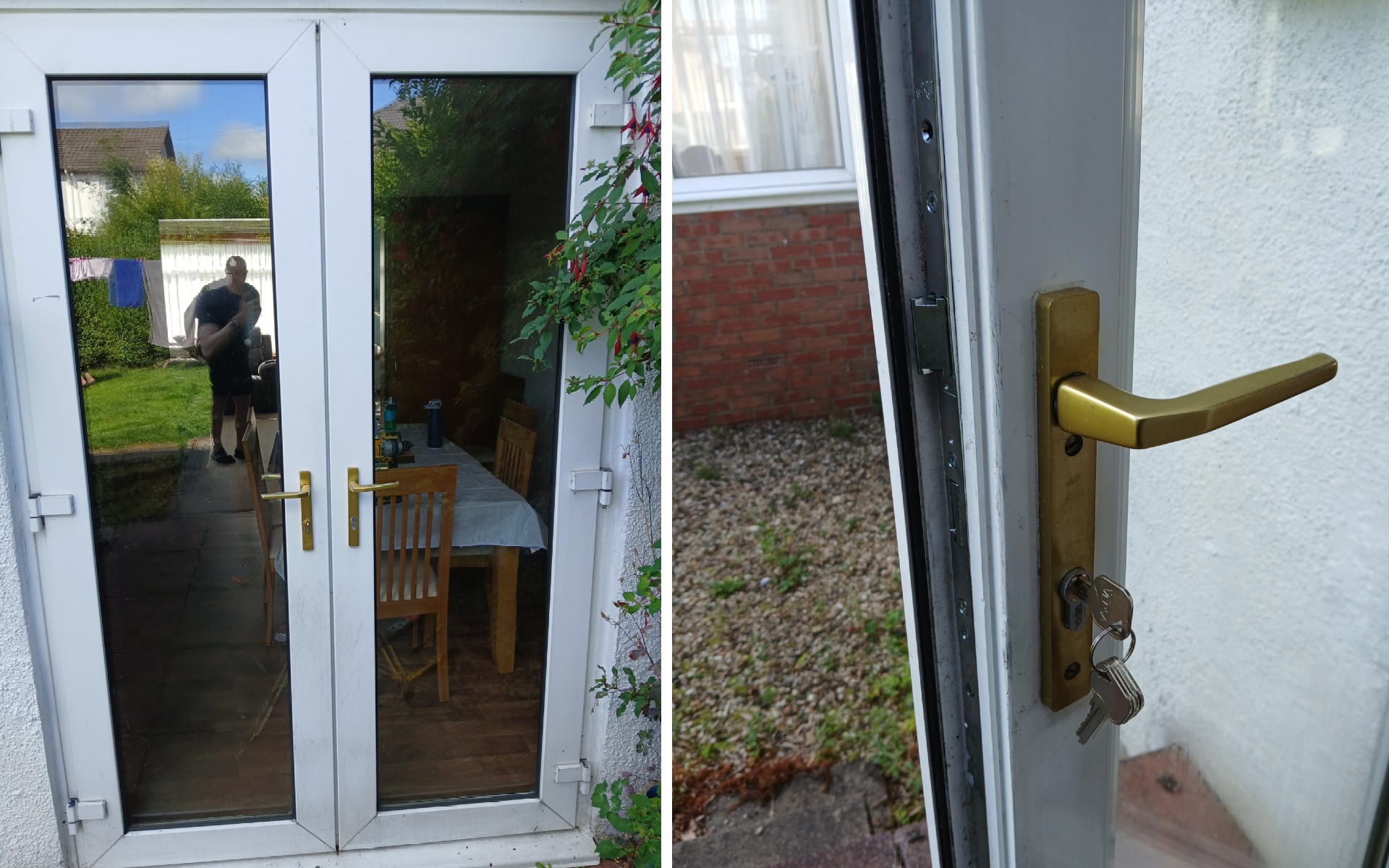
I was recently called to a property in Renfrew where the customer was having problems locking their French doors.
The doors had gradually moved out of alignment and were now catching each other at both the top and the bottom. Every time the handle was lifted, the multipoint locking mechanism ground against the frame instead of engaging smoothly.
The doors could still be locked, but only with considerable effort.
Left like this, the extra strain would eventually have damaged the locking mechanism, leading to a much more expensive repair.
Diagnosing the Problem
French doors rely on both leaves working together correctly.
If either door drops even a few millimetres, it affects:
- The gap between the doors.
- The way the key operates, causes the key to snap.
- The position of the locking points.
- The keeps in the frame.
- How smoothly the handles operate.
On this pair of doors there were six adjustable hinges in total, shared between the active and passive doors.
The first priority was restoring the correct alignment before touching the locking mechanism.
Realigning Both Doors
The aim was to achieve two things:
- An even gap running down the centre where the two doors met.
- A consistent clearance of around 3–4mm between the locking points and their corresponding keeps.
Achieving these clearances allows the locking mechanism to move freely instead of rubbing against the frame.
Using my 18 years of experience repairing uPVC and composite doors, I adjusted four of the six hinges, checking the doors after each adjustment rather than trying to do everything at once.
Small adjustments often make a big difference.
After several fine adjustments, the passive door opened and closed freely without catching, and both doors now sat evenly within the frame.
Fine-Tuning the Locking Mechanism
With the doors correctly aligned, I turned my attention to the active door.
I lifted the handle several times, watching how each locking point entered its keep.
Rather than forcing the mechanism to work against the frame, I adjusted the keeps so they worked with the locking points, allowing them to engage naturally.
This significantly reduced the effort needed to lift the handle while ensuring the door pulled tightly against the weather seals.
It's a simple adjustment, but one that can dramatically improve how a door feels to operate.
Back to Smooth Operation
After making the final adjustments, I tested the doors repeatedly.
The passive door opened and closed without rubbing.
The active door locked smoothly.
The handle lifted easily.
The locking points engaged cleanly.
Most importantly, the grinding that had been putting unnecessary strain on the mechanism had completely disappeared.
The entire repair took around 30 minutes, but that's where experience counts. Knowing what to adjust, in what order and by how much allows problems like this to be resolved efficiently without replacing parts that aren't actually faulty.
Another Happy Customer
Once I was satisfied everything was operating correctly, I invited the customer to try the doors herself.
The improvement was immediate. The doors opened and closed effortlessly, the handle lifted smoothly and the locking mechanism worked exactly as it should.
By correcting the alignment before damage occurred, the customer avoided the cost of replacing a perfectly good multipoint locking mechanism and was left with French doors that once again operated as they were designed to.
French Doors Becoming Difficult to Lock?
If your French doors are rubbing, difficult to lock or require excessive force to lift the handle, don't ignore the early warning signs. Problems like these are often caused by dropped doors or poor alignment rather than a faulty lock. Correcting the alignment early can prevent unnecessary wear on the multipoint locking mechanism, improve security and save the cost of replacing parts that haven't actually failed.