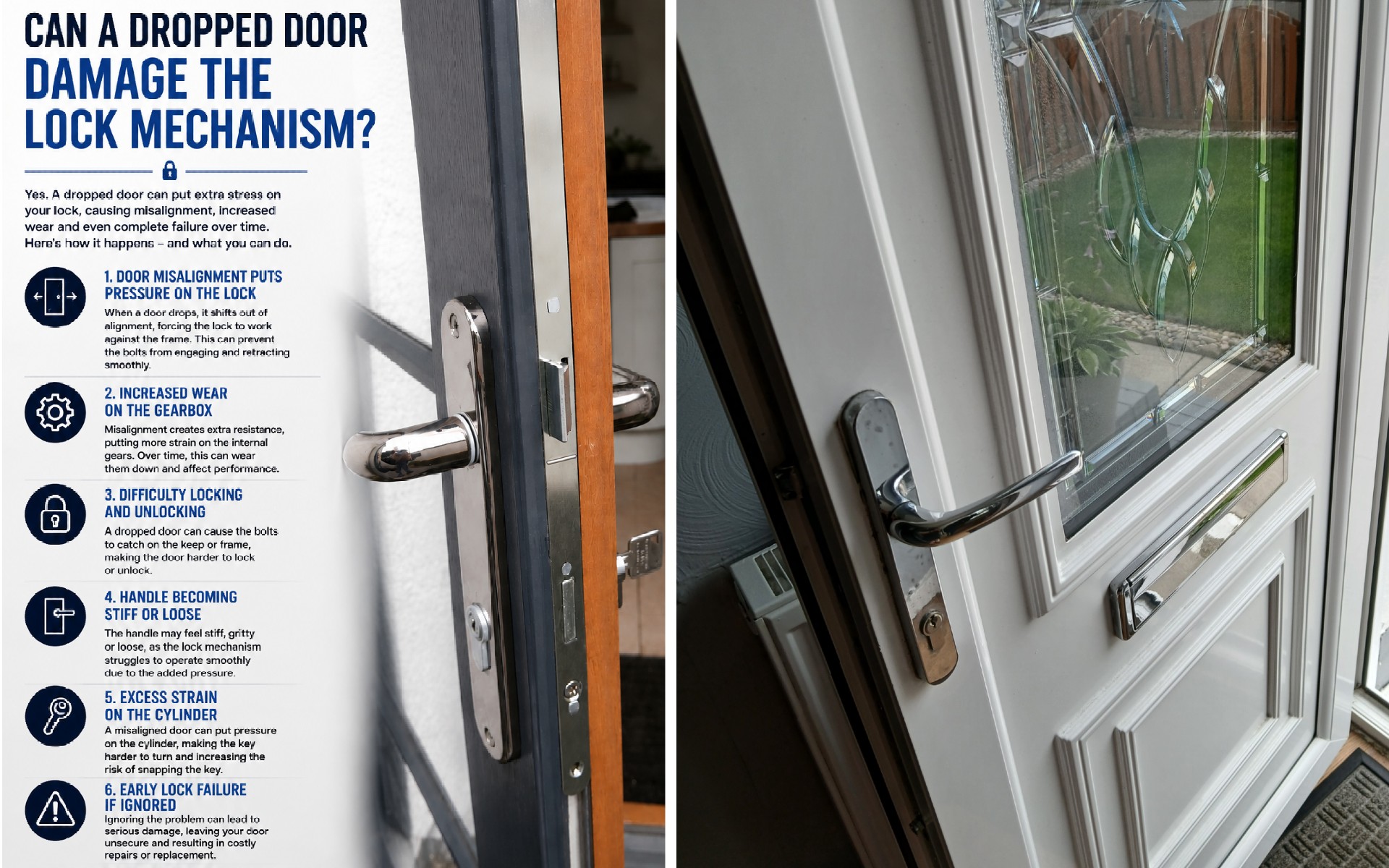
Yes, absolutely. In fact, a dropped door is one of the leading causes of gearbox and multipoint locking mechanism failures.
Many homeowners assume the lock has simply worn out when their door becomes difficult to lock. In reality, the locking mechanism is often the victim rather than the cause. A door that's out of alignment places constant strain on the lock every time it's opened, closed or locked.
The longer the problem is left, the greater the chance of expensive repairs.
How Does a Door Drop?
uPVC and composite doors are surprisingly heavy, and years of daily use can cause them to move slightly on their hinges.
This can happen because of:
- Everyday use.
- Worn hinges.
- Building movement.
- Seasonal expansion and contraction.
- Previous incorrect adjustments.
Even a movement of just a few millimetres can affect how the locking mechanism operates.
The Locking Points No Longer Line Up
When the door drops, the hooks, rollers, mushrooms and deadbolts no longer align correctly with the keeps on the frame.
Instead of sliding smoothly into place, they begin to rub and catch.
As a result, you may notice:
- The handle becoming harder to lift.
- The key becoming stiff.
- The door catching the frame.
- Having to push or pull the door to lock it.
The lock is still trying to do its job, but it's working against unnecessary resistance.
The Gearbox Takes the Greatest Strain
The gearbox is the heart of the multipoint locking mechanism.
Every time you lift the handle, the gearbox has to move every locking point into position. If the door is misaligned, it has to overcome extra resistance every single time.
Over months or years, this can lead to:
- Premature wear.
- Broken springs.
- Internal component failure.
- A stiff or rough mechanism.
- Complete gearbox failure.
Many failed gearboxes have simply been operating under excessive strain caused by poor door alignment. Can a Faulty Gearbox Be Repaired? explains when replacing the gearbox is all that's required.
Handles Can Wear Out Too
A stiff door doesn't only affect the gearbox.
The additional force needed to operate the lock is transferred through the handles, which can eventually develop problems such as:
- Broken return springs.
- Loose fixings.
- Cracked backplates.
- Worn spindle connections.
If your handles are becoming loose or no longer spring back properly, they may be suffering because the locking mechanism has been under strain.
The Lock Cylinder Can Also Be Damaged
When you have to force the key to lock or unlock the door, extra pressure is placed on the euro cylinder.
Over time this may cause:
- Stiff key operation.
- Worn internal pins.
- Difficulty removing the key.
- Premature cylinder failure.
- Snapped keys.
Often the cylinder isn't faulty—it's simply reacting to the pressure created by a dropped door.
Warning Signs Your Door Has Dropped
A door that needs adjusting will usually give plenty of warning before the lock fails completely.
Common signs include:
- Difficulty lifting the handle.
- The key becoming stiff.
- The door catching the frame.
- Scrape marks around the frame.
- Draughts appearing around the door.
- Having to push or pull the door while locking it.
- The lock working smoothly with the door open but becoming stiff once it's closed.
If you're experiencing these symptoms, Easier to Lock with the Door Open explains why this is one of the clearest indicators of an alignment problem.
Why Replacing the Lock Doesn't Always Solve the Problem
It's common for homeowners to replace a failed gearbox or lock cylinder without addressing the reason it failed.
If the door remains out of alignment, the replacement parts will continue working under exactly the same conditions as the originals.
That's why a professional repair should always include checking:
- Door alignment.
- Hinge condition.
- Keep positions.
- Locking point operation.
Correcting the underlying problem helps ensure the repair lasts.
A Simple Adjustment Can Prevent Expensive Repairs
In many cases, realigning the door can:
- Restore smooth locking.
- Reduce strain on the gearbox.
- Improve security.
- Eliminate draughts.
- Extend the life of the locking mechanism.
A straightforward adjustment is often far less expensive than replacing a gearbox or complete multipoint lock.
Fix the Door Before the Lock Fails
A dropped door rarely improves on its own. If your handle is becoming harder to lift or your key no longer turns as smoothly as it once did, the locking mechanism is often telling you that the door needs attention. Correcting the alignment early removes unnecessary strain from the gearbox, lock cylinder and handles, helping to prevent avoidable failures and extending the life of the entire locking system. For related advice, see Why Door Alignment Matters, Door Dropped? Signs Your Hinges Need Adjustment, and uPVC Door Realignment and Lock Adjustment.