Introduction
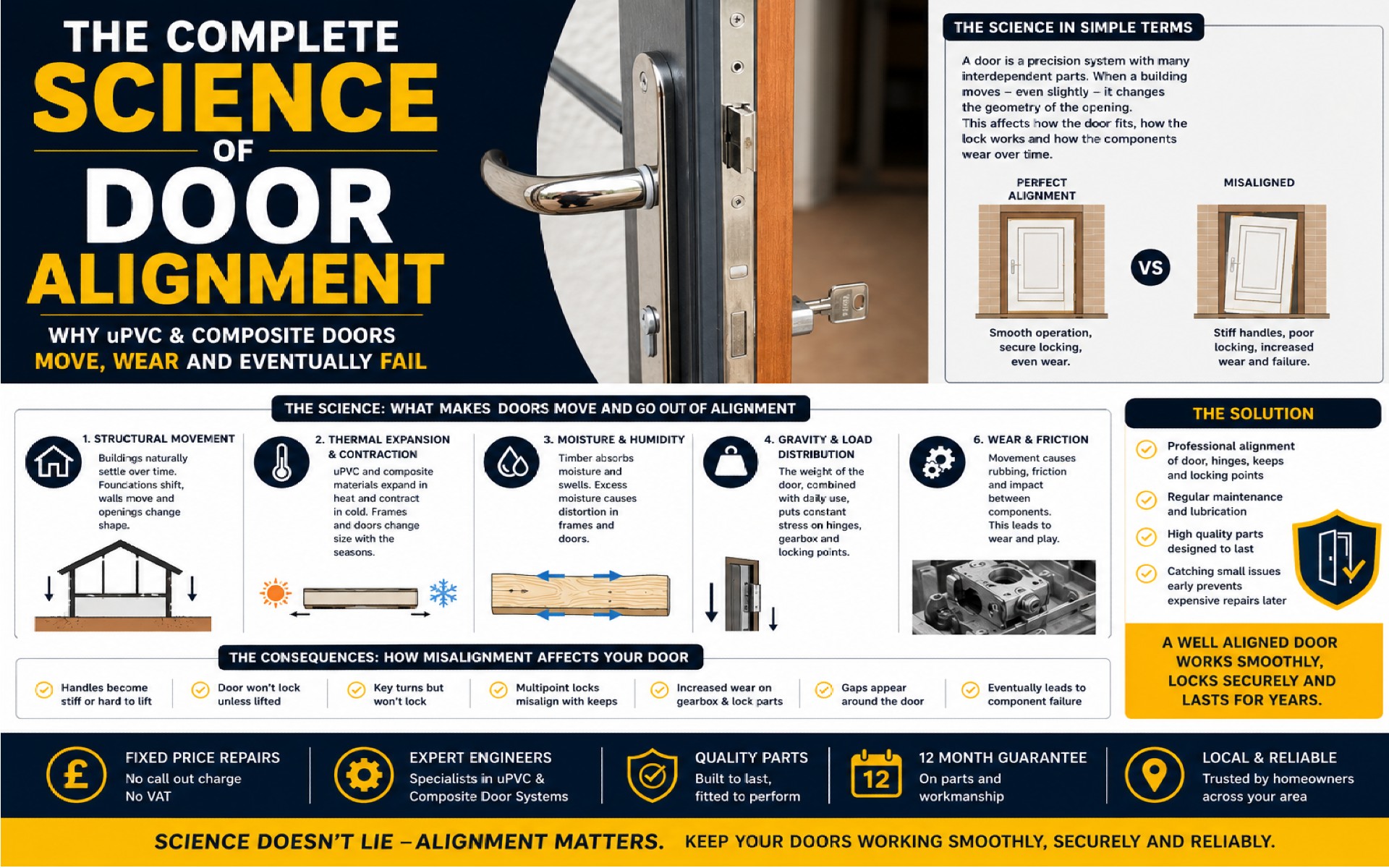
Door alignment isn't simply moving a hinge until the door closes.
It's an engineering problem involving geometry, mechanics, material science and physics.
Every time you close your front door, hundreds of kilograms of force are transferred through the hinges, frame and locking mechanism. Every component must work within very small tolerances. A movement of only 2–3mm can completely change how the door operates.
When people say their door has "dropped", what has actually happened is that the relationship between the door, hinges, frame and locking mechanism has changed.
Understanding the science explains why.
1. Geometry – Everything Must Line Up
Door alignment begins with geometry.
A door is essentially a large rectangle suspended inside another rectangle (the frame).
For everything to work correctly:
- The door must remain square.
- The frame must remain square.
- The locking points must line up precisely with the keeps.
- The latch must enter the keep centrally.
- The hinges must all share the load equally.
Modern multipoint locks often work with clearances of only 2–4mm.
If the geometry changes slightly, the mechanism immediately starts working harder.
2. Compression – The Invisible Force
When you lift the handle, the locking points don't simply lock the door.
They pull it into the frame.
This creates compression against the weather seals.
Compression serves several purposes:
- Prevents draughts.
- Stops water ingress.
- Reduces noise.
- Improves security.
- Holds the door firmly within the frame.
Too little compression results in:
- Draughts.
- Door rattle.
- Water leaks.
- Loose feeling door.
Too much compression causes:
- Heavy handles.
- Stiff locks.
- Premature gearbox wear.
- Excessive hinge loading.
The goal is not maximum compression.
It's correct compression.
3. Hinge Pivot – Why Doors Drop
Many people imagine a hinge simply holds the door.
In reality, every hinge is a pivot point.
Every time the door opens, the hinges support the entire weight of the door while allowing it to rotate.
Over years of use:
- Bearings wear.
- Fixings loosen.
- The door settles slightly.
Because the weight is hanging away from the hinges, even tiny amounts of wear are magnified at the locking side.
A movement of only 1mm at the hinge can become several millimetres at the handle side of the door.
This is why dropped doors are so common.
4. Weight Distribution – Gravity Never Stops Working
A composite door can weigh well over 50kg.
Some glazed doors weigh considerably more.
That weight is constantly trying to rotate the door downwards.
The hinges continuously resist this force.
Every time the door opens:
- Gravity pulls down.
- Hinges resist.
- The frame absorbs the load.
- The locking mechanism eventually compensates.
Over thousands of operating cycles, small changes accumulate.
Eventually:
- The top corner catches.
- The bottom rubs.
- Handles become stiff.
The lock hasn't changed.
The weight distribution has.
5. Tolerances – Millimetres Matter
Modern door hardware is manufactured to very fine tolerances.
Typical examples include:
- Euro cylinders sitting almost flush with the handles.
- Locking points entering keeps with only a few millimetres clearance.
- Gearbox followers engaging precisely with the spindle.
- Compression rollers operating within narrow adjustment ranges.
A door can move only 2–3mm and suddenly:
- The handle becomes difficult.
- Hooks scrape.
- Rollers bind.
- The key becomes stiff.
This explains why doors often appear to "suddenly" develop faults.
In reality, they've been slowly moving for years until those tolerances were exceeded.
6. Friction – The Hidden Cause of Gearbox Failure
Friction is the enemy of every locking mechanism.
When correctly aligned:
- Hooks enter the keeps cleanly.
- Rollers rotate smoothly.
- The latch retracts freely.
When alignment changes:
The locking points begin rubbing instead of engaging.
That friction travels directly into:
- The gearbox.
- The curtain in vectis gearbox.
- The spindle.
- The handles.
- The key.
- The euro cylinder.
The homeowner feels a stiff handle.
The gearbox experiences greatly increased internal loading.
Eventually something breaks.
7. Thermal Expansion – Doors Change Size Every Day
All materials expand when heated and contract when cooled.
Different materials move by different amounts.
For example:
- uPVC expands.
- Aluminium expands.
- Steel expands.
- Composite materials expand at different rates.
- Timber absorbs moisture as well as expanding with temperature.
A south-facing door exposed to direct sunlight can become significantly warmer than the surrounding frame.
The result may be:
- Stiff locking in summer.
- Easier operation during winter.
- Seasonal alignment changes.
Many customers report:
"It only sticks on hot days."
Often the lock hasn't changed at all.
The door has simply expanded.
8. Load Transfer – Where the Forces Go
When you lift the handle, you're not just moving a lock.
You're transferring force through an entire system.
The force travels:
Hand
↓
Handle
↓
Spindle
↓
Gearbox
↓
Drive bars
↓
Hooks and rollers
↓
Frame keeps
↓
Door frame
↓
Building structure
If any part of that chain becomes misaligned, the force has to go somewhere else.
Usually it ends up overloading the gearbox.
This is why replacing the gearbox without correcting the alignment often results in another failure later.
Why Gearboxes Usually Aren't the Original Problem
People often blame the gearbox because it's the part that finally breaks.
In reality, it's usually the victim.
A gearbox may spend years operating under excessive load because:
- The house moved.
- Hinges settled.
- Keeps shifted.
- The door dropped.
- Thermal movement altered the clearances.
Eventually the gearbox reaches its limit.
Replacing it without addressing the underlying cause is like replacing worn tyres without fixing poor wheel alignment.
Why Door Alignment Is a Science
Proper alignment isn't guessing.
It's analysing:
- Geometry.
- Load paths.
- Compression.
- Friction.
- Weight distribution.
- Mechanical advantage.
- Material movement.
- Manufacturing tolerances.
Every adjustment changes several other relationships.
Moving one hinge changes:
- Door height.
- Compression.
- Hook engagement.
- Roller position.
- Latch position.
- Keep alignment.
This is why experienced locksmiths make several small adjustments rather than one large one.
The Result of Correct Alignment
When everything works together correctly:
- The handle lifts effortlessly.
- The key turns smoothly.
- Hooks enter the keeps cleanly.
- Rollers compress the seals evenly.
- The latch engages positively.
- The gearbox operates under minimal load.
- The weather seal works properly.
- Components last significantly longer.
A correctly aligned door doesn't just feel better.
It is mechanically operating the way its designers intended.
Conclusion
Door alignment is far more than a simple hinge adjustment. It is the careful balancing of geometry, weight, compression, friction and load transfer so that every component in the locking system works together efficiently. Even small changes caused by house movement, thermal expansion or everyday wear can place significant strain on a multipoint locking mechanism, eventually leading to stiff handles, worn gearboxes and lock failures. Understanding the science behind door alignment explains why accurate diagnosis and precise adjustment are just as important as replacing worn parts, helping to extend the life of both the door and its locking system.