Introduction
Most people assume that if a key fits into the lock and turns, it must be the correct key. Unfortunately, that's not always the case. A poorly cut key can still operate the lock while slowly causing damage every time it's used.
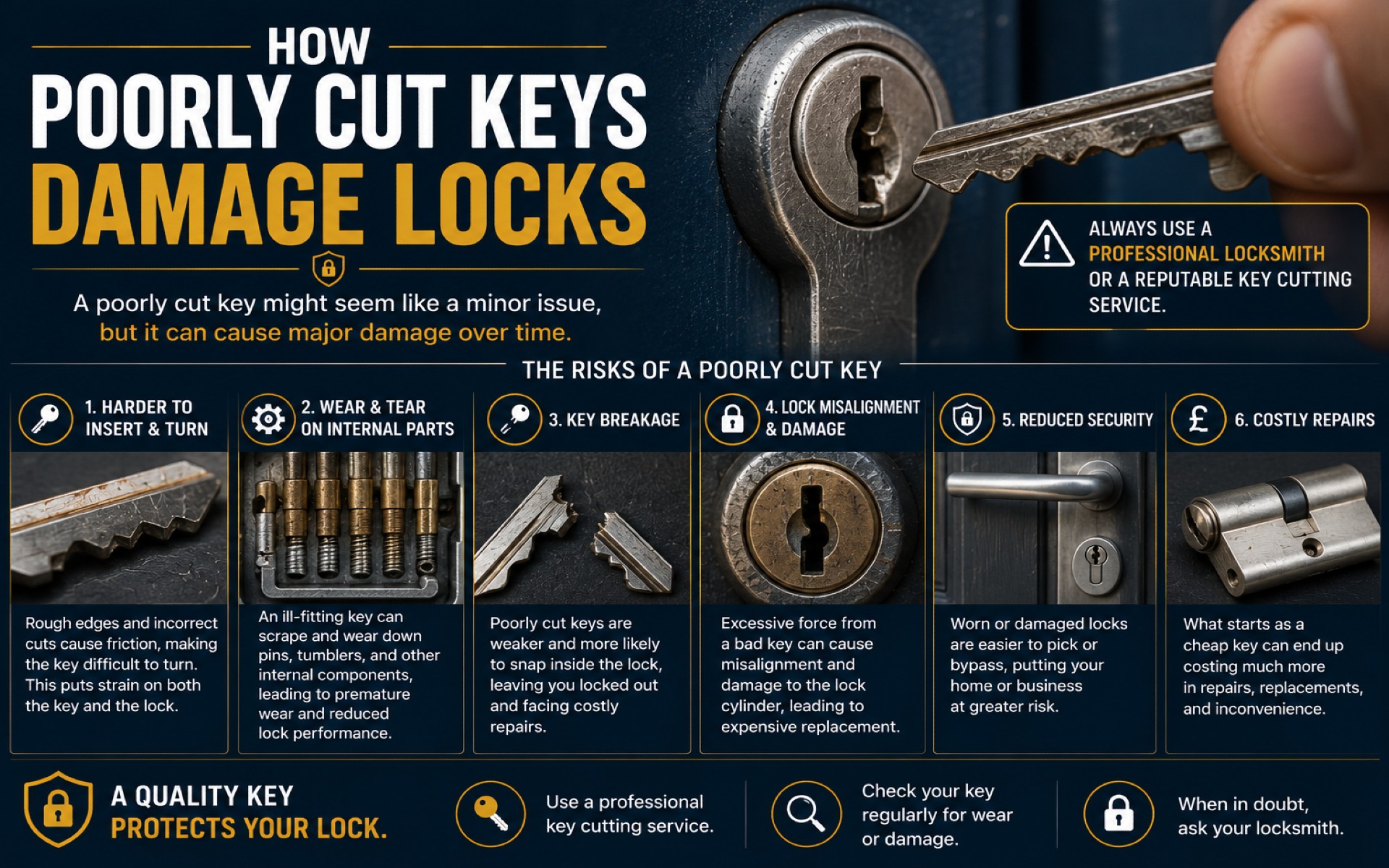
Over time, an inaccurate key places unnecessary strain on the internal components of the lock cylinder. What starts as a key that occasionally feels stiff can eventually lead to worn pins, damaged springs, a sticking lock or even complete lock failure. Using accurately cut keys is one of the simplest ways to protect both your lock and your investment.
Not All Key Copies Are Identical
A replacement key should match the original manufacturer's specification exactly.
If the cutting machine is:
- Poorly maintained.
- Incorrectly calibrated.
- Fitted with worn cutting wheels.
- Operated incorrectly.
the new key may not be an exact copy.
The difference might only be a fraction of a millimetre, but modern locks are manufactured to extremely fine tolerances, and even tiny inaccuracies can affect how they operate.
Never Copy a Copy
One of the biggest causes of poor-quality keys is repeatedly copying existing duplicates.
Each time a copy is made, small inaccuracies can be introduced. When that copy is copied again, those inaccuracies become larger.
After several generations, the newest key may bear little resemblance to the original manufacturer's profile.
For this reason, it's always best to have new keys cut from the original key whenever possible.
What Happens Inside the Lock?
Inside every euro cylinder is a series of precision-made components, including:
- Pins.
- Springs.
- Chambers.
- Shear lines.
When the correct key is inserted, every pin lifts to exactly the right height, allowing the cylinder to turn smoothly.
A poorly cut key lifts those pins to slightly incorrect positions.
The lock may still operate, but every turn forces the pins and springs against each other in ways they weren't designed for.
Over time, this causes unnecessary wear inside the cylinder.
Damage Builds Up Gradually
Using an inaccurate key once or twice is unlikely to cause serious harm.
The problem comes with repeated daily use.
Every time the lock is operated, additional wear occurs, eventually leading to:
- Worn lock pins.
- Weak or broken springs.
- Increased friction.
- Wear to the key itself.
- Metal particles inside the cylinder.
- Premature cylinder failure.
Like any mechanical component, the damage accumulates slowly until the lock begins to show symptoms.
Warning Signs of a Poorly Cut Key
Common symptoms include:
- The key feels rough when turning.
- The key sticks in the lock.
- You need to wiggle the key.
- The key is difficult to remove.
- The lock feels inconsistent.
- Different keys behave differently.
- One key works perfectly while another doesn't.
Many homeowners assume the cylinder is wearing out when the real problem is simply one poor-quality key.
High-Security Locks Need Greater Accuracy
Modern anti-snap and high-security cylinders are engineered with extremely tight manufacturing tolerances.
This provides better protection against:
- Lock snapping.
- Picking.
- Drilling.
- Bumping.
However, these tighter tolerances also mean they are less forgiving of inaccurate key copies.
Using accurately cut keys helps ensure these locks continue to operate smoothly for many years.
Cheap Key Cutting Can Become Expensive
Saving a few pounds on a poor-quality key copy can become very costly.
A badly cut key may eventually damage a perfectly good lock, leading to:
- Stiff operation.
- Cylinder replacement.
- Emergency lockouts.
- Broken keys.
- Damaged gearboxes if excessive force is used.
In many cases, replacing the cylinder costs considerably more than having a quality key cut in the first place.
What Should You Do?
If a newly cut key doesn't feel right:
- Stop using it if possible.
- Compare it with another working key.
- Try the original key.
- Have it checked by a reputable locksmith or experienced key cutter.
If the original key works perfectly and the new one doesn't, the key is often the problem rather than the lock.
Poor Keys Can Affect More Than the Cylinder
Many people don't realise that a badly cut key can affect more than just the lock cylinder.
As the key becomes harder to turn, homeowners naturally apply more force. That additional force is transferred through the entire locking system, placing unnecessary strain on:
- The euro cylinder.
- The gearbox.
- The handle.
- The spindle.
- The multipoint locking mechanism.
Over time, this can accelerate wear throughout the door's locking system and contribute to premature gearbox or mechanism failure.
Long-Term Benefits of Using Quality Keys
Using accurately cut keys helps to:
- Reduce wear inside the cylinder.
- Protect the lock pins and springs.
- Keep the key turning smoothly.
- Reduce strain on the gearbox.
- Extend the life of the locking mechanism.
- Lower the risk of snapped keys and lock failures.
- Avoid unnecessary repair costs.
Conclusion
A poorly cut key can slowly damage a lock without the homeowner even realising it. Although the key may still fit and turn, small inaccuracies place extra strain on the precision components inside the cylinder every time it's used. Over months or years, this additional wear can lead to stiff operation, damaged pins, broken springs and eventually complete lock failure. Having keys cut by a reputable locksmith or experienced key cutter, and always copying from the original key where possible, is one of the simplest ways to protect your lock, extend its lifespan and avoid unnecessary repairs.