Introduction
When a door develops a fault, it's natural to assume the solution is simply replacing the broken part. After all, if the handle has snapped or the lock no longer works, replacing that component seems the obvious answer.
Unfortunately, door repairs are rarely that straightforward.
Many homeowners have already spent money replacing locks, handles or cylinders, only to discover the problem hasn't gone away—or worse, the replacement fails a few months later because the original cause was never identified.
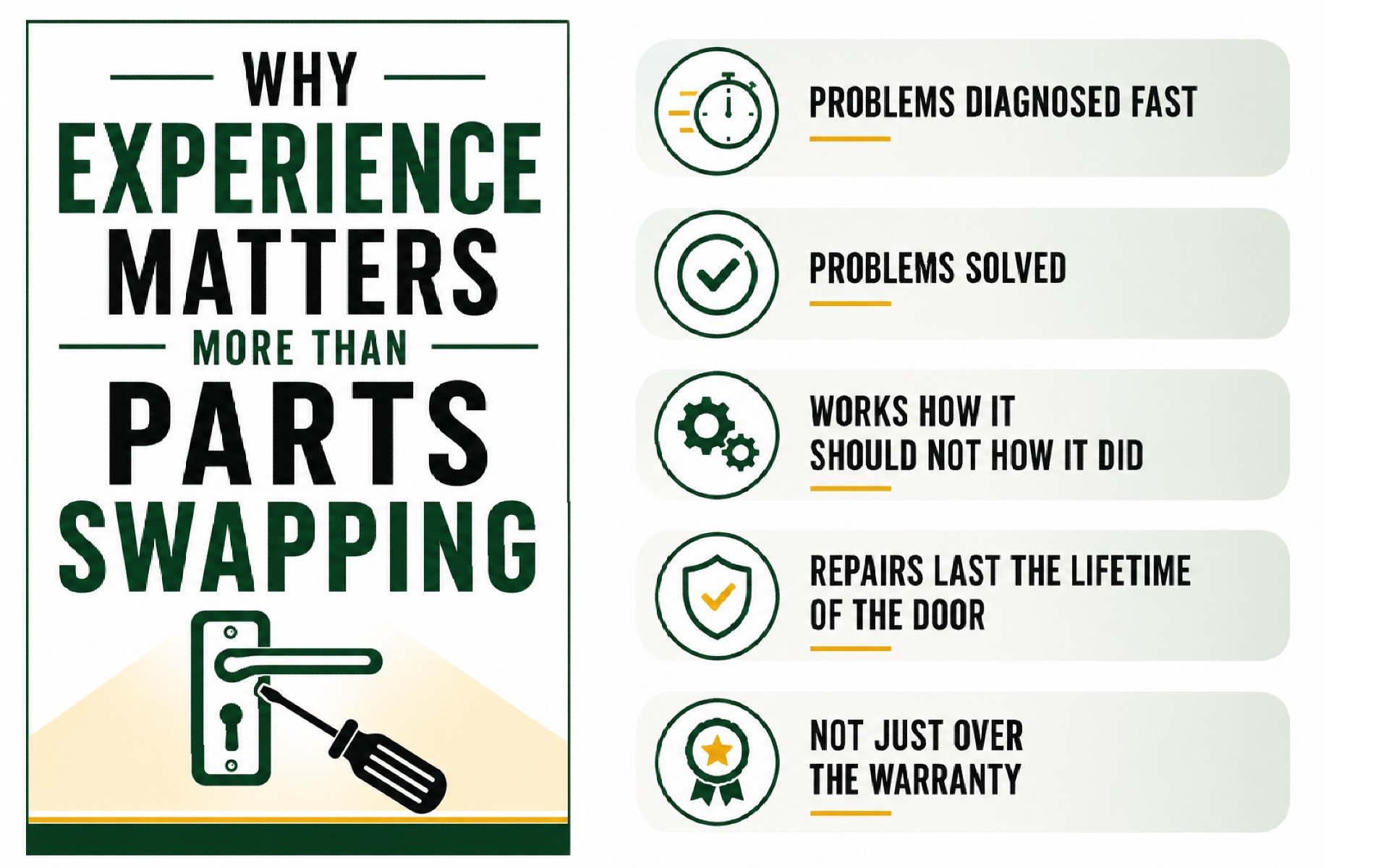
The difference between a temporary fix and a long-lasting repair often comes down to one thing: experience.
An experienced locksmith doesn't just replace parts—they diagnose why the part failed in the first place.
Door Components Rarely Fail Without a Reason
Modern door locks are mechanical systems made up of many interdependent components.
Like any mechanical system, parts eventually wear out, but they rarely fail without an underlying cause.
Common reasons include:
- A dropped door.
- Poor door alignment.
- Worn hinges.
- Excessive strain on the locking mechanism.
- Lack of maintenance.
- Years of normal wear and tear.
Replacing the failed component without correcting these underlying issues often means the new part will be subjected to exactly the same conditions.
The result is another failure—and another repair bill.
The Obvious Fault Isn't Always the Real Fault
One of the most valuable skills an experienced locksmith develops is the ability to look beyond the obvious.
For example, imagine your door handle has snapped.
It would be easy to assume the handle was simply poor quality.
However, an experienced locksmith is more likely to ask:
- Why did the handle break?
- Was the handle becoming stiff beforehand?
- Is the gearbox beginning to fail?
- Has the door dropped out of alignment?
- Are the locking points rubbing against the frame?
- Has excessive force been needed every time the door was locked?
Very often, the broken handle isn't the cause of the problem—it's simply the final symptom of a locking system that's been working under excessive strain for months or even years.
Correct Diagnosis Saves Money
Replacing parts by trial and error can quickly become expensive.
It's not uncommon for homeowners to replace:
- The euro cylinder.
- The door handles.
- The gearbox.
only to discover that the real problem was a door that had dropped by just a few millimetres.
A proper diagnosis ensures that:
- Only worn components are replaced.
- Perfectly serviceable parts are retained.
- The underlying cause is corrected.
- The repair is far less likely to fail again.
Accurate diagnosis doesn't just solve the problem—it avoids unnecessary expense.
Experience Helps Recognise Common Patterns
After repairing hundreds—or even thousands—of residential doors, experienced locksmiths begin to recognise patterns that aren't always obvious to homeowners.
For example:
- A handle that won't spring back often points to a gearbox beginning to fail.
- A lock that works perfectly with the door open usually indicates poor door alignment.
- A key that's stiff only when the door is closed often suggests the locking points are meeting resistance from the frame.
- A broken gearbox is frequently the result of prolonged strain caused by a dropped door.
- Repeatedly broken handles often indicate an alignment problem rather than poor-quality hardware.
Recognising these patterns allows faults to be identified more quickly and repaired more effectively.
Knowing What Doesn't Need Replacing
Experience isn't only about knowing what to replace—it's also about recognising what can be left alone.
Not every fault requires a complete multipoint locking mechanism.
Sometimes replacing only:
- The gearbox.
- The euro cylinder.
- The door handles.
- A worn hinge.
- An individual locking component.
is enough to restore smooth, reliable operation.
Knowing when not to replace expensive components is often just as valuable as knowing when replacement is necessary.
Door Alignment Is Often the Missing Piece
One of the biggest differences between simply changing parts and carrying out a professional repair is checking the door alignment.
Even the highest-quality replacement gearbox can fail prematurely if:
- The hooks don't line up with the keeps.
- The locking points are working against resistance.
- The handle requires excessive force to lift.
- The door has gradually dropped on its hinges.
Correcting the alignment removes unnecessary strain from the entire locking system, allowing replacement parts to operate as they were designed.
Older Doors Require Specialist Knowledge
Many older uPVC and composite doors contain locking mechanisms that are no longer manufactured.
Without experience, it's easy to assume the only solution is replacing the entire door.
However, a locksmith familiar with older locking systems may be able to:
- Source compatible replacement parts.
- Replace only the centre case (gearbox).
- Upgrade to a modern compatible mechanism.
- Adapt suitable replacement components.
- Repair the existing mechanism where practical.
That knowledge can often save homeowners thousands of pounds.
Repair Before Replacement
Experience also brings confidence in repairing rather than automatically replacing.
For example:
- A failed gearbox doesn't always require a new multipoint locking mechanism.
- A worn euro cylinder doesn't mean replacing the complete lock.
- A stiff handle doesn't automatically require new handles.
- A faulty locking mechanism doesn't necessarily mean replacing the entire door.
The best repair is often the one that replaces the fewest components while restoring smooth, secure and reliable operation.
The Value of Preventative Repairs
Experience also helps identify problems before they become emergencies.
A locksmith who recognises the early signs of wear can often recommend relatively simple adjustments or repairs before major components fail.
Examples include:
- Realigning a dropped door before the gearbox breaks.
- Replacing worn hinges before excessive strain develops.
- Correcting stiff operation before the handles fail.
- Replacing a worn cylinder before it eventually seizes.
Preventative repairs are usually quicker, less disruptive and considerably less expensive than emergency repairs following a complete lock failure.
Experience Means Better Long-Term Value
Choosing a locksmith isn't simply about finding someone who can install a replacement part.
It's about choosing someone who can:
- Diagnose the actual fault.
- Understand why it occurred.
- Recommend the most appropriate repair.
- Prevent the same problem happening again.
That approach provides better long-term value by reducing unnecessary replacement parts and extending the life of your existing door.
Conclusion
Modern door locking systems are complex assemblies of moving components, and successful repairs require far more than simply replacing the part that appears to be broken.
An experienced locksmith understands how the entire system works, recognises the warning signs of developing faults and identifies the underlying cause before recommending any repair. Whether the problem is poor door alignment, worn hinges, a failing gearbox or a damaged multipoint locking mechanism, correcting the cause is what ensures the repair lasts.
At A.L.S. Locksmiths, our approach has always been to repair the cause rather than simply replace the symptom. By carrying out careful diagnosis, using quality replacement parts and ensuring the door operates correctly afterwards, we help homeowners avoid unnecessary expense while extending the life of the doors they already own.
Frequently Asked Questions
Why is diagnosis so important when repairing a door?
Because the visible fault isn't always the original cause. A broken handle, stiff key or failed gearbox is often the result of poor alignment or excessive strain elsewhere in the locking system.
Can replacing the wrong part make the problem worse?
It may not make the problem worse, but it often fails to solve it. If the underlying cause isn't addressed, the replacement part may wear out prematurely.
Why do experienced locksmiths check the door alignment?
Poor alignment is one of the most common causes of premature gearbox, handle and multipoint locking mechanism failures. Correcting it reduces strain on every moving component.
Can older doors still be repaired if parts are obsolete?
Often, yes. Many older locking systems can be repaired using compatible replacement parts, upgraded components or replacement gearboxes without replacing the entire door.
Is replacing fewer parts really better?
Usually. If the remaining components are in good condition, replacing only the worn parts is often the most cost-effective and practical solution, while preserving the original door.