Introduction
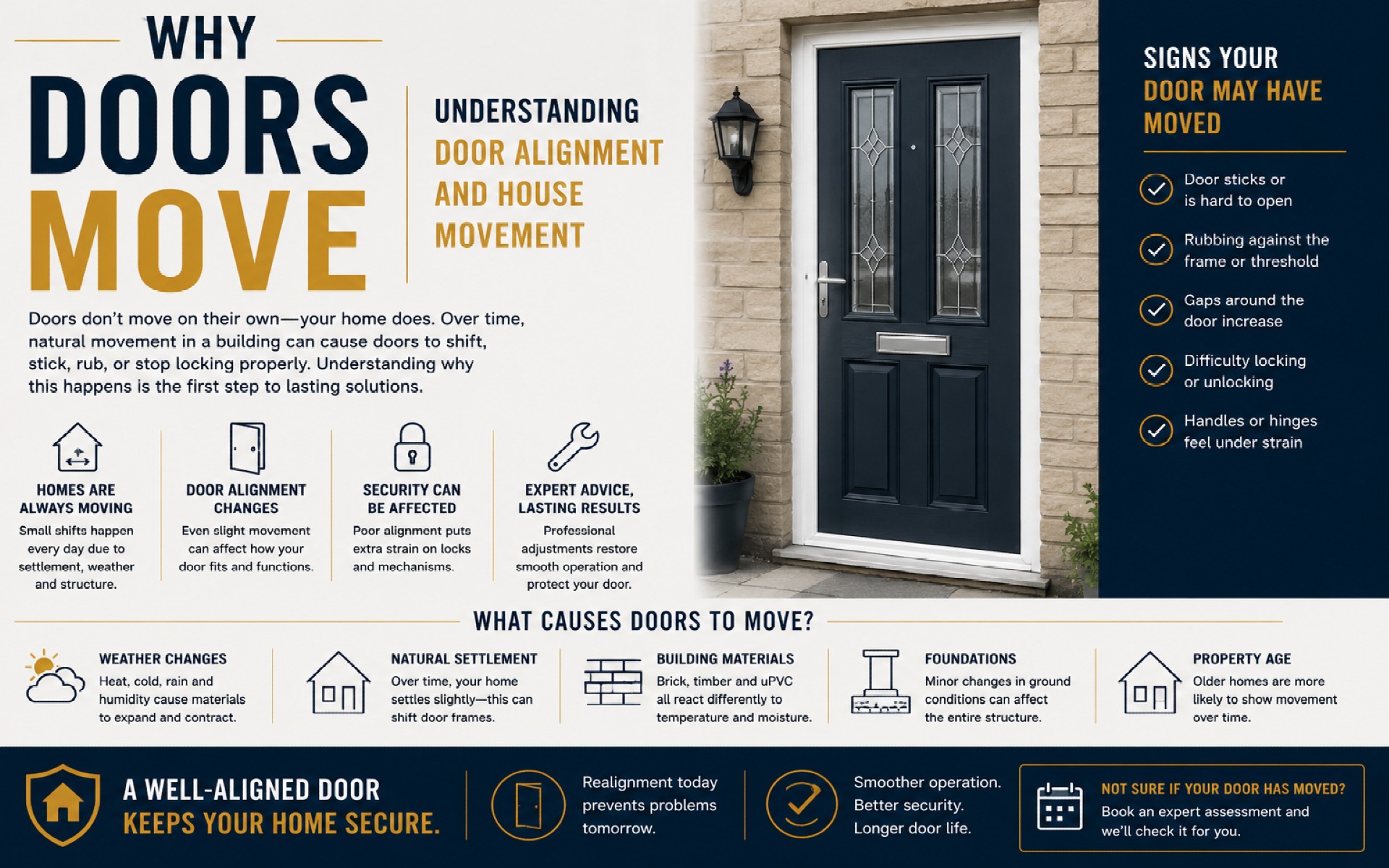
Many homeowners assume that if a door becomes difficult to lock, the lock itself must be faulty. In reality, the lock is often only reacting to changes elsewhere. Doors are connected to walls, frames, hinges and foundations, all of which move slightly over time.
Whether your home is brand new or over a century old, every property experiences some degree of movement. Foundations settle, materials expand and contract, hinges wear and buildings respond to changes in temperature and moisture throughout the year.
Modern doors are engineered to operate with very precise tolerances. As little as a few millimetres of movement can affect how smoothly the locking mechanism operates. Understanding why this happens helps explain why even the highest-quality doors occasionally require adjustment or repair.
Buildings Never Stay Completely Still
A common misconception is that once a house has been built, it remains exactly the same forever.
In reality, every building moves.
This movement is usually gradual and measured in millimetres rather than centimetres, but it is perfectly normal and occurs throughout the life of a property.
Factors contributing to movement include:
- Natural settlement.
- Seasonal temperature changes.
- Changes in ground moisture.
- Expansion and contraction of building materials.
- Wind loading.
- Everyday structural loading.
- Long-term ageing of the building.
Most of these movements are so gradual that homeowners never notice them until a door or window becomes difficult to operate.
Why New Build Homes Behave Differently
New homes continue to settle after construction has finished.
As the weight of the building transfers fully onto its foundations, small amounts of movement are entirely normal during the first few years.
This natural settlement can affect:
- Door alignment.
- Window alignment.
- Lock operation.
- Hinge adjustment.
- Compression of weather seals.
In most cases, these small adjustments are simply part of the building reaching its long-term equilibrium and are not an indication of poor workmanship.
Developers often make minor door and window adjustments during the initial warranty period because this type of movement is expected.
Older Homes Continue to Move Too
Although older properties have usually completed their initial settlement, they do not stop moving altogether.
Instead, they experience gradual movement caused by:
- Seasonal expansion and contraction.
- Fluctuating moisture levels.
- Drying and ageing of materials.
- Long-term structural loading.
- Normal wear over decades of use.
Because these changes happen slowly, they often go unnoticed until they begin affecting the operation of doors and windows.
How Foundations Influence Door Alignment
Every door opening ultimately depends on the foundations supporting the building.
If one section of the building settles slightly more than another, even by only a few millimetres, the geometry of door openings can change.
This may result in:
- The door rubbing on the frame.
- The handle becoming difficult to lift.
- Hooks or rollers missing their keeps.
- A key becoming stiff to turn.
- Uneven gaps around the door.
- Increased pressure on the locking mechanism.
The door itself may remain perfectly serviceable—the relationship between the door and its frame has simply altered over time.
Minor settlement of this type is common and is not usually a sign of structural failure.
However, if movement is sudden, accompanied by significant cracking or causes major distortion, advice should be sought from a suitably qualified building professional.
Even Small Movements Affect Modern Locks
Modern multipoint locking systems are manufactured with relatively fine tolerances.
Every locking point is designed to engage precisely with matching keeps fitted to the frame.
Even slight movement can cause:
- Increased resistance.
- Handles becoming stiff.
- Keys becoming difficult to turn.
- Locking points dragging.
- Excessive strain on the gearbox.
Because the locking mechanism is doing exactly what it was designed to do, homeowners often assume the lock has failed when it is actually responding to changes in door alignment.
Different Building Materials Behave Differently
Every material responds differently to changes in temperature and moisture.
Understanding these characteristics helps explain why doors require occasional adjustment.
Timber
Timber is a natural material that continually exchanges moisture with the surrounding environment.
As moisture levels change, timber may:
- Expand.
- Shrink.
- Twist slightly.
- Bow over time.
These movements are completely normal and are one reason why timber doors and frames benefit from regular maintenance.
uPVC
uPVC is considerably more dimensionally stable than timber.
It does not absorb moisture in the same way, making it less susceptible to swelling and shrinkage.
However, uPVC still responds to changes in temperature and will expand and contract slightly throughout the year.
Although maintenance requirements are generally lower, periodic adjustment may still become necessary.
Aluminium
Aluminium is extremely stable in relation to moisture.
However, it expands and contracts more noticeably with temperature changes than either timber or uPVC.
Modern aluminium door systems are specifically designed to accommodate this thermal movement through carefully engineered clearances and fixings.
Heavy Doors Naturally Place Greater Loads on Components
Modern composite doors and fully glazed entrance doors are considerably heavier than many earlier uPVC doors.
That additional weight places greater loads on:
- Hinges.
- Fixings.
- Door frames.
- Multipoint locking mechanisms.
- Gearboxes.
- Door handles.
Even high-quality hinges gradually experience wear over many thousands of opening and closing cycles.
A door dropping by only a few millimetres may be enough to increase pressure on the locking system significantly.
Fortunately, adjustment is often all that's required to restore smooth operation.
Doors and Windows Often Show the Same Symptoms
Doors and windows are installed within the same structural openings and are therefore influenced by the same building movement.
It's common to notice several symptoms appearing around the same time, including:
- Windows becoming harder to open.
- Doors requiring extra force to lock.
- Changes in weather seal compression.
- Uneven frame gaps.
- Increased draughts.
- Slight rubbing around moving parts.
Looking at the building as a whole often provides a clearer understanding of why these problems have developed.
Weather Can Affect How Your Door Operates
Many homeowners notice that their door works differently during different times of the year.
For example:
- A door that locks perfectly in winter may feel tighter during hot summer weather.
- Increased humidity can affect timber components.
- Cold weather may slightly reduce clearances.
- Extended periods of heavy rain can alter moisture levels around the building.
These seasonal variations are usually temporary but can make existing alignment issues more noticeable.
Why the Lock Is Often Innocent
When homeowners experience:
- A stiff key.
- A handle that won't lift.
- Difficulty locking the door.
- Hooks failing to engage properly.
it's natural to blame the lock.
However, the lock is frequently operating exactly as designed.
The real issue is often that the door has moved slightly, causing the locking mechanism to work under pressure.
Replacing the lock without correcting the alignment usually results in the same symptoms returning because the underlying cause hasn't changed.
Regular Adjustments Extend the Life of Every Component
Doors benefit from periodic maintenance in much the same way as other mechanical systems.
Routine checks should include:
- Hinge adjustment.
- Door alignment.
- Handle operation.
- Locking point engagement.
- Weather seal compression.
- Frame clearances.
- General operation of the locking mechanism.
Correct alignment reduces unnecessary strain on the gearbox, handles, hinges and multipoint locking mechanism, helping every component last longer.
Repair Before Replacement
A door that has become difficult to lock doesn't automatically need a new locking mechanism—or a new door.
In many cases, correcting the alignment restores smooth operation immediately and prevents further wear on the locking system.
Where components have already been damaged by prolonged strain, replacing the worn parts while correcting the alignment usually provides a long-lasting repair without the expense of replacing the entire door.
Conclusion
A door doesn't exist in isolation. Its performance is influenced by the walls, frame, hinges, foundations and even the changing seasons. Small amounts of movement are a completely normal part of a building's life, and over time they can alter the relationship between the door and its frame by just enough to affect how smoothly the locking system operates.
Understanding this relationship explains why many locking problems are actually alignment issues rather than failed locks. By recognising the effects of building movement, carrying out periodic adjustments and addressing minor problems early, homeowners can reduce unnecessary strain on the gearbox, handles and multipoint locking mechanism. In most cases, keeping a door properly aligned is one of the simplest and most effective ways to extend its lifespan, improve reliability and avoid more expensive repairs in the future.
Frequently Asked Questions
Is it normal for doors to move over time?
Yes. Every building experiences small amounts of movement due to settlement, seasonal temperature changes, moisture levels and normal structural ageing. Even a few millimetres of movement can affect how a door operates.
Why is my new build door difficult to lock?
New homes commonly experience natural settlement during their first few years. This can affect door alignment and may require minor hinge adjustments to restore smooth operation.
Can weather affect my door?
Yes. Temperature changes cause materials such as uPVC, aluminium and timber to expand and contract. Timber is also affected by changes in humidity, which can alter how the door fits within the frame.
Why does my lock suddenly feel stiff?
A stiff lock is often caused by poor door alignment rather than a fault with the lock itself. If the locking points no longer line up correctly with the frame, extra pressure is placed on the entire locking mechanism.
Does a dropped door damage the lock?
It can. Continued operation under excessive strain may accelerate wear on the gearbox, handles, multipoint locking mechanism and lock cylinder. Correcting the alignment early can help prevent more expensive repairs.