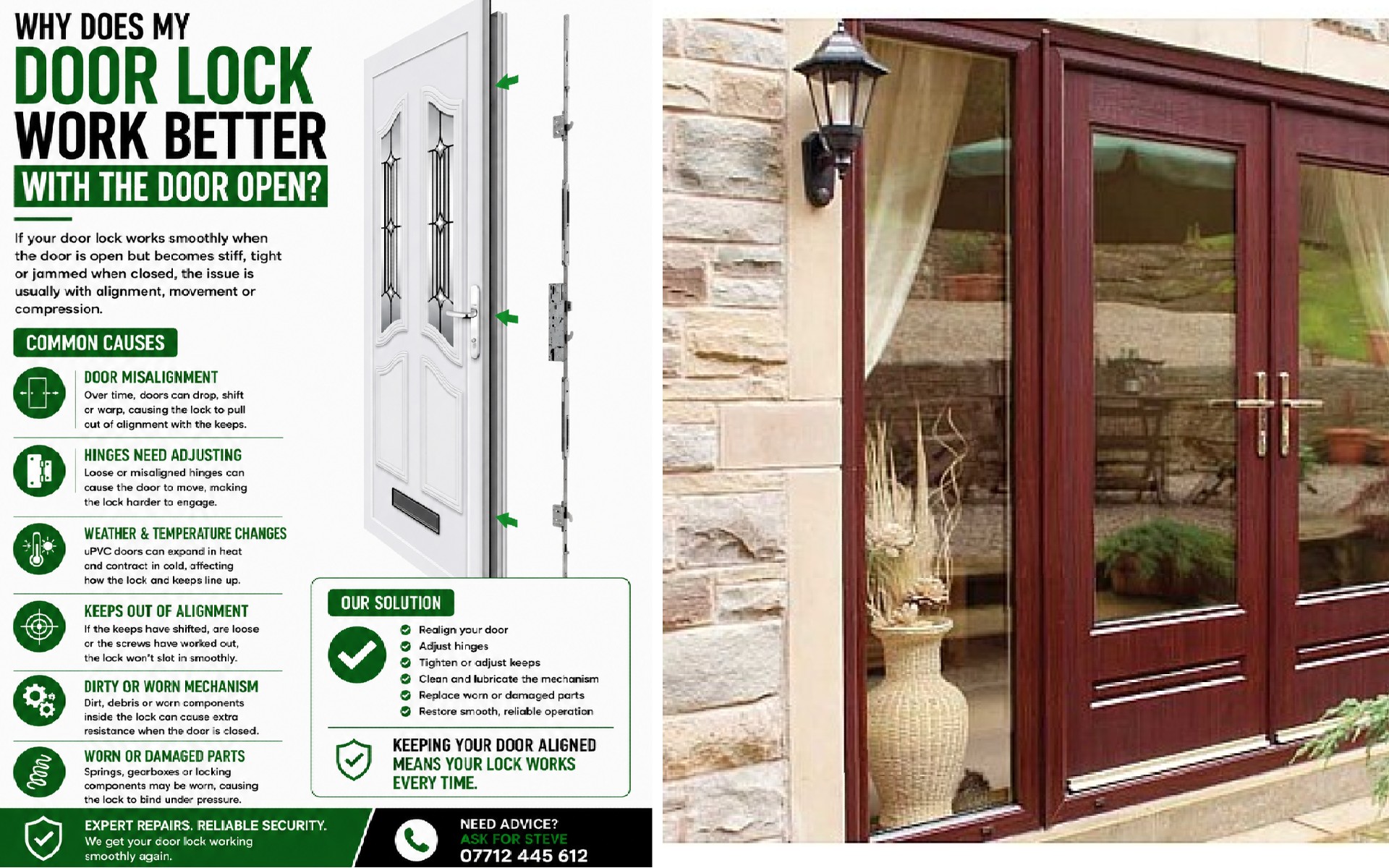
If your door locks perfectly when it's open but becomes stiff, difficult to lock, or won't lock at all when it's closed, the lock itself is often not the problem.
This is one of the most common faults with uPVC, composite and French doors, and it's usually caused by the door being out of alignment rather than a faulty lock.
Ignoring the problem can eventually lead to a failed gearbox or a jammed multipoint locking mechanism.
Why Does It Work When the Door Is Open?
When the door is open, the locking mechanism isn't under any pressure.
The:
- Gearbox
- Hooks
- Rollers
- Deadbolts
- Latch
can all move freely because they aren't engaging with the keeps in the frame.
As soon as you close the door, every locking point has to line up perfectly. If they don't, the mechanism has to work much harder.
Your Door May Have Dropped
The most common cause is a door that has gradually dropped on its hinges.
This can happen because of:
- Everyday use
- The weight of the door
- Hinge wear
- Natural movement over time
Even a few millimetres of movement can stop the locking points lining up correctly.
The Keeps May Be Out of Alignment
The hooks, rollers and deadbolts are designed to slide smoothly into the keeps fitted to the frame.
If the keeps no longer line up, you may notice:
- The handle becoming difficult to lift.
- The key becoming stiff.
- The top or bottom locking points refusing to engage.
- The door needing to be pushed or pulled before it locks.
The locking mechanism is often working perfectly—it's simply meeting resistance.
Don't Force the Handle
If the lock becomes stiff when the door is closed, avoid forcing the handle.
Doing so places excessive strain on:
- The gearbox
- The multipoint locking mechanism
- Internal linkages
- Door handles
Many gearboxes fail because they've been forced to operate against a misaligned door for months.
Could the Gearbox Already Be Damaged?
If the problem has been ignored for some time, the gearbox may already have suffered internal wear.
Warning signs include:
- Grinding or clicking noises
- The handle feeling rough
- The key turning inconsistently
- The handle lifting but the locking points not moving properly
In these cases, replacing the gearbox may be necessary as well as correcting the door alignment.
How the Problem Is Repaired
The correct repair depends on what has been damaged.
It may involve:
- Realigning the door
- Adjusting the hinges
- Replacing the gearbox
- Replacing the complete multipoint locking mechanism
- Replacing worn handles if required
Simply replacing parts without correcting the alignment usually results in the same problem returning.
Why Door Realignment Is Essential
Once the door has been repaired, it should always be checked to ensure:
- The door sits squarely in the frame.
- Every locking point engages smoothly.
- The handle lifts easily.
- The key turns without resistance.
- The new mechanism isn't working under unnecessary strain.
Correct alignment is one of the most important parts of a long-lasting repair.
Most Doors Don't Need Replacing
A door that works perfectly when it's open is usually telling you that the locking mechanism is still capable of operating. The problem is often the relationship between the door and the frame, not the door itself.
In most cases, correcting the alignment and replacing any worn components restores smooth, reliable operation without the expense of a new door.
Fix the Cause Before the Lock Fails
If your door only locks properly when it's open, don't ignore it. It's an early warning that something has moved out of alignment or the locking mechanism is beginning to wear. Dealing with the problem now can prevent a complete lock failure later. A professional inspection, correct diagnosis and proper realignment will usually restore smooth operation and help you keep the door you already have.