Introduction
Most homeowners never see the inside of a door lock, yet every modern locking system contains a carefully selected combination of metals, alloys and engineered plastics. Each material has been chosen for a specific purpose, whether that's strength, corrosion resistance, precision machining, smooth operation or long-term durability.
No single material is suitable for every component. A modern lock is the result of material science and engineering working together, with each part designed to perform a particular job as efficiently and reliably as possible.
The materials hidden inside your lock influence everything from how smoothly your key turns to how well the lock resists corrosion, withstands attack and continues operating after many years of daily use.
This guide explains why different materials are used inside modern locks and how each contributes to the security and reliability of your front door.
Material Choice Is an Engineering Decision
When engineers design a locking system, they rarely ask, "What's the strongest material available?"
Instead, they ask questions such as:
- Which material machines most accurately?
- Which resists corrosion best?
- Which offers the lowest friction?
- Which withstands repeated movement?
- Which provides the greatest strength where it's actually needed?
- Which offers the longest service life?
Every component is selected according to the job it performs.
The result is a locking system that balances:
- Security.
- Reliability.
- Durability.
- Manufacturing precision.
- Cost.
- Ease of maintenance.
Why Brass Is Used for Lock Cylinders
Brass has been the preferred material for lock cylinders for well over a century.
At first glance, it may seem surprising that such an important security component isn't manufactured entirely from hardened steel.
The answer lies in the unique properties of brass.
Brass offers:
- Excellent corrosion resistance.
- Outstanding machining accuracy.
- Smooth movement.
- Long service life.
- Good wear resistance.
- Reliable dimensional stability.
The chambers inside a euro cylinder must be manufactured to extremely fine tolerances.
Each pin needs to move freely while remaining perfectly aligned with the key.
Brass allows this level of precision far more easily than hardened steel.
Modern high-security cylinders strengthen vulnerable areas with hardened steel rather than replacing the entire cylinder body.
Why Hardened Steel Is Used Selectively
Steel provides exceptional strength, but it isn't the ideal material for every component.
Instead, manufacturers reinforce the areas most likely to come under attack.
Hardened steel is commonly used for:
- Anti-drill pins.
- Reinforcing bars.
- Anti-snap protection.
- Hooks.
- Deadbolts.
- Rollers.
- Cam protection.
- Critical structural components.
Its hardness makes it highly resistant to:
- Drilling.
- Cutting.
- Breaking.
- Wear.
- Forced manipulation.
Using hardened steel only where it's needed keeps locks both secure and practical to manufacture.
Stainless Steel Isn't Completely Rust-Proof
Many homeowners believe stainless steel can never rust.
In reality, the word stainless means highly resistant to corrosion rather than completely immune.
Its performance depends upon factors including:
- The alloy composition.
- Exposure to moisture.
- Salt in the atmosphere.
- Surface contamination.
- Ongoing maintenance.
Homes close to the coast experience particularly challenging conditions because airborne salt gradually attacks exposed metal surfaces.
Even high-quality stainless steel benefits from occasional cleaning to preserve the thin protective oxide layer that gives it its corrosion resistance.
How Zinc Alloys Improve Door Hardware
Many modern door handles, escutcheons and decorative lock components are manufactured from zinc alloys rather than solid steel.
This isn't a compromise in quality.
Zinc alloys offer several engineering advantages:
- Excellent casting characteristics.
- Consistent dimensions.
- Good corrosion resistance.
- Reduced weight.
- Smooth surface finishes.
- Cost-effective production.
After casting, components may receive finishes such as:
- Chrome.
- Satin chrome.
- Satin nickel.
- Black.
- White.
- Brass-effect coatings.
- Anthracite grey.
- Bronze.
These finishes provide both protection and aesthetic appeal.
Why Modern Locks Use Engineering Plastics
Some homeowners are surprised to discover plastic components inside quality locks.
However, modern engineering plastics are very different from ordinary household plastics.
They are selected because they provide:
- Low friction.
- Quiet operation.
- Excellent wear resistance.
- Corrosion immunity.
- Dimensional stability.
- Lightweight construction.
Common applications include:
- Bushes.
- Guides.
- Spacers.
- Covers.
- Retaining clips.
- Low-load moving components.
Security-critical parts remain manufactured from metal, while plastics are used where they improve performance and reduce wear.
The Metals Found Inside a Multipoint Lock
A modern multipoint locking mechanism contains numerous different materials working together.
Hardened Steel
Used for:
- Hooks.
- Deadbolts.
- Rollers.
- Locking points.
- Anti-drill components.
Chosen because of its exceptional strength and wear resistance.
Mild Steel
Used for:
- Internal connecting rods.
- Linkages.
- Structural components.
- Faceplates.
- Reinforcing sections.
These components are usually protected with galvanising or specialist coatings to reduce corrosion.
Brass
Used for:
- Cylinder plugs.
- Internal pins.
- Keys.
- Precision-machined cylinder components.
Brass allows extremely accurate machining while providing smooth operation over many years.
Zinc Alloys
Commonly used for:
- Door handles.
- Escutcheons.
- Decorative hardware.
- Certain gearbox housings.
They combine strength with excellent manufacturing consistency and attractive finishes.
Stainless Steel
Frequently used for:
- Springs.
- Fasteners.
- Corrosion-resistant faceplates.
- Selected internal components.
Its corrosion resistance makes it particularly valuable for exposed hardware.
Why Springs Require Special Materials
Springs perform one of the hardest jobs inside a lock.
Every time the handle is lifted or the latch returns, the spring compresses and expands.
To withstand thousands of operating cycles, spring materials must offer:
- High fatigue resistance.
- Elasticity.
- Corrosion resistance.
- Consistent performance.
Many springs are manufactured from stainless or specially treated spring steel, allowing them to maintain their shape over many years of repeated use.
Thermal Expansion Matters
Every material expands slightly as it becomes warmer and contracts again as it cools.
This natural process is known as thermal expansion.
Different materials expand at different rates.
For example:
- Aluminium expands more than steel.
- Brass expands differently from stainless steel.
- Zinc alloys respond differently again.
Lock designers carefully allow for these differences.
Without these allowances:
- Components could bind together in hot weather.
- Moving parts could become excessively loose in colder temperatures.
- Smooth operation would be impossible.
Precision engineering ensures every component continues functioning throughout normal seasonal temperature changes.
Corrosion Protection Extends Lock Life
Many steel components receive protective surface treatments before assembly.
Common protective finishes include:
- Zinc plating.
- Galvanising.
- Nickel plating.
- Powder coating.
- Passivation.
These treatments help prevent corrosion while maintaining smooth movement between interacting parts.
Regular cleaning and appropriate lubrication help these protective finishes remain effective throughout the life of the lock.
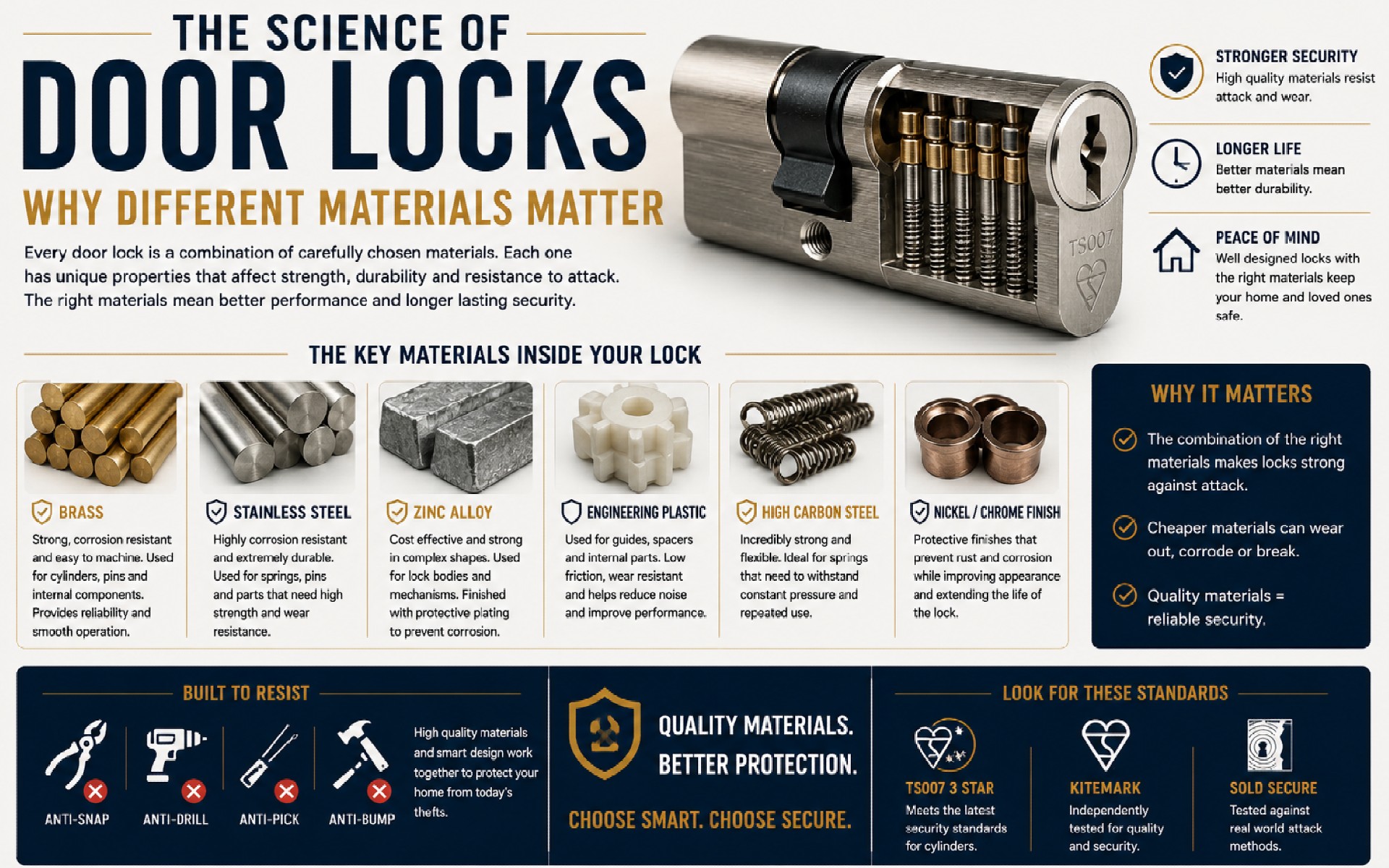
Different Materials Solve Different Problems
One of the reasons modern locks perform so well is that no single material is expected to do every job.
For example:
- Brass provides precision machining.
- Hardened steel provides strength.
- Stainless steel provides corrosion resistance.
- Zinc alloys allow complex castings.
- Engineering plastics reduce friction.
- Spring steel provides elasticity.
Each material contributes something different to the finished product.
Precision Manufacturing Is Just as Important
The quality of the materials alone doesn't determine how well a lock performs.
Manufacturing precision is equally important.
Modern CNC machining, automated assembly and rigorous quality control ensure:
- Consistent dimensions.
- Accurate pin alignment.
- Smooth key operation.
- Reliable locking.
- Reduced internal wear.
The combination of carefully selected materials and precision manufacturing is what gives today's locks their reliability.
Better Materials Mean Better Security
Modern security improvements are not solely about resisting burglars.
Improved materials also provide:
- Longer service life.
- Reduced maintenance.
- Greater reliability.
- Improved corrosion resistance.
- Smoother everyday operation.
- Better resistance to wear.
A lock that continues operating smoothly for many years is less likely to develop faults that could compromise either convenience or security.
Conclusion
The security and reliability of a modern door lock depend on much more than clever design. Every internal component is manufactured from a material chosen for a specific purpose, whether that's the precision machining of brass, the strength of hardened steel, the corrosion resistance of stainless steel, the versatility of zinc alloys or the low-friction performance of engineering plastics.
Rather than relying on a single material, modern locks combine the strengths of many different materials to create a system that is durable, secure and capable of withstanding years of daily use. Understanding the security standards and engineering hidden inside even the simplest-looking lock helps explain why quality locking systems continue to perform reliably while protecting homes against both everyday wear and modern methods of attack.
Frequently Asked Questions
Why are lock cylinders made from brass instead of steel?
Brass offers excellent machining accuracy, corrosion resistance and smooth operation. High-security cylinders reinforce vulnerable areas with hardened steel where additional strength is needed.
Does stainless steel rust?
Stainless steel is highly resistant to corrosion but not completely rust-proof. Its performance depends on the grade of steel, environmental conditions and regular maintenance.
Why do modern locks contain plastic parts?
Engineering plastics reduce friction, minimise wear and improve smooth operation. They're generally used for low-load components rather than security-critical parts.
What is the strongest metal used inside a lock?
Hardened steel is typically the strongest material used in modern locks and is commonly found in anti-drill pins, locking points and anti-snap reinforcements.
Why don't manufacturers make the entire lock from hardened steel?
Different materials are better suited to different jobs. Brass machines more accurately, stainless steel resists corrosion, zinc alloys are ideal for casting complex shapes and engineering plastics reduce friction. Using each material where it performs best results in a stronger, smoother and more reliable locking system.