Introduction
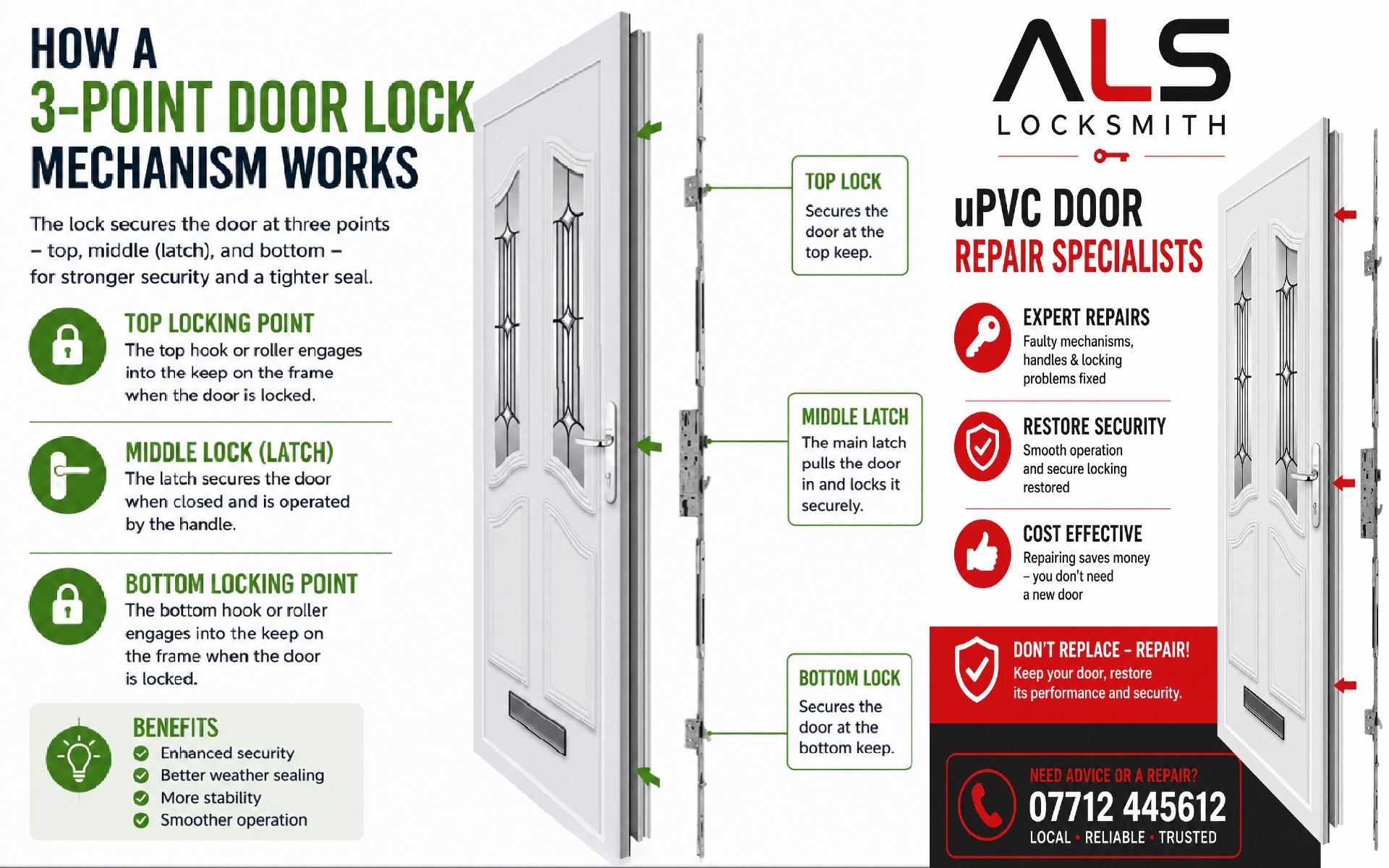
Most modern composite doors are fitted with a 3 point locking mechanism, providing significantly greater security than a traditional single-point lock. Instead of relying on a single lock in the centre of the door, the system secures the door at three separate positions, making it more resistant to forced entry while also pulling the door tightly against the frame.
Although these locking systems are designed to provide years of reliable service, they contain several moving components that can eventually wear. Understanding how a 3 point locking mechanism works can help you recognise the early warning signs of a fault before the door becomes difficult—or impossible—to lock.
What Is a 3 Point Locking Mechanism?
A 3 point locking mechanism is a type of multipoint lock that secures a composite door in three key locations:
- Top locking point
- Centre locking point
- Bottom locking point
All three locking points operate together using a single handle and key.
When the mechanism is working correctly, it distributes the locking force evenly along the height of the door, creating a secure seal and helping the door close smoothly.
The Main Components
A typical composite door locking system consists of several components that work together:
- Multipoint locking mechanism
- Gearbox
- Euro cylinder
- Internal and external door handles
- Top and bottom locking points
- Centre latch and deadbolt
- Keeps fitted to the door frame
Each part performs a different function, and a fault with any one of them can affect how the entire locking system operates.
How the Locking Mechanism Works
The locking process happens in three stages.
Closing the Door
When the door is closed, the centre latch engages with the frame and keeps the door shut.
At this stage, however, the door is not fully locked. The upper and lower locking points remain retracted until the handle is lifted.
Lifting the Handle
When the handle is lifted, the gearbox transfers movement through the multipoint locking mechanism.
This causes:
- The top locking point to engage.
- The bottom locking point to engage.
- The centre deadbolt to move into position.
All three locking points engage with the keeps in the frame, securing the door evenly from top to bottom.
Turning the Key
Turning the key locks the gearbox, preventing the handle from being operated from outside and securing the locking mechanism in its fully locked position.
The door is now securely locked at all three points.
Why Three Locking Points Are More Secure
Compared with a traditional single-point lock, a 3 point locking mechanism offers several important advantages.
These include:
- Increased resistance to forced entry.
- Better distribution of locking pressure.
- Improved compression of the weather seals.
- Reduced movement during high winds.
- A tighter, more secure fit against the frame.
By locking the door at multiple points, the system helps improve both security and everyday performance.
Why 3 Point Locking Mechanisms Fail
Although these mechanisms are built to last, they are subject to wear every time the door is used.
The most common causes of failure include:
- Everyday wear and tear.
- Poor door alignment.
- A dropped door.
- Worn or loose hinges.
- Repeatedly forcing a stiff handle.
- General mechanical wear within the gearbox or locking mechanism.
In many cases, the locking system has been working under excessive strain long before it eventually fails.
Common Warning Signs
Most locking mechanisms give warning signs before they stop working completely.
Look out for symptoms such as:
- The handle becoming difficult to lift.
- The key becoming stiff or difficult to turn.
- The top or bottom locking point failing to engage.
- Only one or two locking points operating.
- The handle failing to spring back.
- Grinding, clicking or crunching noises.
- Having to push or pull the door to make it lock.
Having these problems investigated early often prevents a complete lock failure.
Gearbox or Complete Mechanism?
Not every fault requires the entire locking strip to be replaced.
If the locking points and connecting rods remain in good condition, replacing only the gearbox is often the most economical solution.
A complete multipoint locking mechanism is more likely to be required where there is:
- Extensive internal wear.
- Broken locking points.
- Damaged connecting rods.
- Seized components.
- Obsolete parts that cannot be repaired individually.
An accurate diagnosis ensures only the necessary components are replaced.
Door Alignment Is Just as Important
Replacing the locking mechanism without correcting the reason it failed often results in the same problem returning.
If the door has dropped or moved out of alignment, the new mechanism will immediately begin operating under the same excessive pressure as the old one.
Following any repair, the door should be checked to ensure:
- It sits squarely within the frame.
- All three locking points engage smoothly.
- The handle lifts easily.
- The key turns without resistance.
- No unnecessary strain is placed on the gearbox.
Correct alignment helps maximise the lifespan of the replacement components.
Most Composite Door Lock Problems Can Be Repaired
A faulty 3 point locking mechanism rarely means a composite door needs replacing. In most cases, the problem can be resolved by replacing the worn gearbox or locking mechanism, correcting the door alignment and ensuring the locking system operates without unnecessary strain.
Repairing the existing locking system is usually faster, more affordable and far less disruptive than replacing the entire door. When the door itself remains structurally sound, a properly diagnosed repair can restore smooth, secure and reliable operation for many years.