You pop out into the back garden to hang the washing. The dog is following you around, the kids are playing in the house, and you pull the back door shut behind you.
A few minutes later, you reach for the handle.
It will not open.
You try again. You push the door, pull the handle and jiggle it a little. Nothing. You are standing in your own garden, looking at your own door, wondering how on earth you have managed to lock yourself out without even leaving the house.
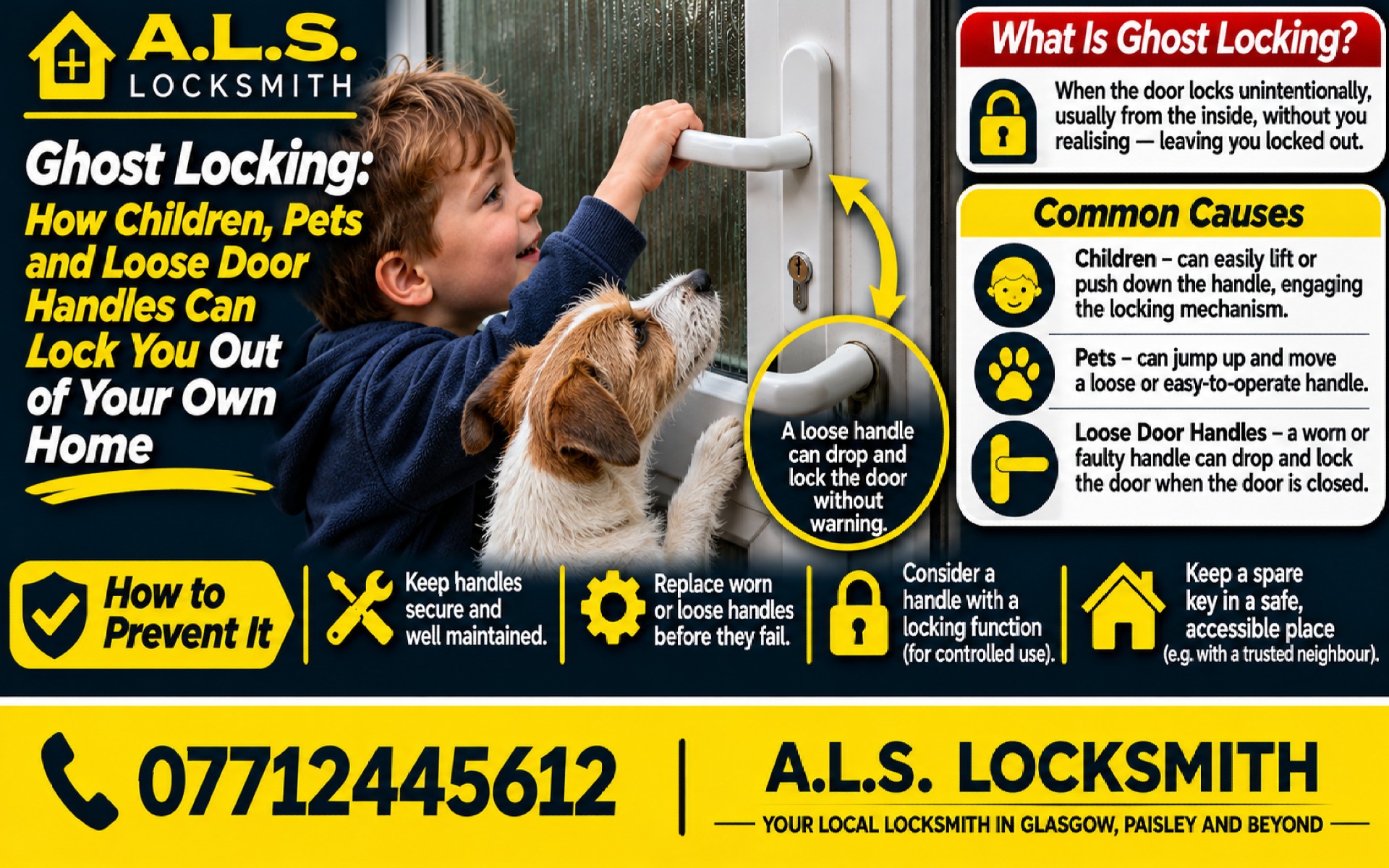
Welcome to what we like to call ghost locking — when a door appears to lock itself and leaves you stranded on the wrong side.
At A.L.S Locksmiths, we know that a door does not need to be old or obviously broken to cause an unexpected lockout. Sometimes, a worn handle, a temperamental latch or a failing multipoint mechanism is all it takes.
How can a door lock itself when you are still at home?
Many modern uPVC and composite doors use spring-loaded handles and multipoint locking mechanisms.
Depending on the design, lifting the handle engages several locking points along the door. Turning the key then deadlocks the mechanism.
Other doors have a latch that engages when the door closes, allowing it to stay shut without the key being turned. Some nightlatches and specialist locking systems can also engage automatically.
The exact behaviour depends on the hardware fitted.
Problems can arise when a handle, latch or locking mechanism is worn or operating unpredictably. The door may close behind you, the latch may engage, or the handle may move into a position that leaves you unable to reopen the door from outside.
It can feel as though the door has developed a mind of its own.
1. The dog that accidentally becomes a locksmith
Dogs are brilliant at getting involved in household activities. Unfortunately, they are not always brilliant at understanding door locks.
A large dog jumping up against an internal handle could move it, particularly if the handle is already loose or the mechanism is unusually easy to operate.
On some doors, lifting the handle engages the multipoint locking points. If the door closes while those points are engaged, reopening it from outside may require the correct key or another authorised unlocking method.
However, a dog cannot normally deadlock every type of multipoint door simply by touching a handle. The outcome depends on the particular mechanism and how it operates.
If your dog regularly jumps against the back door, it is worth checking whether the handle is loose, the springs are weak or the locking system is behaving inconsistently.
2. Toddlers and curious little hands
Young children love exploring handles, switches and anything else within reach.
A child pushing down on a lever handle might retract a latch. Lifting a handle on some uPVC doors can engage the multipoint mechanism. If the door then closes, an adult outside may find that it cannot be reopened without a key.
This is particularly inconvenient when a parent has stepped outside to put the bins out, collect something from the car or hang the washing.
It is important to remember that different doors behave differently. A child moving the handle will not automatically lock every door, but a door that can latch or engage its locking points unexpectedly deserves attention.
If young children are in the house, make sure the door's locking arrangement is suitable for the household and does not create an emergency escape hazard.
3. The loose handle that gives you a warning
Sometimes the real culprit is not the dog or the toddler. It is the door handle itself.
A uPVC handle can become loose, develop excessive movement or stop returning to its normal position because of worn springs or damaged internal components.
You might notice that:
-
The handle droops rather than returning to its normal position.
-
It feels loose or wobbly.
-
It no longer springs back smoothly.
-
The latch does not retract consistently.
-
The handle feels different from one day to the next.
These are warning signs worth investigating.
Some handle problems can be resolved by replacing worn furniture or restoring the correct fixing. Others are symptoms of a failing gearbox or another fault within the locking mechanism.
Replacing the handle alone will not necessarily solve a problem caused by the gearbox, so it is important to identify the actual cause.
4. Could a worn gearbox be responsible?
The central gearbox is an important component in many multipoint locking systems. It transfers movement from the handle and cylinder to the locking points.
Over time, internal parts can wear or become damaged. The handle may become stiff, feel unusually loose or fail to operate the locking points consistently.
Sometimes the fault develops gradually. At other times, the mechanism can fail unexpectedly.
If the door has started behaving differently, do not assume the handle is the only problem. A worn gearbox may need repair or replacement, depending on the design and availability of suitable parts.
Catching the problem early may help prevent a complete failure at an inconvenient time.
5. How to reduce the risk of an unexpected lockout
You cannot control every enthusiastic dog or curious toddler, but you can take a few practical precautions.
Check the handle. If it is loose, drooping or failing to return properly, arrange an inspection rather than waiting for it to stop working.
Pay attention to changes. A handle that suddenly becomes stiff, unusually free-moving or inconsistent may indicate a developing fault.
Understand your door. Find out whether the door latches automatically, whether lifting the handle engages the locking points and what is required to reopen it from outside.
Keep an appropriate key accessible. If your door requires a key to reopen it from outside, consider how you will avoid being stranded when stepping into the garden. Keep keys secure and away from children.
Do not force the handle. If the mechanism starts sticking, forcing it may make the problem worse.
Check safe escape. Any change to the locking arrangement must allow occupants to escape safely in an emergency. Do not fit or use a lock in a way that could trap someone inside.
6. What if you are already locked out in the garden?
First, do not panic. It may be a simple latch or handle problem, but avoid forcing the door or trying to manipulate the mechanism with improvised tools.
If another safe entrance is available, use it. Otherwise, contact a locksmith who can assess the situation and advise on the appropriate way to regain entry.
If a child, vulnerable person or animal is at immediate risk inside, treat the situation as urgent and contact the appropriate emergency service if necessary.
Once access has been restored, ask for the handle, latch and multipoint mechanism to be checked. Getting back inside is only half the job if the fault is likely to happen again.
7. Why a small repair now can prevent a bigger problem later
A loose handle may appear to be a minor annoyance, but it can indicate wear that affects the door's operation.
Depending on the cause, the solution may involve replacing the handle, correcting a fitting problem, adjusting the door or repairing a faulty gearbox.
Not every stiff or loose handle requires a complete mechanism replacement. Equally, fitting a new handle will not fix every internal fault.
The sensible approach is to diagnose the problem and carry out the repair that is actually needed.
How A.L.S Locksmiths can help
At A.L.S Locksmiths, we repair uPVC and composite door locks across Glasgow, Paisley and surrounding areas.
We can inspect loose handles, faulty latches, worn multipoint gearboxes and doors that have become difficult to operate. Our aim is to identify the cause and explain the available repair options before work begins.
We offer fixed pricing, no call-out fees and a 12-month guarantee on parts supplied and fitted, subject to the guarantee's terms and exclusions. The agreed price includes the parts and labour for the specified repair, and we are not VAT registered.
If your door has started behaving strangely, it is worth getting it checked before the next trip into the garden becomes an unexpected outdoor adventure.
Final thoughts: don't wait until you are stranded
Ghost locking might sound amusing when you are telling the story afterwards, but being locked out of your own home is no fun — especially when the washing is still in the basket and the dog is watching through the glass.
A loose handle, worn spring or faulty gearbox may provide warning signs before a complete failure occurs.
If your uPVC or composite door handle is loose, the latch is unreliable or the locking mechanism has started behaving unpredictably, contact A.L.S Locksmiths to discuss a repair.
Fix the warning signs before your back door decides to keep you outside.