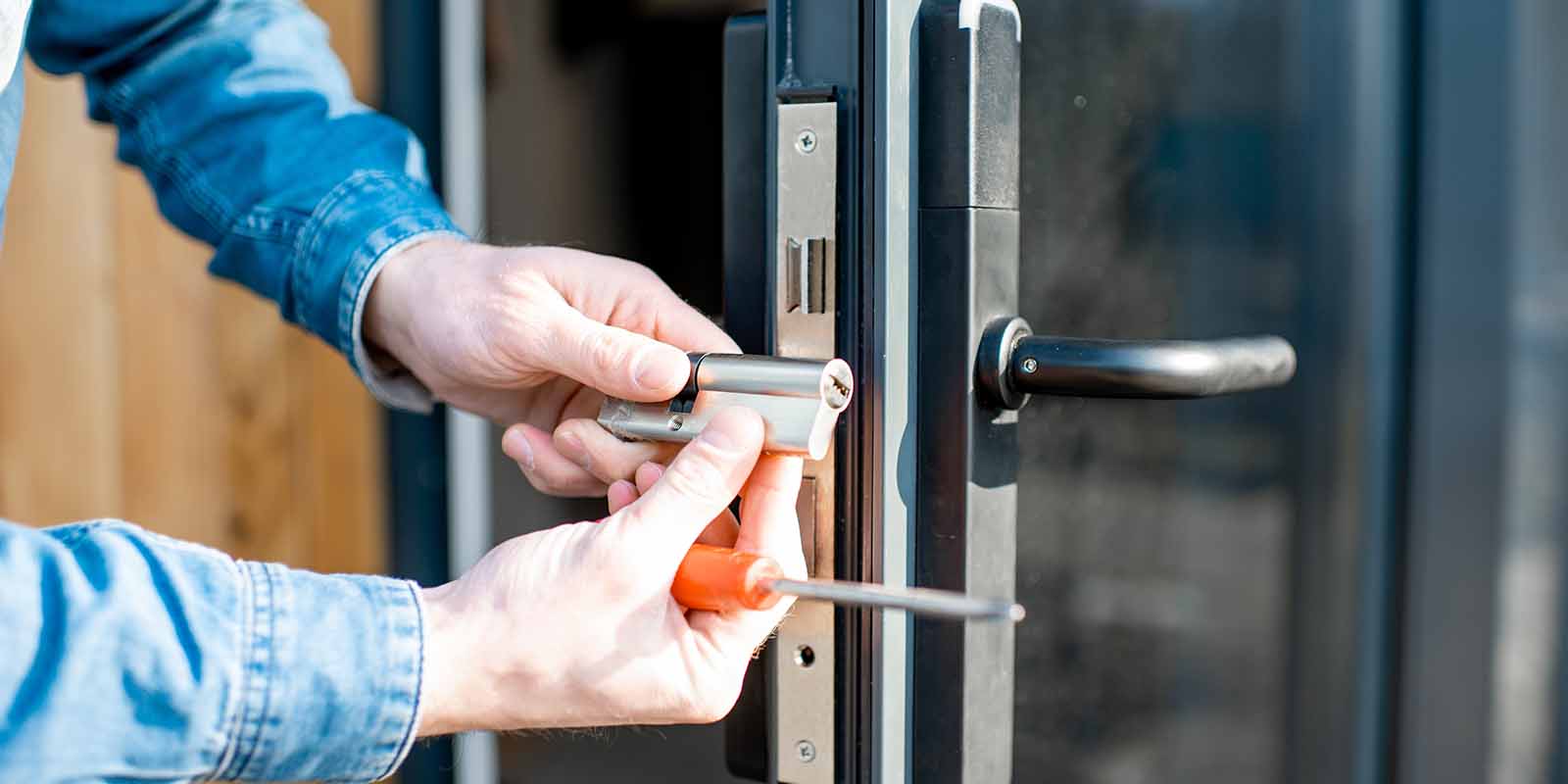
A door lock must protect a property without creating a danger for the people living inside it. In a rented property, a faulty locking mechanism, an unsuitable lock or a communal entrance that cannot be opened safely from the inside can raise important questions about fire safety and a landlord's legal responsibilities.
In Scotland, private landlords must meet the Repairing Standard, which includes specific requirements for common doors in tenement buildings. Other fire safety requirements may apply depending on the property, particularly in houses in multiple occupation (HMOs).
At A.L.S Locksmiths, we understand that choosing the right lock is about more than security. It is also about ensuring that a door operates correctly and that occupants can use it safely.
This guide explains the main rules, the difference between security and emergency escape, and what tenants and landlords should do when a door lock causes concern.
1. Can a tenant be locked inside a rented property?
People must be able to escape safely from a building in an emergency. A lock or faulty door mechanism that prevents an occupant from opening an escape door from the inside can present a serious safety risk.
However, the precise legal requirements depend on the type of property and the door concerned. It would be inaccurate to say that every external door in every Scottish rental property is subject to exactly the same keyless-locking rule.
For private rented flats in tenement buildings, the Scottish Government's Repairing Standard guidance specifically addresses common doors. These must be secure and fitted with satisfactory emergency exit locks that allow tenants to open them from the inside without a key, so they do not prevent escape during a fire.
You can read the official guidance in the Scottish Government's Repairing Standard: Common Doors.
2. What are the rules for communal entrance doors in tenements?
In a tenement or block of flats, the communal entrance is an important part of the route between an individual flat and the outside.
Under the Repairing Standard, where the requirements apply, common doors must be secure and fitted with satisfactory emergency exit locks.
The Scottish Government's guidance explains that:
-
Common doors must be capable of being secured.
-
A common front door will generally need a suitable secure-entry system, subject to the stated exception for certain blocks of three or fewer flats.
-
The system should allow tenants to identify visitors or deliveries and open the common front door remotely.
-
The emergency exit lock must allow occupants to open the door from the inside without a key.
The purpose is to balance access control with safe escape. A communal entrance should not be secured in a way that prevents residents leaving in an emergency.
Responsibility can be more complicated in a tenement because the landlord may need cooperation or consent from other property owners before certain work can be completed. Nevertheless, the issue should be raised and addressed rather than ignored.
3. What about the front door of an individual flat or house?
The entrance door to an individual flat is different from a shared communal entrance. The specific Repairing Standard provision about emergency exit locks in tenements expressly concerns common doors.
That does not mean an individual entrance door can safely be allowed to trap someone inside. General fire safety principles require escape routes to remain usable, and additional requirements may apply depending on the building, its layout, the type of accommodation and any applicable fire safety measures.
For landlords, the sensible approach is to check that the door and lock are appropriate for the property and that occupants can operate the door safely.
For tenants, a door that cannot be opened from inside, a handle that fails intermittently, or a mechanism that jams should be reported promptly. If there is an immediate risk that someone cannot escape, treat the matter as urgent.
4. Does a landlord have to fit a BS8621 escape lock?
Not automatically in every rented property.
BS8621 is a British Standard associated with single-point locks that can be operated by a key from outside and without a key from inside. A lock meeting this standard may be a suitable option in some circumstances, but the legal requirement should not be reduced to a rule that every Scottish rental must use BS8621.
The correct lock depends on the door, the existing locking arrangement, the building and the relevant safety requirements.
For example, a properly selected thumbturn cylinder may allow a door to be locked from outside with a key and operated from inside with a turnable knob. However, whether that is suitable depends on the complete locking system and the requirements that apply to the property.
A locksmith should assess the door and the existing mechanism before recommending a replacement.
5. What if the landlord's insurance requires a BS3621 lock?
Some home insurance policies specify particular lock types or security standards. BS3621 is commonly associated with thief-resistant mortice deadlocks, but insurance conditions vary between insurers and policies.
A landlord should not assume that an insurance requirement means a door must be locked in a way that compromises safe escape. Equally, tenants should not assume that a particular lock automatically invalidates insurance.
The practical steps are to:
-
Check the exact wording of the insurance policy.
-
Identify the security standard and locking arrangement required.
-
Check that the proposed lock is suitable for the door and its escape function.
-
Ask the insurer to confirm in writing if there is any uncertainty.
-
Use a competent locksmith to recommend an appropriate solution.
The aim is to achieve suitable security while maintaining safe operation. A lock should not be selected solely because it appears to satisfy an insurance checklist.
6. What about HMOs and bedroom door locks?
A house in multiple occupation, or HMO, generally includes accommodation occupied by three or more people from two or more households who share facilities such as a kitchen or bathroom, subject to the applicable legal definition.
HMOs are subject to licensing and additional safety requirements. Local authorities set standards as part of the licensing process, and fire safety legislation may also apply.
Scottish Government guidance for HMO licensing addresses secure locks and states that door locks must be capable of being opened from inside without a key so residents can escape in a fire.
Landlords should therefore check the specific HMO licence conditions and the applicable fire safety guidance before fitting or changing bedroom locks.
It is also important not to assume that every door in every HMO must automatically be an FD30 or FD60 fire door with a self-closer. Fire door requirements depend on the building, the escape strategy and the relevant standards. Where a fire door or self-closing device is required, it must be suitable and maintained correctly.
7. What other fire safety requirements apply to Scottish rentals?
Door locks are only one part of fire safety. Scottish homes must also meet the applicable requirements for fire detection and warning.
For private rented homes, the Scottish Government states that the standard generally requires:
-
One smoke alarm in the main living room or the room used most frequently for daytime living.
-
One smoke alarm in every hallway and landing.
-
One heat alarm in the kitchen.
-
Smoke and heat alarms that are ceiling-mounted and interlinked.
The exact installation should reflect the property layout and applicable requirements. Additional standards may apply to HMOs or where building regulations require a higher level of protection.
Carbon monoxide detection is also required in relevant circumstances, including where a property has a fixed combustion appliance other than an appliance used solely for cooking. The precise requirements and siting depend on the installation.
Official guidance is available here:
8. What if a door mechanism is faulty or parts are missing?
A door can remain locked while its mechanism is damaged or incomplete. That does not necessarily mean the door is in a satisfactory state of repair.
For example, a UPVC or composite door may still secure at some locking points even though its gearbox is worn, components are missing or the handle does not operate correctly. A mechanism that is likely to jam or fail should be inspected.
Under the Repairing Standard, private landlords must keep landlord-provided fixtures and fittings in a reasonable state of repair and proper working order. Repairs must be completed within a reasonable time after the landlord becomes aware of the defect.
If the fault affects safe escape, the landlord should treat it seriously and arrange an appropriate inspection and repair.
A competent locksmith can assess whether the problem can be repaired or whether the mechanism needs replacement. Replacing the entire door is not necessarily required if a suitable repair restores correct operation.
9. What should tenants do if the landlord will not act?
If a tenant believes a lock or door mechanism is unsafe, the first step is to report the problem in writing.
Explain what is wrong, how it affects the door and whether it is difficult or impossible to open from inside. Photographs or a short video may help show the defect, provided they can be taken safely.
Tenants should keep copies of messages and note when the fault was reported. If the problem is serious, state clearly why urgent attention is needed.
If a private landlord does not resolve a problem that may breach the Repairing Standard, a tenant can apply to the First-tier Tribunal for Scotland (Housing and Property Chamber). The Tribunal can consider the evidence and, where appropriate, order the landlord to carry out the necessary work.
Visit the Housing and Property Chamber for information about applications and the process.
If a door cannot be opened safely from inside and there is an immediate danger, do not wait for the normal repair process. Seek urgent assistance.
10. How A.L.S Locksmiths can help
Choosing a suitable lock involves more than matching a cylinder or gearbox to a door. The locking system must fit correctly, operate reliably and be appropriate for the door's security and escape requirements.
A.L.S Locksmiths provides locksmith services in Glasgow, Paisley and surrounding areas, including:
-
UPVC and composite door lock repairs.
-
Faulty multipoint gearbox diagnosis and replacement.
-
Euro cylinder replacement and security upgrades.
-
Door alignment and locking-mechanism adjustments.
-
Advice on selecting suitable replacement locks.
If a door is difficult to lock, the handle is failing, or the mechanism appears to have missing or damaged components, an inspection can help identify the cause and the appropriate repair.
Final thoughts
Fire safety and property security must work together. A door needs to protect the property, but the locking arrangement must also be appropriate for the building and must not prevent occupants from escaping safely.
Scottish law specifically requires suitable emergency exit locks on common doors in tenement buildings covered by the Repairing Standard. Other properties, including HMOs, may have additional requirements depending on their circumstances.
If you are a landlord, check the relevant standards and insurance conditions before selecting a lock. If you are a tenant and a door cannot be opened safely or its mechanism is faulty, report the problem promptly and keep a written record.
The right lock is one that provides appropriate security while allowing the door to perform its intended function safely.