
If you rent out a property in Scotland, you may wonder whether landlord insurance is a legal requirement. What happens if you do not have buildings insurance? Could your mortgage lender insist on cover? And how does insurance relate to your responsibilities for maintaining secure doors and locks?
The answer depends on the type of property, how it is financed and the terms of any insurance policy.
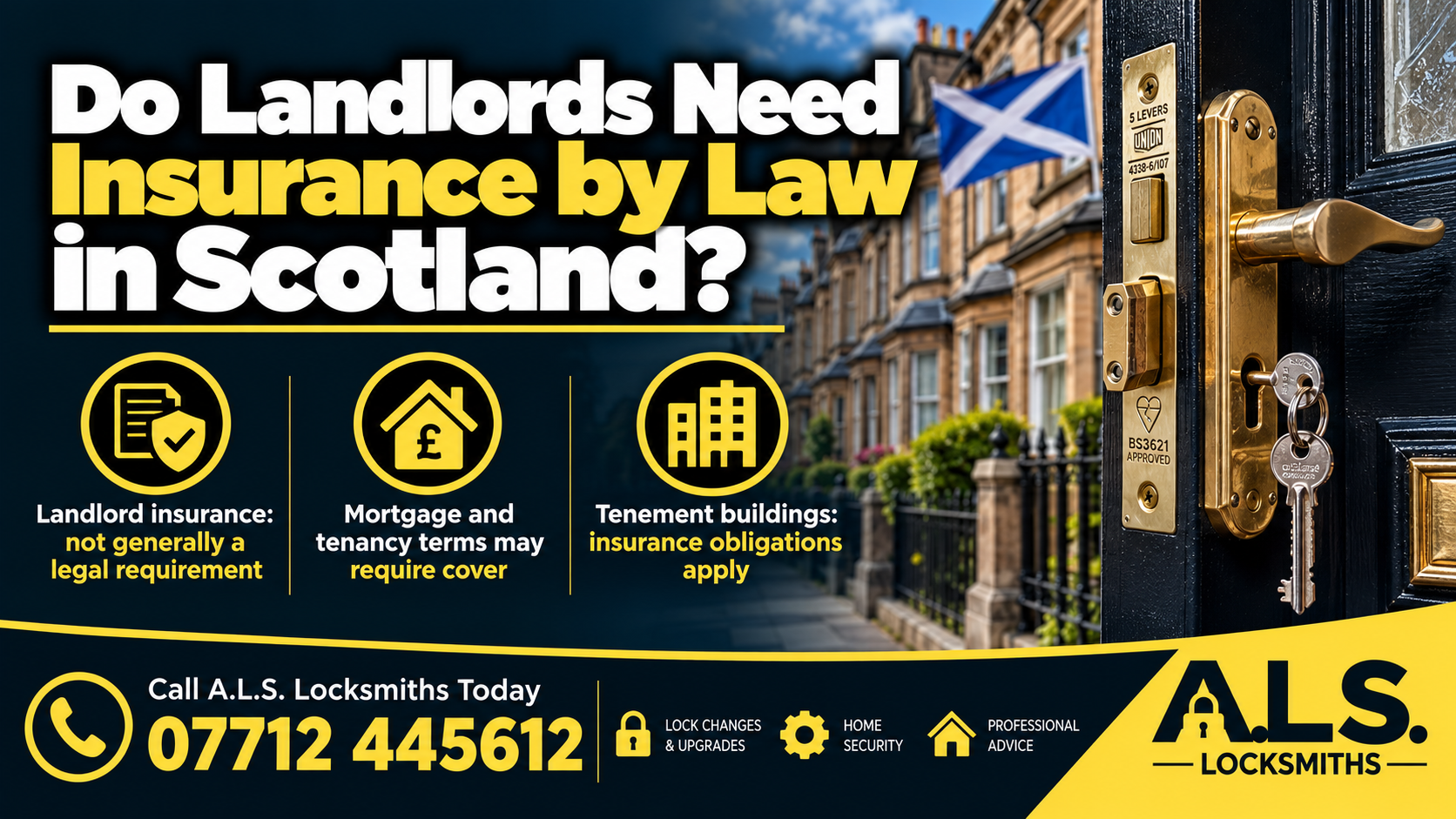
There is no general law requiring every Scottish landlord to purchase a policy specifically called landlord insurance. However, statutory buildings insurance requirements apply to owners of tenement flats, subject to the relevant provisions and exceptions, and mortgage lenders commonly require buildings insurance as a condition of lending.
At A.L.S Locksmiths, we help landlords across Glasgow, Paisley and surrounding areas with lock repairs, replacements and security upgrades. Understanding insurance requirements alongside property maintenance responsibilities can help landlords protect their properties.
1. Is Landlord Insurance Compulsory in Scotland?
For a typical private rental property, there is no single law requiring every landlord to purchase a comprehensive landlord insurance package.
However, other requirements may apply:
-
Tenement flats: Section 18 of the Tenements (Scotland) Act 2004 requires each owner to insure their flat and relevant parts of the tenement against prescribed risks. A common building insurance policy can satisfy this obligation in whole or in part. Statutory exceptions apply in certain circumstances.
-
Mortgaged rental properties: Mortgage lenders commonly require suitable buildings insurance. Landlords must check their own mortgage conditions.
-
Other rental properties: Even where no specific statutory insurance requirement applies, appropriate cover can help protect against substantial financial losses.
Read section 18 of the Tenements (Scotland) Act 2004.
2. What Does Landlord Insurance Cover?
Depending on the policy, landlord insurance may include:
-
Buildings insurance: Cover for insured damage to the structure and permanent fixtures.
-
Landlord contents insurance: Cover for specified furniture and appliances supplied by the landlord.
-
Property owners' liability: Cover for certain claims where the landlord is legally liable for injury or property damage.
-
Loss of rent: Cover for lost rental income following specified insured events.
Not every policy includes all these protections. Landlords should read their policy documents carefully and make sure the insurer knows the property is rented out.
3. Do Landlords Need Insurance if the Property Is Mortgage-Free?
A mortgage-free landlord may not have a lender imposing insurance conditions. However, the legal insurance obligations that apply to tenement owners may still apply.
For other property types, buildings insurance may not be a specific legal requirement, but the financial consequences of an uninsured fire, flood or other major incident can be substantial.
Landlords should also ensure that their insurance policy is appropriate for a rented property. Standard owner-occupier cover may not provide the protection required once a home is let to tenants.
4. Do Landlords Need Insurance-Approved Locks?
There is no single lock specification that every Scottish landlord must fit to every external door.
However, an insurer may specify security conditions in its policy. These might include particular lock standards for certain external doors or requirements relating to how the property is secured when unoccupied.
For example, a policy may require a BS3621-compliant mortice lock on a suitable wooden external door, or specify security requirements for a UPVC or composite door.
A suitably rated anti-snap euro cylinder can improve resistance to certain forced-entry techniques, but the correct specification depends on the door, the locking system and the insurer's requirements.
Always check the actual policy wording. Do not assume that one particular lock rating is mandatory for every rental property, or that fitting a higher-rated lock automatically satisfies all insurance conditions.
5. What If a Tenant Reports a Faulty Door Lock?
Insurance is only one part of a landlord's responsibilities. Scottish private landlords must also ensure their properties meet the applicable Repairing Standard.
If a tenant reports that a lock is broken, stiff or unable to secure the door, the landlord should assess the fault and arrange any necessary repair within a reasonable time. The urgency depends on the nature of the problem and the risk to the property's security.
A faulty lock may need a cylinder replacement, a mortice lock repair, a multipoint gearbox replacement or an adjustment to a misaligned door.
If the property does not meet the Repairing Standard, a tenant may be able to apply to the First-tier Tribunal for Scotland (Housing and Property Chamber).
For a detailed explanation of the law and possible consequences, read our related article: [What Happens If a Landlord Does Not Repair a Faulty Door Lock?] (insert internal link to Blog 2).
6. Can a Landlord's Insurance Claim Be Rejected Because of a Faulty Lock?
Not automatically.
If a burglary occurs after a tenant has reported a faulty lock, the insurer will consider the policy terms and the circumstances of the incident. The landlord's repair obligations and any relevant security conditions may also be important.
A landlord may face questions about whether they dealt appropriately with a known defect, but it is incorrect to assume every claim will be rejected simply because a lock was faulty.
Similarly, a landlord is not automatically liable for every item stolen from a tenant's home. Civil liability depends on the circumstances, including the landlord's obligations, what they knew and whether their actions contributed to the loss.
Keeping records of reported defects, inspections and completed repairs can help landlords demonstrate how they managed maintenance issues.
7. Keeping Your Rental Property Secure
Regular maintenance can help identify problems before a lock fails completely.
Landlords should check that external doors close and lock correctly, investigate stiff cylinders and handles, and arrange repairs where mechanisms or door alignment have deteriorated.
Where a tenant reports that a property cannot be secured, the landlord should assess the situation promptly and decide what work is necessary.
For more information about landlord repair obligations, consult the Scottish Government's guidance on repairs and maintenance.
Landlord Lock Repairs in Glasgow and Paisley
A.L.S Locksmiths provides lock repairs, replacements and security upgrades for landlords in Glasgow, Paisley and surrounding areas.
We work with mortice locks, euro cylinders, UPVC and composite door mechanisms, and multipoint locking systems.
If a lock is faulty, we can assess the problem and advise on a suitable repair or replacement. If your insurer specifies a particular lock standard, confirm the requirement before arranging the work.
Our fixed-price approach means the quoted price is the price you pay, with no hourly rates or call-out fees.
Final Thoughts
Landlord insurance is not universally compulsory for every rental property in Scotland. However, statutory insurance obligations can apply to tenement flats, and mortgage lenders commonly require buildings insurance.
Landlords also have separate responsibilities for property maintenance and security. Understanding these obligations, checking policy conditions and dealing with faulty locks promptly can help protect both the property and its occupants.
For Scottish landlords, insurance and maintenance should be considered together, but they are separate obligations.
Landlord insurance is only one part of protecting a rental property. Landlords also have legal responsibilities for repairs and security. Read our guide to [what happens if a landlord does not repair a faulty door lock in Scotland] to understand the Repairing Standard and what can happen if a reported fault is ignored.
This article provides general information about Scottish law and insurance, not legal or financial advice. Requirements depend on the property, ownership arrangements, mortgage conditions and policy wording.