Understanding Why Conservatory Doors Develop Problems Over Time
Conservatory doors work much harder than many homeowners realise. Unlike the main entrance to your home, conservatory doors are attached to a structure that experiences significant changes in temperature throughout the year.
During summer, conservatories can become extremely hot. In winter, temperatures can fall close to those outside. These continual temperature changes cause the doors, frames and locking mechanisms to expand and contract more than many other external doors.
Combined with years of daily use, this movement can eventually affect alignment, locking performance and overall operation.
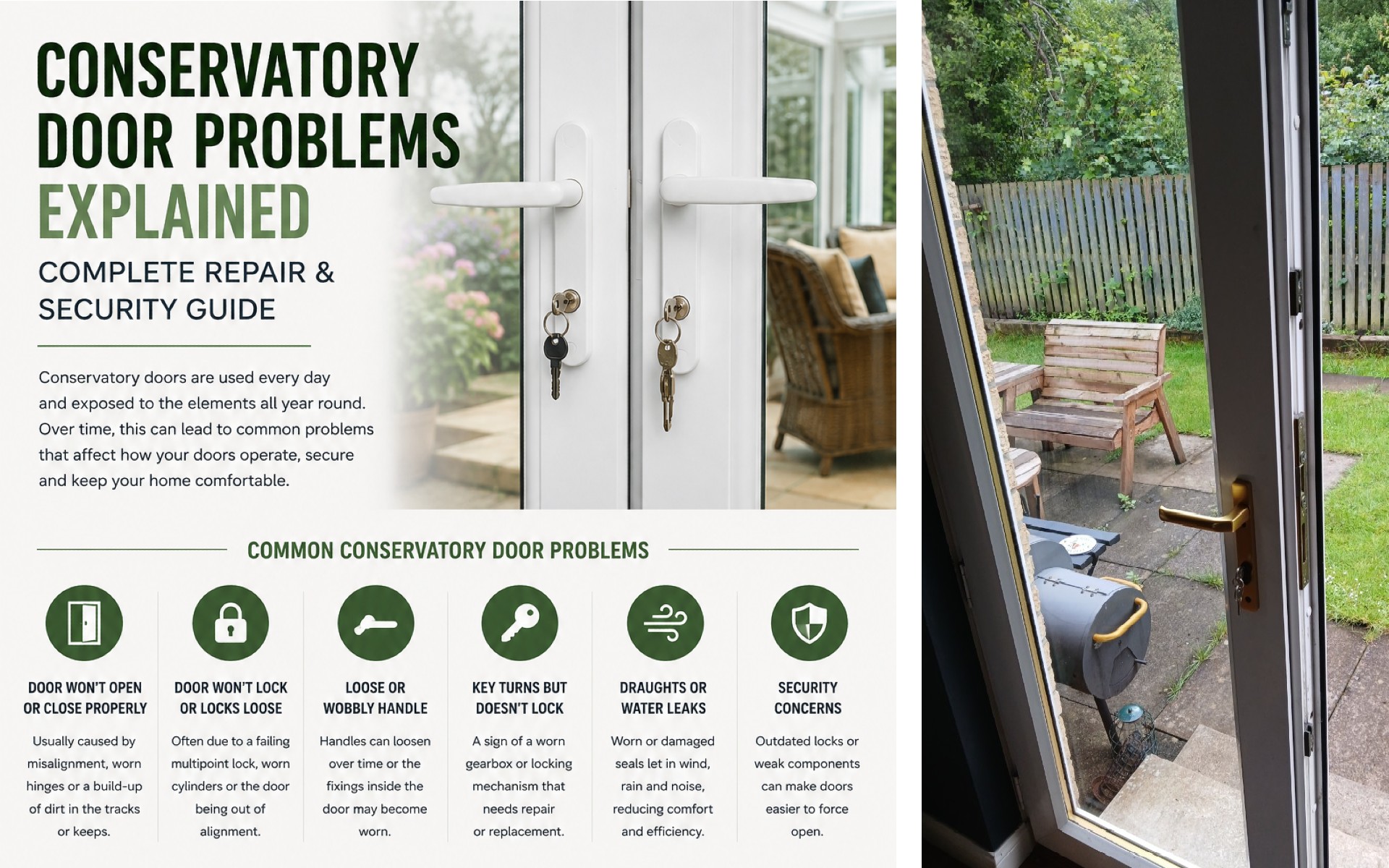
This guide explains the most common conservatory door problems, what causes them and how many can be repaired without replacing the entire door.
Why Conservatory Doors Become Hard to Open
One of the first signs of a problem is increased resistance when opening or closing the door.
Common causes include:
- Door movement.
- Dropped hinges.
- Expansion during warm weather.
- Misaligned locking points.
- Worn rollers.
- Debris in the threshold.
Many homeowners assume the lock has failed when the real problem is that the door is no longer perfectly aligned with its frame.
Common Conservatory Door Lock Problems
Conservatory doors commonly develop faults such as:
- Handle difficult to lift.
- Key difficult to turn.
- Lock works with the door open but not closed.
- Door won't latch properly.
- Hooks won't engage.
- Door won't unlock.
- Gearbox wear.
- Worn handles.
- Stiff rollers.
Most of these problems develop gradually rather than suddenly.
How Secure Is Your Conservatory Door?
Many conservatories provide direct access into the main house.
For that reason, their doors deserve the same attention as the front or back door.
A secure conservatory door should include:
- A properly functioning multipoint locking mechanism.
- A high-security euro cylinder.
- Secure handles.
- Correctly adjusted hinges.
- Fully engaging locking points.
- Good frame condition.
A quality lock alone cannot compensate for a door that no longer aligns correctly.
Why Conservatory Doors Drop Over Time
Most conservatory doors are fitted with adjustable hinges.
Over many years several factors may cause the door to drop slightly.
These include:
- Heavy glazed panels.
- Continuous daily use.
- Hinge wear.
- Seasonal movement.
- Building settlement.
Even a movement of only a few millimetres can affect locking performance.
Conservatory Door Realignment Explained
Realignment restores the relationship between:
- Door.
- Frame.
- Hinges.
- Keeps.
- Locking points.
Correct adjustment allows:
- Handles to lift smoothly.
- Hooks to engage fully.
- Rollers to compress the weather seals correctly.
- Keys to turn with less effort.
Many locking problems disappear once the door has been correctly aligned.
How Weather Affects Conservatory Door Locks
Conservatories experience much greater temperature variation than most other parts of the home.
Warm weather may cause:
- Expansion of door materials.
- Increased seal compression.
- Tighter handle operation.
Cold weather may lead to:
- Slight contraction.
- Different locking tolerances.
- Changes in alignment.
These seasonal changes are perfectly normal but can reveal existing wear or alignment issues.
Why Conservatory Doors Won't Close Properly
A conservatory door that refuses to close easily is usually affected by one or more of the following:
- Dropped hinges.
- Misaligned keeps.
- Worn weather seals.
- Threshold obstruction.
- Door movement.
- Distorted frame.
- Locking point interference.
Forcing the door closed increases strain on the gearbox and handles.
Why Conservatory Door Locks Wear Out
Multipoint locking mechanisms contain numerous moving parts.
Every time the door is used:
- The latch operates.
- The handles rotate.
- The gearbox moves.
- Hooks engage.
- Rollers compress the seals.
After many thousands of cycles, natural wear occurs.
However, poor alignment greatly accelerates this process by forcing the mechanism to work harder than intended.
Keeping Conservatory Doors Secure During Winter
Winter places additional demands on conservatory doors.
Simple maintenance can help keep them operating reliably.
Regularly check:
- Handle operation.
- Hinge adjustment.
- Lock engagement.
- Weather seals.
- Drainage channels.
- Lubrication of moving parts.
Avoid forcing a stiff door, as this may damage the gearbox or handles.
Addressing minor problems early often prevents more expensive repairs later.
Signs Your Conservatory Door Needs Attention
You should investigate the door if you notice:
- The handle becoming stiff.
- The key difficult to turn.
- The door rubbing the frame.
- Uneven gaps.
- Draughts.
- Water ingress.
- Clicking noises.
- Door movement when locked.
These symptoms often indicate that adjustment or repair is needed before additional wear develops.
Repair Before You Replace
Many homeowners assume a conservatory door that has become difficult to lock or close needs replacing. In reality, most problems are caused by normal wear, hinge movement or changes in alignment rather than the door itself. Professional realignment, replacement of worn components or repair of the multipoint locking mechanism can often restore smooth operation and reliable security at a fraction of the cost of fitting a new door. Regular maintenance and prompt attention to small changes in performance will also help extend the life of the door and reduce the likelihood of more expensive repairs in the future.