Smart locks are becoming increasingly popular with homeowners looking for keyless entry, smartphone control and convenient access. However, while they offer some useful features, they also introduce additional complications that are worth considering before replacing a traditional lock.
As locksmiths, we understand the importance of keeping things simple, reliable and secure. A lock should do one job properly: protect your property and allow you to enter when you need to. Smart locks can achieve this, but their electronic components introduce potential points of failure that mechanical locks simply do not have.
Smart Locks vs Traditional Mechanical Locks
| Feature | Smart Lock | Mechanical Lock |
|---|---|---|
| Power supply | Requires batteries or electricity | No batteries required |
| Entry method | App, keypad, fingerprint or key, depending on model | Physical key |
| Electronic faults | Possible | No electronic components to fail |
| Mechanical wear | Possible | Possible |
| Internet or Bluetooth | Required for some features | Not required |
| Purchase cost | Generally higher | Generally lower |
| Maintenance | Batteries and possible software updates | Periodic checks and maintenance |
| Repair costs | Can be higher if electronics fail | Often simpler to repair |
| Installation | Compatibility and alignment are important | Compatibility and alignment are important |
| Physical security | Depends on the lock's design and installation | Depends on the lock's design and installation |
| Emergency access | Depends on the model; may require a backup key, emergency power supply or another override | Normally opened with the correct key, provided the lock is working correctly |
| Long-term simplicity | More components to manage | Generally simpler |
The verdict: Smart locks offer convenience, but a quality mechanical lock provides straightforward operation without batteries, software or connectivity requirements. For many homeowners, a properly fitted mechanical lock remains the practical choice.
1. Battery Failure and Power Problems
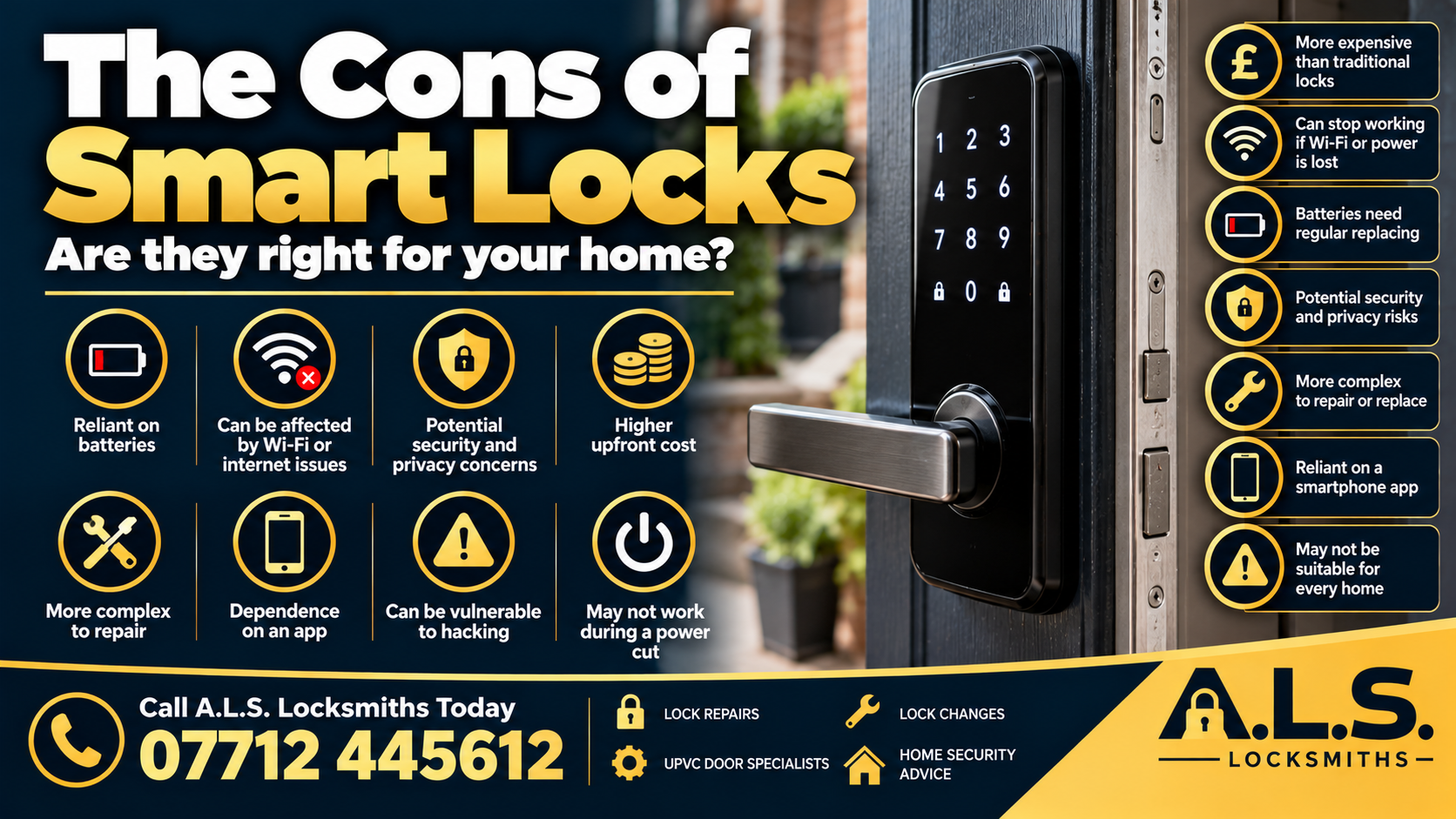
Most smart locks rely on batteries to operate. If the batteries run flat, you could find yourself unable to unlock your door electronically.
Some models include an emergency power connection or a backup key, but these features vary between manufacturers. Homeowners must also remember to monitor battery warnings and replace batteries before they fail.
A traditional mechanical lock does not depend on batteries or an electrical supply. Provided the key and lock mechanism are in good working order, it operates without an electronic power source.
2. More Components Mean More Potential Faults
A conventional lock has relatively few moving parts. A smart lock combines mechanical components with electronics, motors, sensors and, in some cases, wireless communication systems.
Any of these components can develop a fault. Keypads can stop responding, fingerprint readers can struggle to recognise prints, and internal motors or gears can fail.
If the electronic section stops working, the problem may require specialist diagnosis or replacement of the complete unit rather than a straightforward mechanical repair.
3. Mechanical Problems Can Damage the Motor
One of the most important considerations is the condition and alignment of the door itself.
UPVC and composite doors can move slightly with temperature changes and general wear. Hinges may require adjustment, the door may drop, or the locking points may begin to bind against the keeps in the frame.
With a traditional lock, these problems can already cause stiffness or difficulty locking the door. With a motorised smart lock, the additional resistance can put strain on the motor and internal gearing.
A smart lock cannot compensate for a poorly aligned door. The door and locking mechanism must operate smoothly before an electronic lock is installed.
Correcting the alignment and servicing the mechanism first can help prevent avoidable faults.
4. Connectivity and Software Dependence
Some smart locks depend on Bluetooth, Wi-Fi, a smartphone app or a separate internet-connected hub.
Connection problems, software updates, device compatibility issues or network interruptions can affect remote access and other connected features. Depending on the model, basic local entry may continue working, but not every function will necessarily remain available.
A mechanical lock does not require an app, a wireless connection or software support. You use the correct key to operate the mechanism directly.
5. Higher Purchase and Replacement Costs
Smart locks generally cost more than standard mechanical locks, particularly when additional access features or professional installation are required.
Replacement costs can also be higher if an electronic component fails or a discontinued model becomes difficult to source.
Traditional locks are available in a wide range of prices and specifications. In many cases, an individual component can be replaced without changing the entire locking system.
For homeowners who want dependable security without unnecessary expense, a quality mechanical lock can offer better long-term value.
6. Installation and Compatibility Problems
Not every smart lock is suitable for every door.
UPVC doors, composite doors, timber doors and multipoint locking systems all have different requirements. A smart lock designed for a standard deadbolt may not be suitable for a multipoint mechanism commonly found on modern UK doors.
Installation may also involve additional holes, mounting plates, wiring or specific clearances. Incorrect fitting can cause binding, unreliable operation or damage to the door.
Before choosing a smart lock, check that it is compatible with the existing door and locking system. Professional assessment is particularly important where modifications could affect the door's security or future repairability.
7. Privacy and Cybersecurity Concerns
Connected locks can record access events and, depending on their design, transmit information through an app or cloud service.
This raises questions about who can access entry records, how account security is managed and what happens if a manufacturer's software or online service is compromised.
These risks vary considerably between products, and not every smart lock has the same vulnerabilities. Nevertheless, connected devices introduce security considerations that do not apply in the same way to a purely mechanical lock.
8. Removing or Replacing a Smart Lock Can Be Complicated
If a smart lock fails and you decide to return to a traditional lock, the changeover may not be straightforward.
Some installations use non-standard mounting holes, specialist fittings or components that do not match conventional locks. Wiring can also be damaged during removal if the unit is dismantled carelessly.
Depending on the model and how it was fitted, the door may need additional work before a replacement lock can be installed properly.
This is particularly worth considering before making permanent alterations to an otherwise serviceable door.
9. Emergency Access Needs Careful Consideration
A smart lock should always have a reliable way to gain access if its electronics fail.
Depending on the model, this might be a physical key override, an external emergency power connection or another manufacturer-specified method. Not every smart lock provides all these options, so it is important to understand exactly how your chosen lock works before relying on it as your only means of entry.
For example, a lock that requires an electronic keypad to operate could become difficult to use if its batteries fail and there is no suitable backup method available.
A conventional keyed lock offers a simpler arrangement, although keys can still be lost, broken or damaged, and mechanical locks can seize or wear out.
No lock is completely fault-proof. The aim is to choose a suitable, well-maintained system with a dependable method of entry.
Why We Recommend Keeping Things Mechanical
Smart locks can be useful in the right circumstances, particularly where temporary access codes or remote access are important. However, these conveniences come with extra components, additional maintenance requirements and potential electronic failure points.
For many homeowners, a good-quality mechanical lock remains a practical choice because it is straightforward to operate, widely supported by locksmiths and often easier to repair.
For UPVC and composite doors, the priority should be a correctly fitted, suitable lock combined with a door that closes and locks smoothly. A properly sized, security-rated cylinder and a sound locking mechanism can provide effective protection without adding unnecessary electronic complexity.
Conclusion: Is It Better to Stick with a Mechanical Lock?
For most homeowners who prioritise straightforward operation, reliability and ease of maintenance, sticking with a quality mechanical lock is a sensible choice.
Smart locks are not automatically insecure or unreliable, and a well-designed model can work well when correctly installed and maintained. However, keyless convenience is not the same as improved physical security.
Before replacing your existing lock, consider whether you genuinely need the additional electronic features. If your current lock is working correctly, a suitable security upgrade or professional servicing may be a more practical investment than replacing it with a smart lock.
Need advice on your door locks?
A.L.S. Locksmiths provides lock repairs, replacements, security upgrades and UPVC and composite door servicing across Paisley, Glasgow, Dumbarton and surrounding areas.
We can assess your existing locking system and recommend a suitable solution for your door and budget.
A.L.S. Locksmiths — practical advice, professional workmanship and security you can rely on.